





Continues here


War and the Dollar System: Making Room for China
War and the Dollar System: A Structural Change is Here
Authored by GoldFix
Comment: Just look at the graphics below alone. It is so obvious only a blind man will not see in our opinion. Further to that, this War is about the entry of the Yuan on the global stage to share the spotlight with the USDollar
“Everyone now knows that everyone knows the rules of the game have changed.”
-Simon White Bloomberg
p
The Iran conflict has introduced measurable strain into the global monetary system, accelerating an observable shift in reserve composition and challenging assumptions underpinning the post-Bretton Woods II dollar order.
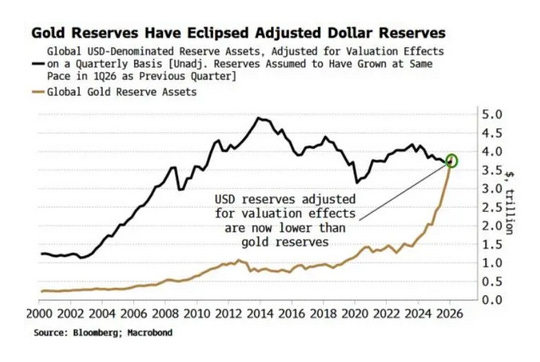
According to Simon White, Bloomberg macro strategist, recent data indicate that valuation-adjusted dollar reserves have fallen below central bank gold holdings for the first time since the late 1990s, marking a structural milestone in the evolution of global reserve assets.
A Gradual Erosion, Not a Sudden Break
The report situates the current moment within a longer historical process. Reserve currency transitions unfold over extended periods, punctuated by identifiable inflection points rather than singular collapse events. The historical trajectory of sterling provides the relevant analogue, where a sequence of geopolitical and monetary disruptions progressively reduced its global role.
“Sterling’s fading was punctuated by several milestones over an extended period.”
Within this framework, the Iran conflict is presented as an additional milestone, layered on prior developments including the increased use of financial sanctions and the seizure of sovereign assets. These events contribute to a gradual reassessment of the reliability and neutrality of the dollar system.
Reframing Reserve Demand Through Adjusted Measures
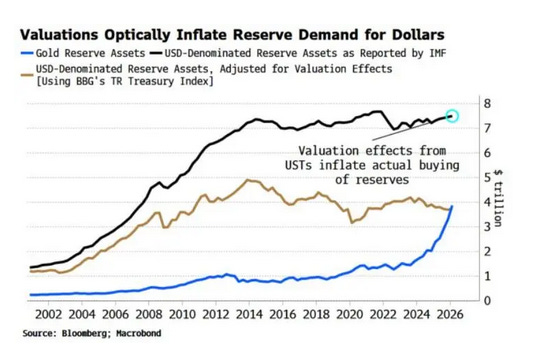
A central component of the analysis is the adjustment of dollar reserves to remove the effects of interest income, allowing for a more comparable assessment against gold holdings. Under this framework, reported dollar reserves decline materially when stripped of yield effects, reducing the apparent scale of active demand.
“A more equal comparison is with the dollar shorn of its earning effect.”
Using this adjusted measure, dollar reserves are estimated near $4 trillion, compared with approximately $7.5 trillion on an unadjusted basis. This distinction separates passive valuation gains from underlying allocation decisions, focusing attention on actual demand dynamics.
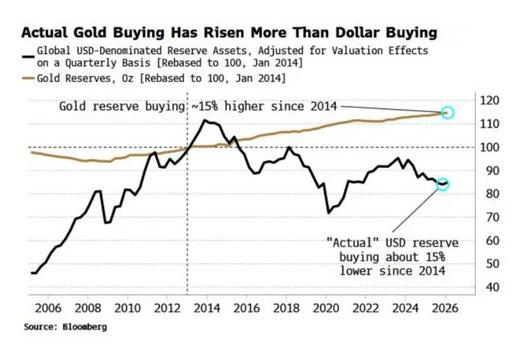
At the same time, central bank gold holdings, measured in physical tonnage, have increased meaningfully over the same period. The divergence between declining adjusted dollar reserves and rising physical gold accumulation indicates a shift in reserve preferences rather than a purely price-driven phenomenon.
Shifting Behavior Among Reserve Managers
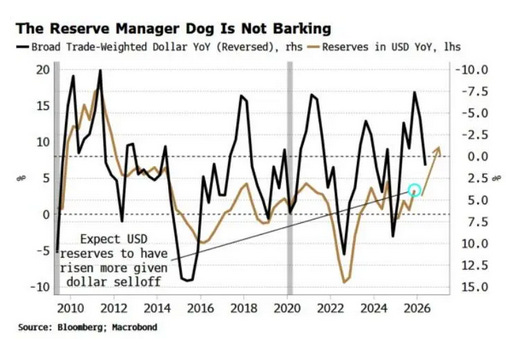
The report identifies a change in the behavior of reserve managers as a critical transmission channel. Historically, central banks acted counter-cyclically in foreign exchange markets, accumulating dollars during periods of weakness and reducing exposure during periods of strength. This pattern contributed to stabilizing demand for dollar assets.
“The exchange-rate decline in the dollar… has not been met by meaningful purchases.”
Recent currency depreciation has not generated comparable accumulation flows, suggesting a weakening of this stabilizing mechanism. This shift implies that the dollar is no longer functioning as the default reserve asset during periods of adjustment, altering its role within the system.
Gold as Neutral Collateral
The reallocation toward gold is framed in terms of collateral preference rather than speculative demand. Gold is characterized as an asset that operates outside the financial system, free from counterparty risk and insulated from policy intervention.
“The market has re-alighted on the age-old solution of gold as unimpeachable global collateral.”
This repositioning reflects a broader reassessment of asset neutrality following episodes of financial weaponization. In the absence of alternative reserve assets that meet similar criteria, gold emerges as a functional substitute within reserve portfolios.
Petrodollar Death Watch
— VBL’s Ghost (@Sorenthek) April 10, 2026
Market Rundown | Housekeeping: Support Independent Media | The Reset is a process, not an eventhttps://t.co/AFaFktv6A8
Energy Markets as a Source of Systemic Pressure
The report extends the analysis to energy markets, identifying them as a key channel through which strain is transmitted into the dollar system. Elevated oil and gas prices increase the demand for dollars among importing economies, often requiring the liquidation of financial assets to secure funding.
Free Posts To Your Mailbox
Contributor posts published on Zero Hedge do not necessarily represent the views and opinions of Zero Hedge, and are not selected, edited or screened by Zero Hedge editors.
Loading...