





Liquidity Unmasked: The Silent Force Moving Markets
Liquidity is often spoken of yet seldom understood. In both science and finance, it is too easily reduced to the presence of money or the ease of exchange. Such simplifications obscure its deeper nature. To grasp its meaning, one must step away from markets and return to the order of the natural world, where liquidity first reveals itself through the principles of physics and chemistry.
In the study of matter, liquidity arises as a state of balance. Particles remain close enough to preserve unity, yet free enough to allow movement. It stands between the rigidity of the solid and the disorder of the gas. In this middle path, there is both form and freedom. A liquid does not resist change, nor does it dissolve into chaos; it adapts, flows, and settles according to its environment. Its virtue lies not merely in motion, but in harmonious motion—flexibility guided by structure.
Chemistry deepens this understanding. The nature of a liquid is shaped by the forces that bind its elements—subtle attractions that both connect and restrain. When these forces are in proper measure, the liquid flows with ease, as seen in water, which holds together while remaining ever mobile. When the bonds grow too strong, movement slows, and the liquid thickens. When they weaken too much, cohesion is lost, and the form dissolves.
Thus, liquidity is not excess nor absence, but proportion. It is the quiet balance between unity and freedom. Where this balance is preserved, there is flow and resilience. Where it is disturbed, there is either rigidity or disorder. In this, the lesson of liquidity reflects a broader truth: that harmony, whether in nature or in markets, is born from the right measure of opposing forces. This duality—between cohesion and freedom—reveals the true nature of liquidity.
When structure is excessive, movement ceases and the system becomes rigid. When freedom is unbounded, unity dissolves and order is lost. The proper state lies in balance: a narrow path where elements move with ease yet remain connected. In this harmony, there is both stability and flow—neither constrained nor scattered but aligned with the measure of what is right.
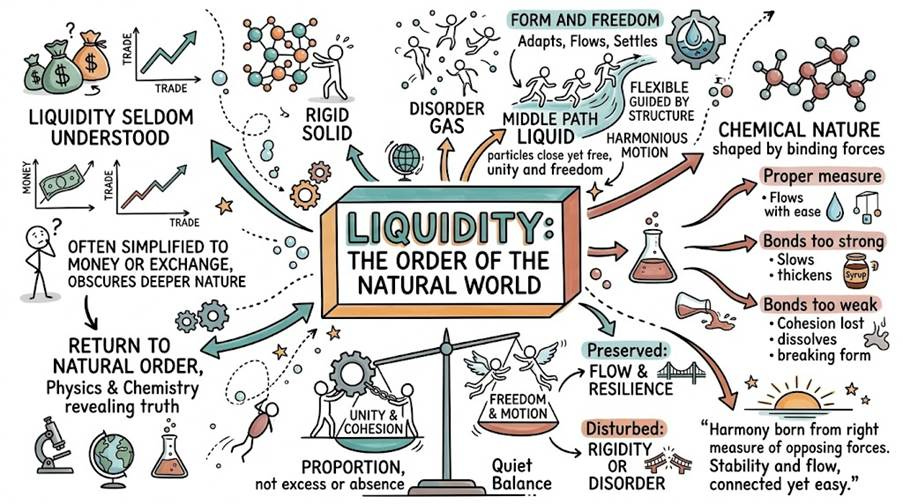
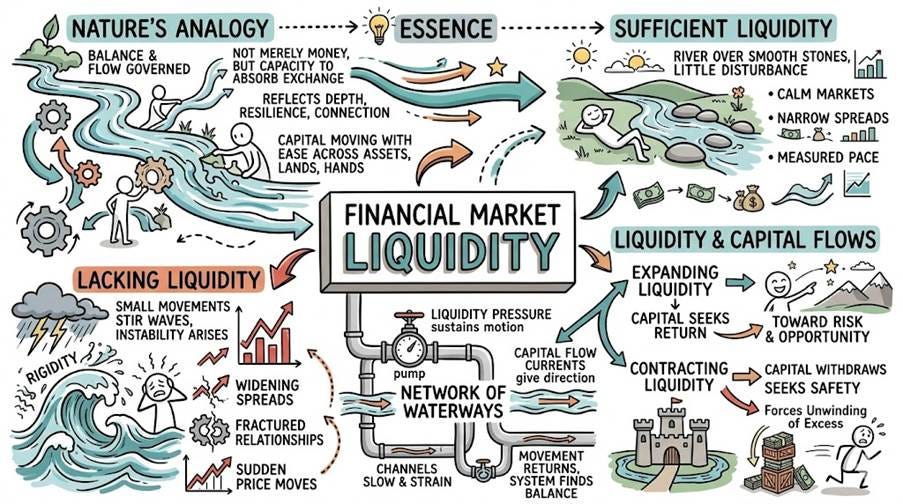
Financial markets follow the same order as nature, for they too are governed by balance and flow. Financial liquidity is not merely the presence of money, but the capacity of the system to receive and absorb exchange without disorder. It reflects depth, resilience, and the quiet connection between all pools of capital. Where liquidity is sufficient, great transactions pass as a river over smooth stones, leaving little disturbance; where it is lacking, even small movements stir waves, and instability arises. At its essence, liquidity is flow—capital moving with ease across assets, lands, and hands. When it is abundant, markets are calm, spreads are narrow, and change unfolds with measured pace. When it recedes, rigidity takes hold: spreads widen, relationships fracture, and price moves with sudden force. Liquidity and capital flows cannot be separated, for the latter is the visible path of the former. When liquidity expands, capital seeks its return, traveling toward risk and opportunity; when it contracts, capital withdraws, seeking safety, and in its retreat forces the unwinding of excess. Thus, the system resembles a network of waterways: liquidity is the pressure that sustains motion, and capital flows are the currents that give it direction. When the pressure is diminished, all channels slow and strain; when it is restored, movement returns and the system finds its balance once more.
A reserve currency is like the wise elder of the village—trusted, widely accepted, and always expected to show up when trouble begins. In the global financial order, it is the currency that nations hold in their coffers, use in trade, and turn to in times of uncertainty. Today, this role is largely carried by the US dollar, which behaves less like a humble servant and more like a very busy innkeeper, providing liquidity to all who pass through the marketplace. When times are calm, it flows generously across borders, financing trade, investment, and ambition; but when fear arises, it retreats home, leaving others scrambling for its presence. In this way, the reserve currency does not merely exist—it governs the rhythm of global liquidity, expanding with confidence and contracting with caution. As the Master might say: “When the well is full, all may drink; when it runs low, even the orderly must compete.”
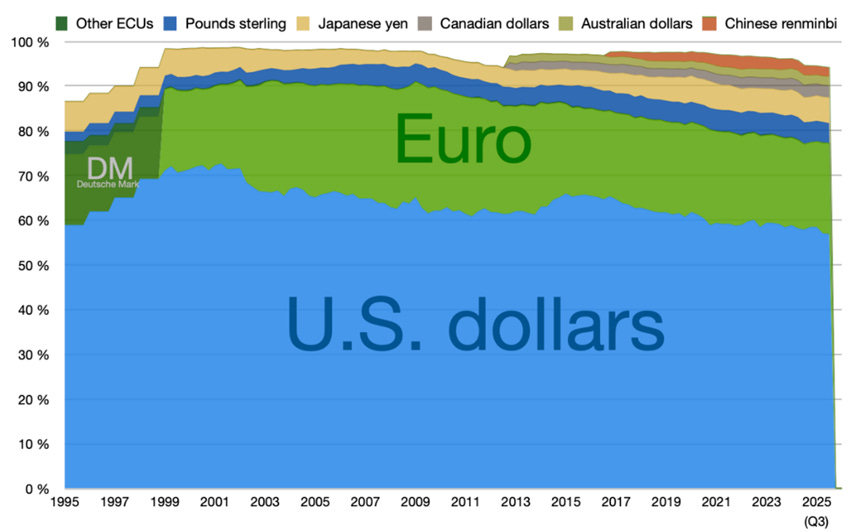
After the great disorder of the Second World War, when many nations lay in ruin, the United States stood as the well-stocked granary in a village of empty bowls. Its factories were intact, its wealth abundant, and its consumers—energetic and insatiable—became the centre of global desire. Thus, the US dollar rose to prominence not merely by decree, but because all roads of trade led to the American buyer. Merchants from distant lands soon learned a simple truth: “He who sells to the richest household accepts the coin of that household.” And so, the dollar became the preferred vessel of exchange. Yet, as prosperity grew, so did the burdens at home—rising costs and taxes led the wise (and profit-seeking) multinationals to move their workshops abroad, producing in distant lands while still selling to the ever-hungry American consumer. In this way, the United States became less the maker and more the buyer, yet its currency remained the master key to global trade. As the Master might observe with a knowing smile: “When the market gathers at your door, even your absence from the workshop does not diminish your power.”
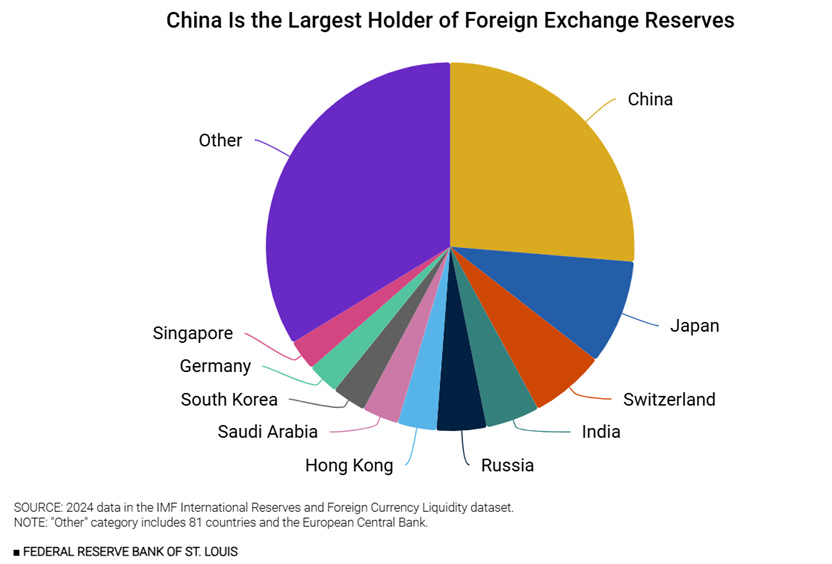
https://www.stlouisfed.org/open-vault/2026/feb/us-dollar-role-as-reserve-currency
In recent years, the stewards of the dollar have generously reminded the world that the reserve currency is not just a neutral medium of exchange, but also a rather effective geopolitical tool—one that can be switched on or off depending on one’s alignment with Washington. Unsurprisingly, a few countries have started to wonder whether keeping all their savings in a system that can freeze them overnight is perhaps not the pinnacle of prudent risk management. As a result, diversification has suddenly become fashionable again, alternatives are being explored, and the once unquestioned dominance of the dollar now comes with a small—but growing—asterisk. After all, nothing strengthens confidence quite like the implicit message: “You’re welcome to use the system… until you’re not.” The outcome is predictable—liquidity, once concentrated and deep, slowly fragments, and the global financial system trades a wide, stable river for a collection of narrower, less reliable streams.
Nowhere is this more obvious than in the role of the US dollar, which, despite all complaints and occasional rebellion, remains the undisputed bloodstream of the global financial system. One may grumble about it, attempt to bypass it, or dream of alternatives—but when it comes to settling trade, servicing debt, or funding investments, the world still rolls up its sleeve and asks for a dose of dollars. The system is, at its core, unapologetically dollar-centric: USD liquidity is not just a lubricant, it is the oxygen, the plasma, the very flow that keeps the global financial body alive and moving. And like any vital fluid, its circulation must be closely observed—for when it...
Read more and discover how to trade it here: https://themacrobutler.substack.com/p/liquidity-unmasked-the-silent-for…
Visit The Macro Butler Website here: https://themacrobutler.com/
Join The Macro Butler on Telegram here : https://t.me/TheMacroButlerSubstack
Register your interest to The Macro Butler World Economic Summit 2026 here:
https://themacrobutler.substack.com/p/the-macro-butler-world-economic-s…
You can contact The Macro Butler at info@themacrobutler.com

Disclaimer
The content provided in this newsletter is for general information purposes only. No information, materials, services, and other content provided in this post constitute solicitation, recommendation, endorsement or any financial, investment, or other advice.
Seek independent professional consultation in the form of legal, financial, and fiscal advice before making any investment decisions.
Always perform your own due diligence