





Continues here


Paper: Replacement Migration was Planned in 2001
Replacement Migration and the Demographic Challenge
Introduction: The Issues
Authored by GoldFix
This is an academic breakdown without comment. But it isn’t good. International immigration was no accident post Covid, and neither will be working until we’re 75. We’ve roughed out some simple graphics to go with this breakdown. Full report at bottom. —
The United Nations Population Division monitors fertility, mortality, and migration trends globally to produce official demographic estimates. Two dominant patterns are now visible in advanced economies: shrinking population sizes and rapid ageing. These twin dynamics raise the central question: can international migration offset the declines in working-age populations and maintain economic balance?
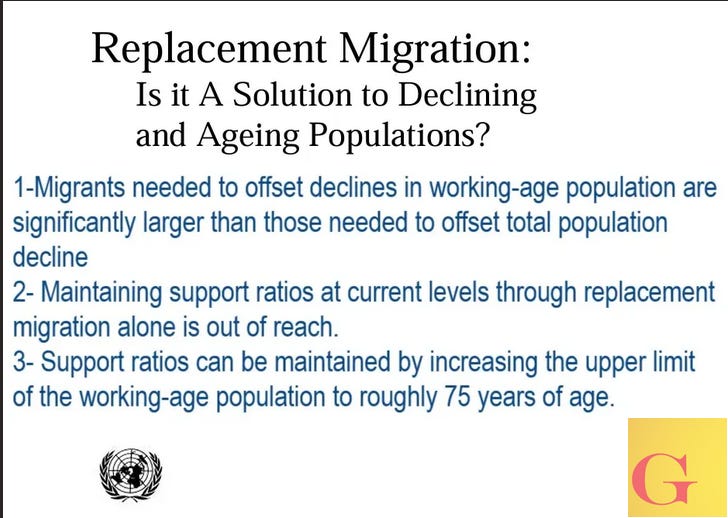
The study defines replacement migration as “the international migration that would be needed to offset declines in population size, the declines in the population of working age, as well as to offset the overall ageing of a population”.
Scope and Countries Covered
The study examines eight national cases—France, Germany, Italy, Japan, Republic of Korea, Russian Federation, United Kingdom, and United States—as well as two regional aggregates, Europe and the European Union. The time frame is 1995 to 2050.
Projected Declines and Ageing
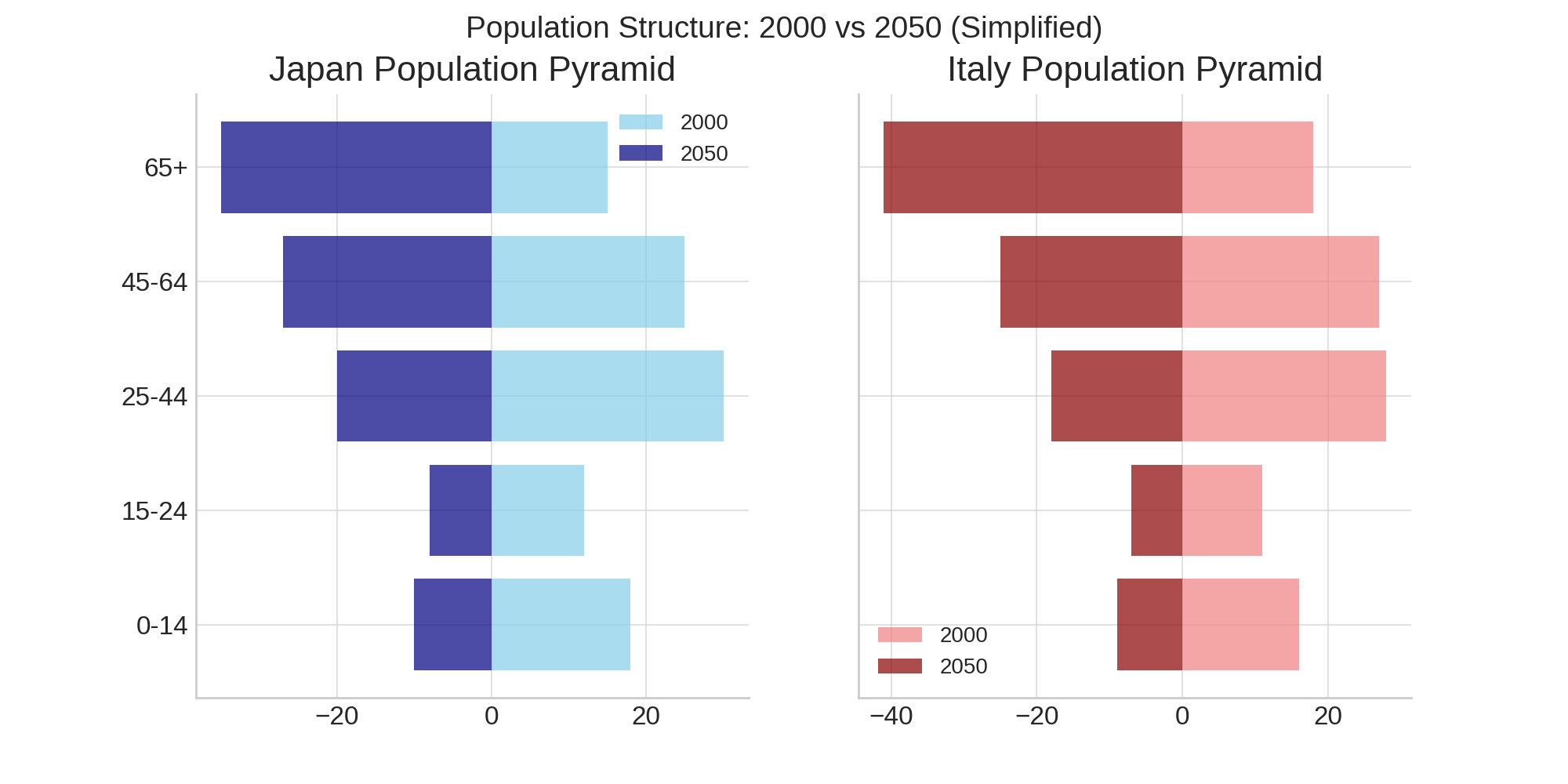
Italy is projected to decline from 57 million people in 2000 to 41 million by 2050. Russia shrinks from 147 million to 121 million, and Japan from 127 million to 105 million.
Ageing intensifies the challenge. In Japan, “the median age of the population is expected to increase by some eight years, from 41 to 49 years. And the proportion of the Japanese population 65 years or older is expected to increase from its current 17 per cent to 32 per cent”. Similarly, in Italy “the median age of the population increases from 41 years to 53 years and the proportion of the population 65 years or older goes from 18 per cent to 35 per cent”.
The Five Migration Scenarios
The study models five demographic futures:
Scenario I: Medium-variant UN projections (baseline).
Scenario II: Zero migration after 1995.
Scenario III: Migration required to maintain total population at peak size.
Scenario IV: Migration required to maintain the working-age population.
Scenario V: Migration required to maintain the potential support ratio (PSR).
The authors conclude that “maintaining potential support ratios through migration alone seems out of reach, because of the extraordinarily large numbers of migrants that would be required”.
Quantifying Migration Requirements
The report shows the magnitude of inflows required varies sharply by scenario.
Under Scenario III (constant total population), Italy would need 12.6 million immigrants (251,000 annually) versus only 0.3 million under the baseline. The European Union as a whole would require 47 million migrants, compared with 13 million.
Under Scenario IV (constant working-age population), Germany would require 24 million migrants by 2050, or 487,000 annually, compared with 17 million under Scenario III. Italy’s requirement grows to nearly 19 million.
Under Scenario V (constant PSR), “the total number of migrants in Japan is 524 million, or 10.5 million per year. For the European Union, the total number is 674 million, or 13 million per year”.
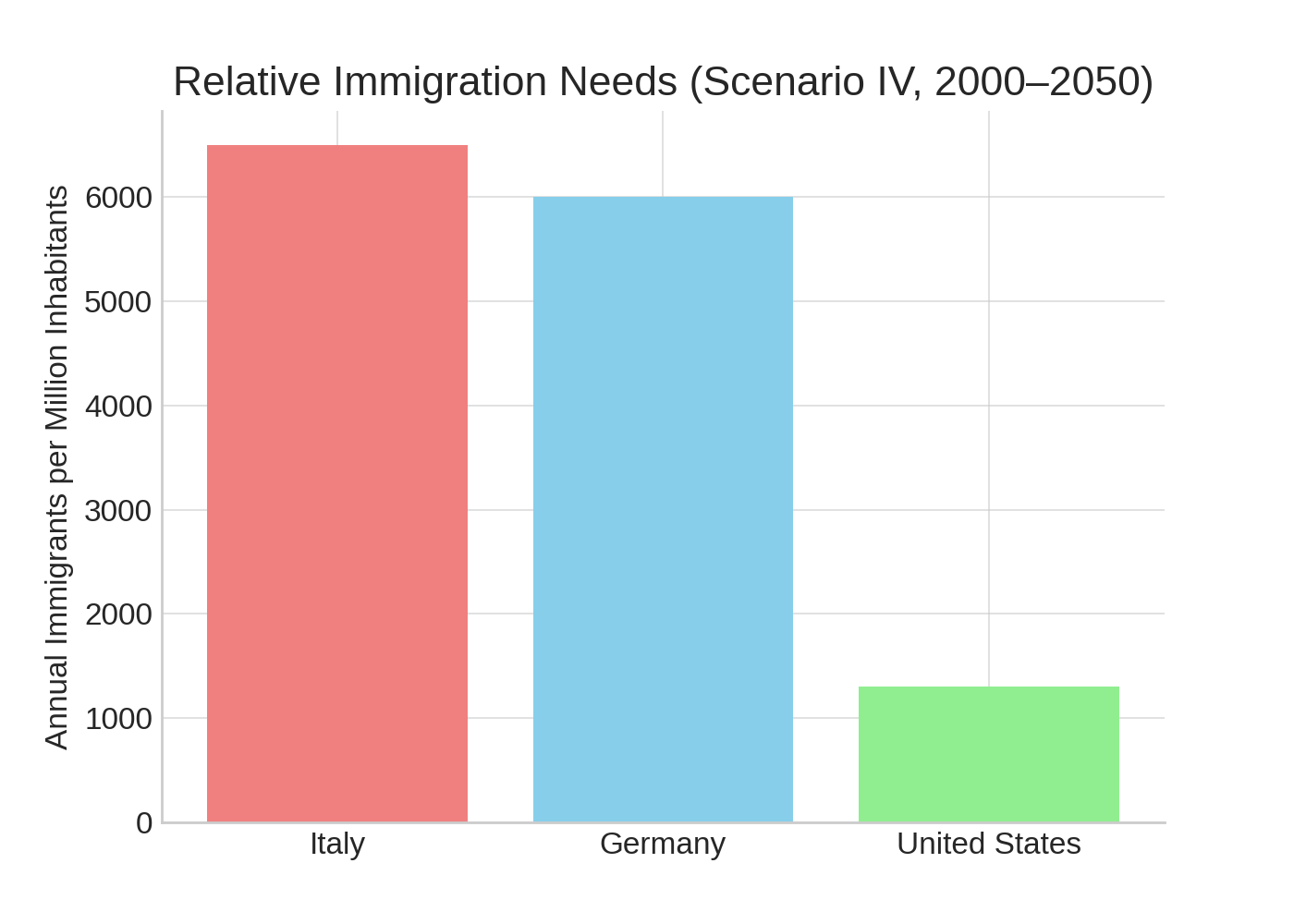
Relative to population size, Italy and Germany would require the highest per capita inflows to sustain their labor forces—6,500 and 6,000 annual immigrants per million inhabitants, respectively. By contrast, “the United States would require the smallest number of immigrants, approximately 1,300 per million inhabitants to prevent the decline of its working-age population”.
Major Findings
The central findings of the study are stark:
“During the first half of the 21st century, the populations of most developed countries are projected to become smaller and older as a result of below-replacement fertility and increased longevity”.
In the absence of migration, declines will be sharper and ageing faster.
Fertility is unlikely to recover to replacement levels, making population decline inevitable.
For France, the UK, the United States, and the European Union, “the numbers of migrants needed to offset population decline are less than or comparable to recent past experience”.
For Italy, Japan, the Republic of Korea, and Europe, “a level of immigration much higher than experience in the recent past would be needed to offset population decline”.
The migration required to maintain working-age populations is significantly larger than that required to maintain total population levels.
“The levels of migration needed to offset population ageing (i.e., maintain potential support ratios) are extremely large, and in all cases entail vastly more immigration than occurred in the past”.
Policy Implications
The study concludes that replacement migration cannot serve as a singular policy solution. Instead, it should be considered alongside domestic reforms. As the report emphasizes, “the new challenges being brought about by declining and ageing populations will require objective, thorough and comprehensive reassessments of many established economic, social and political policies and programmes”.
This includes:
Adjusting retirement ages in response to longer life expectancy.
Revising the scope and sustainability of pension and health-care systems.
Encouraging higher labor-force participation among older workers and women.
Developing integration policies for large inflows of migrants and their descendants.
Conclusion
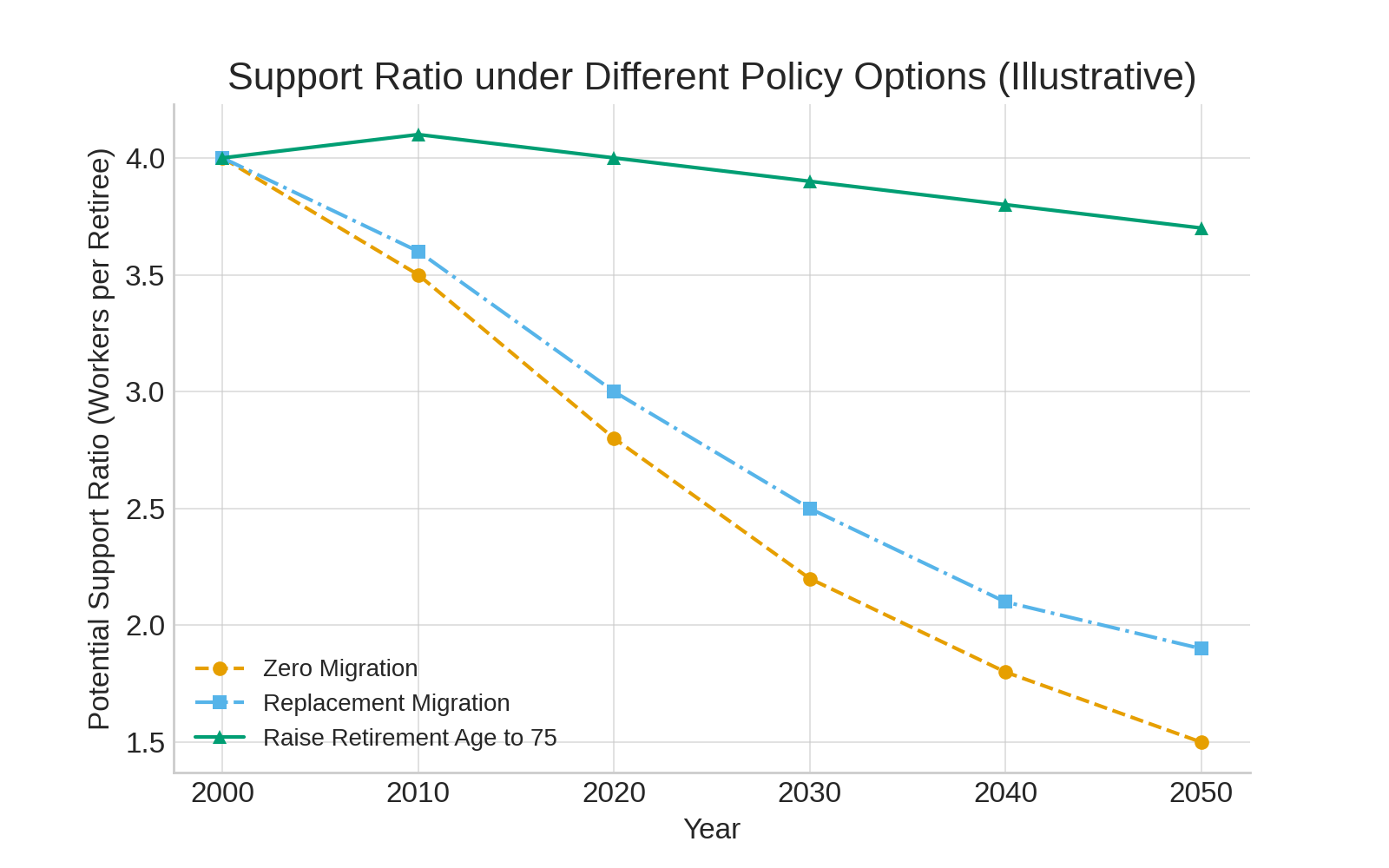
The United Nations report frames migration as a partial and conditional response to demographic decline and ageing. While migration can stabilize population size and maintain working-age cohorts in certain contexts, the levels required to sustain support ratios are prohibitive. Governments will therefore need to combine migration policy with structural reforms in retirement, healthcare, and labor markets.
The central message is clear: demographic transition in advanced economies will reshape societies regardless of the path taken, and migration alone cannot solve the ageing problem.
Free Posts To Your Mailbox
Contributor posts published on Zero Hedge do not necessarily represent the views and opinions of Zero Hedge, and are not selected, edited or screened by Zero Hedge editors.
Loading...