





Antimony: Scarcity and the Next Resource War in a World Losing Harmony
In the ordering of the world, what is overlooked is often what later proves essential. Thus, it is with certain metals, which dwell in quiet obscurity before rising to great importance. In recent years, men have spoken much of lithium, cobalt, and the rare earths, yet there is another—less known, yet no less vital—that has steadily found its place at the heart of industry and statecraft. This metal is antimony.
Antimony, known by the symbol Sb, takes its name from the ancient word stibium. It is neither fully metal nor wholly stone but stands between—reflecting the balance that governs all things. Though seldom discussed beyond learned and technical circles, it serves many purposes at once: in the storing of energy, the crafting of semiconductors, the tempering of fire through retardants, and the forging of tools for defence and advanced industry. Recognizing this, nations such as the United States have named it a critical mineral, for its uses are many and its sources few.
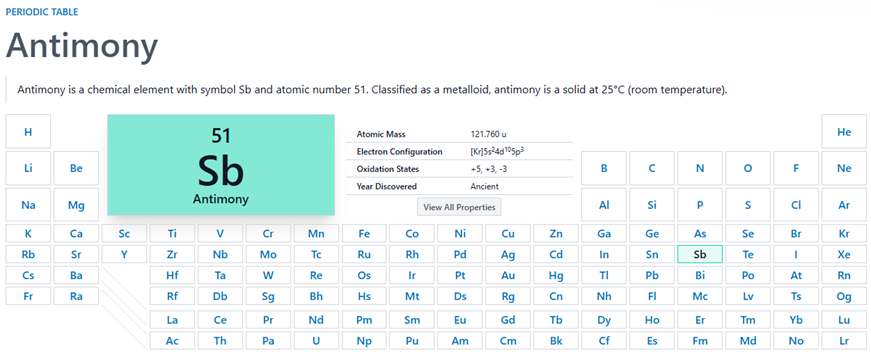
https://pubchem.ncbi.nlm.nih.gov/element/Antimony
In the study of nature, one finds that true understanding lies not in force, but in observing how things hold both strength and limitation within themselves. Antimony belongs to the family of elements aligned with nitrogen, sharing kinship with arsenic and bismuth, yet it does not conform fully to the nature of metals nor that of non-metals. Instead, it stands between the two, a reminder that balance often gives rise to utility. Marked by the number 51 and possessing a measured weight, antimony in its pure form appears as a silvery-gray crystal—orderly in structure, yet brittle in substance, easily broken despite its composed appearance. Its density, its melting and boiling points, and its modest ability to conduct electricity all speak to a material that is not exceptional in isolation. Yet, when joined with others, its virtue is revealed. A small measure added to lead imparts strength and endurance, transforming weakness into resilience, and thus finds its place in batteries, munitions, and crafted alloys. In the same way, through its compounds—most notably antimony trioxide—it lends its influence to protect against fire, working in harmony with other substances to achieve what none could alone. Thus, antimony teaches that what seems fragile in solitude may become indispensable when rightly combined, for usefulness is often born from harmony rather than dominance.
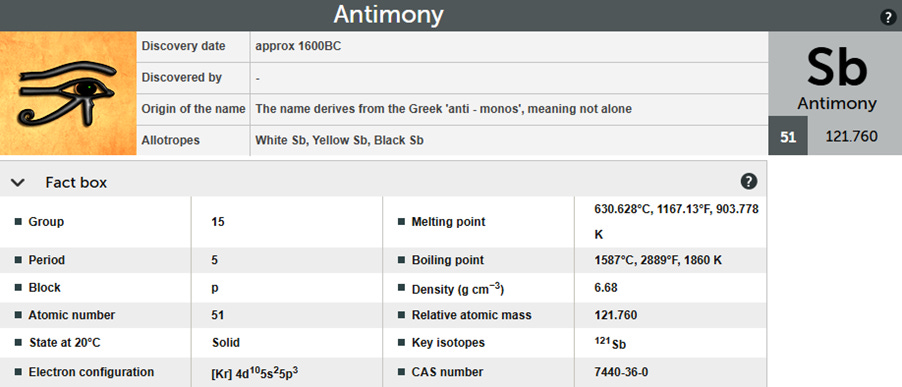
https://periodic-table.rsc.org/element/51/antimony
In the workings of the Earth, one sees that nothing of value is formed in haste, but rather through patience, pressure, and the quiet alignment of forces. Antimony is seldom found in its pure state, for it is shaped within minerals through the deep and gradual processes of nature—where heat, movement, and time act in harmony. Its most common form is found in stibnite, a sulfide mineral that takes shape within veins of rock, born from the passage of hot, mineral-laden fluids through fractures in the Earth’s crust. As these fluids travel, they carry hidden elements; as they cool, what was once unseen settles into form, and antimony joins with sulphur to crystallize. The shifting of the Earth through tectonic motion then gathers and concentrates these formations, placing them within veins and deposits. Thus, what begins as scattered traces becomes, through order and persistence, a source of substance. Over long ages, the wearing away of the surface reveals these hidden stores, bringing them within reach of human endeavour. In this, the formation of antimony reflects a quiet truth: that what is of greatest value is often shaped in obscurity, through the steady balance of unseen forces, long before it is brought to light.
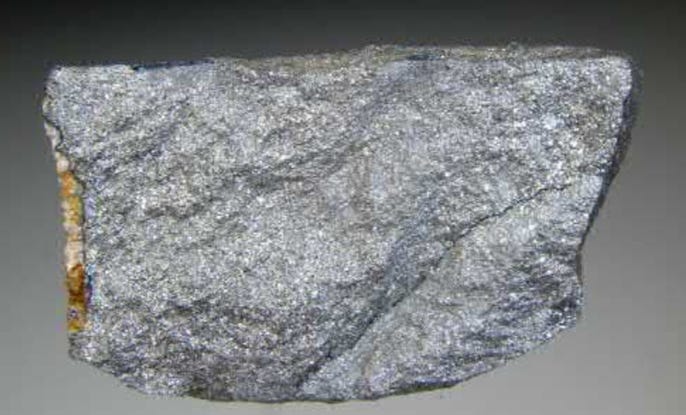
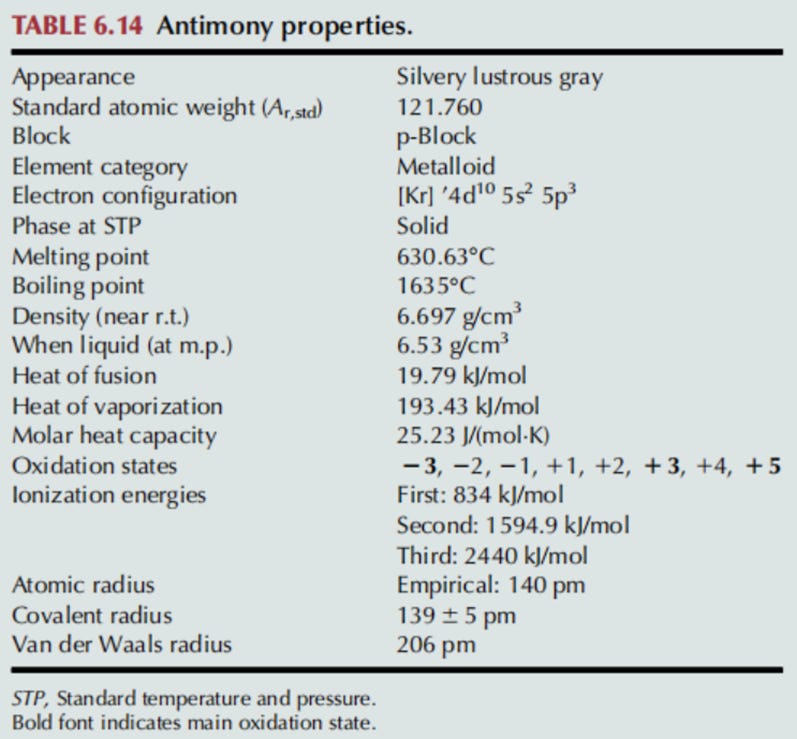
https://www.chemicalbook.com/article/antimony-major-minerals-chemistry-properties-and-reactions.htm
In the ordering of resources across the world, Heaven does not distribute its gifts evenly, and from this imbalance arise both strength and vulnerability among nations. The reserves of antimony are held within a limited number of lands—most notably in China, Russia, Bolivia, Tajikistan, Myanmar, Turkey, and Australia—with China alone holding a great share, as if entrusted with a weighty responsibility. Other regions, such as parts of North America, possess smaller endowments, yet these remain largely unrefined and distant from full use. From such unevenness, the wise observer understands that dependence is quietly formed long before it is…
Since January 1, 2026, The Macro Butler Monthly Meditation has become a subscribers-only edge.
Unlock the framework, understand the signals, and learn how to trade it—subscribe here to gain access.
https://themacrobutler.com/monthly-meditation/
Join The Macro Butler on Telegram here : https://t.me/TheMacroButlerSubstack
Register your interest to The Macro Butler World Economic Summit 2026 here:
https://themacrobutler.substack.com/p/the-macro-butler-world-economic-s…
You can contact The Macro Butler at info@themacrobutler.com

Disclaimer
The content provided in this newsletter is for general information purposes only. No information, materials, services, and other content provided in this post constitute solicitation, recommendation, endorsement or any financial, investment, or other advice.
Seek independent professional consultation in the form of legal, financial, and fiscal advice before making any investment decisions.
Always perform your own due diligence.