





Continues here


CITI: Gold Prices Stagflation ($7,000 Upside)
TL;DR
- Citi expects short-term selling pressure driven by cross-asset de-risking and geopolitical volatility, but maintains a bullish medium-term trajectory toward ~$5,000/oz.
- Scenario Framework Skews Higher
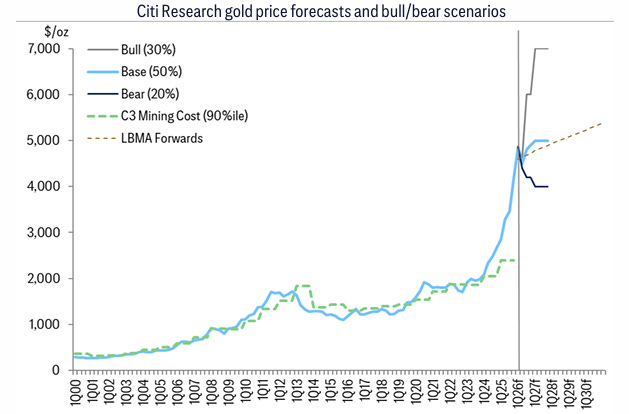
- Base case (~50%) sees a grind to $5,000; bull case (~30%) reaches $6,000 in 2026 and $7,000 in 2027 under stagflation and prolonged geopolitical stress; bear case (~20%) falls toward ~$4,000.
- Market Structure = Small Market, Big Moves
- Gold’s physical market is too small to absorb wealth shifts, meaning small reallocations drive outsized price moves; this creates both upside convexity and downside volatility risk.
- Includes Full slide deck presentation and 6 minute mini-podcast
Exec Sum:
Citi’s latest gold framework is built on a familiar tension for them. The report outlines near-term fragility driven by positioning and cross-asset dynamics, alongside a structurally bullish medium-term trajectory anchored in capital allocation and geopolitical risk. The result is a market that can decline tactically even as its underlying demand base remains intact. They have it both ways so to speak.
Short-Term Deleveraging
Authored by GoldFix
Citi’s first (tactical) principle is that gold is currently exposed to cross-asset de-risking flows, not a deterioration in its core demand drivers. In the near term, selling pressure is expected to persist as investors reduce exposure across risk assets, particularly in response to geopolitical uncertainty and potential equity market stress.
This aligns with the report’s observation that gold often trades pro-cyclically in the early phase of market corrections, declining alongside equities before reasserting its role as a defensive asset. The implication is mechanical rather than discretionary. When portfolios are de-grossed, gold is sold as a source of liquidity.
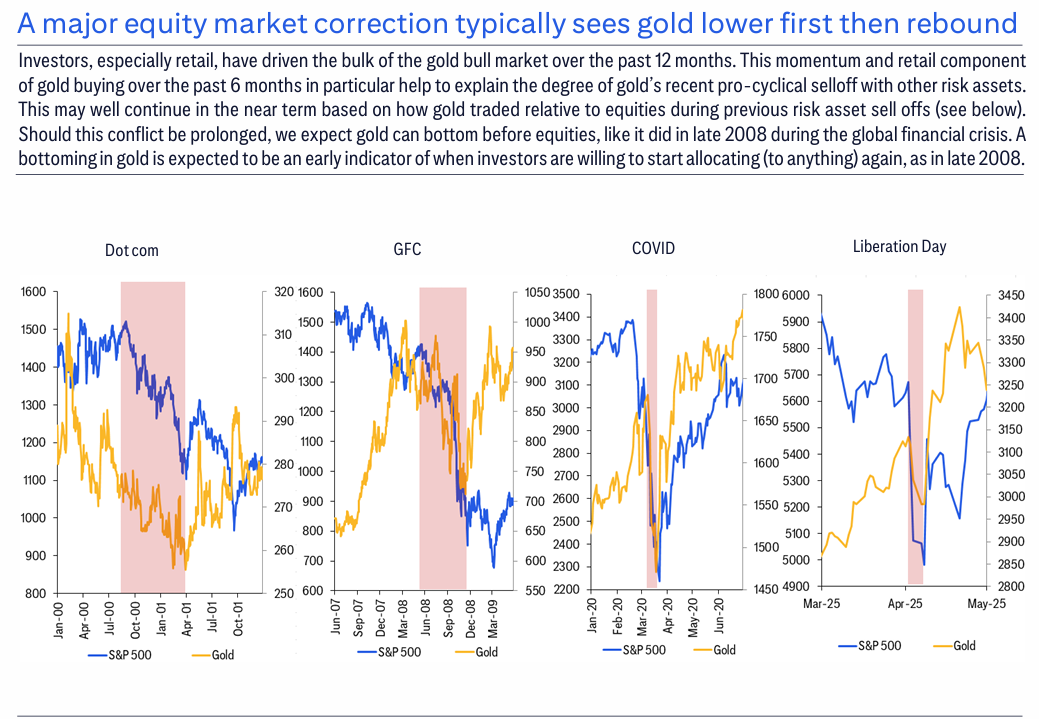
The medium-term trajectory diverges from this dynamic. As uncertainty persists, gold transitions from a liquidity source to a hedge, with capital reallocation shifting back toward defensive assets. Citi’s base case reflects this sequencing: short-term pressure followed by a gradual move higher toward $5,000 per ounce.
The structure here is temporal. The same macro environment produces two distinct price behaviors depending on positioning and time horizon.
Scenario Framework: Convex Upside with Conditional Downside
Citi formalizes its outlook through a three-scenario framework, each tied to macro conditions and capital flows.
The base case sees gold grinding higher toward $5,000 as macro uncertainty supports allocation. The bull case extends this trajectory toward $6,000 to $7,000 under conditions of prolonged geopolitical stress and stagflation. The bear case assumes de-escalation and a return to stable growth, allowing prices to drift lower toward $4,000.
The structure of these scenarios is asymmetrical. Upside outcomes require incremental allocation shifts, while downside outcomes depend on reversal of existing positioning and reduced hedging demand.
This creates convexity. The upside is tied to structural regime change such as stagflation or prolonged conflict, while the downside is tied to a return to stability, which requires multiple variables to normalize simultaneously.
From a positioning standpoint, this suggests that gold is increasingly being priced as a tail-risk hedge embedded within portfolios, rather than purely as a directional commodity trade.
Investment Demand as the Marginal Price Setter
The report makes clear that investment demand, not traditional consumption, is the dominant driver of price formation.
Central bank buying has re-accelerated, reinforcing a structural bid. At the same time, retail bar and coin demand remains elevated, with recent data showing near-record levels. ETF flows have turned more volatile, reflecting tactical positioning shifts rather than a collapse in demand. It implies that gold demand is no longer monolithic.
Central banks provide a steady, strategic floor. Retail and physical investors reinforce directional momentum. ETF flows introduce cyclical volatility.
Free Posts To Your Mailbox
Contributor posts published on Zero Hedge do not necessarily represent the views and opinions of Zero Hedge, and are not selected, edited or screened by Zero Hedge editors.
Loading...