





The Hidden Costs of AI
Artificial Intelligence is spoken of everywhere yet understood nowhere. In the markets of today, its name is repeated so often that meaning is worn thin, like a coin passed through too many hands. Many speak of it as mere software, or as a single object to be bought, banned, regulated, or conveniently “priced in.” This is the error of mistaking the leaf for the tree.
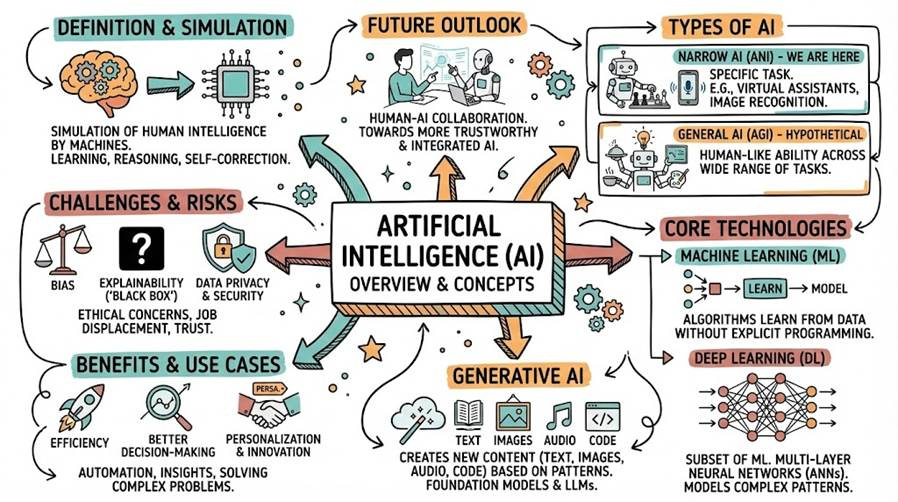
The story is pleasing to the ear, and thus easily accepted. Artificial Intelligence is presented as a perfect instrument of efficiency—one that replaces labour, reduces burdens, and multiplies output without strain. Those in positions of authority gave their approval. Leaders spoke of expanding margins. Observers drew elegant projections of effortless gain. Yet, as the sages remind us, appearances often conceal deeper truths.
What is now revealed is not the disappearance of cost, but its transformation. The burden has not been lifted; it has merely shifted—from human hands to vast structures, from wages to energy, from effort to capital. What was described as a triumph of pure intellect is, in reality, bound to material foundations and finite resources. To understand the true nature of this change, one must set aside illusion and examine the roots. For only by observing the foundation can one grasp the weight of what stands above it.
Artificial Intelligence should not be regarded as a single, unified entity, but rather as a layered structure, where each level depends upon the one beneath it, each carrying its own burdens and limitations. At the foundation lies energy, for without a steady flow of power, no computation can arise; all training, inference, and maintenance are but transformations of electricity. Above this rests hardware—the crafted instruments of silicon and circuitry—through which this energy is given form and direction. Then comes data, the nourishment of these systems, requiring constant gathering, refinement, and care. From this emerges the realm of models and algorithms, where knowledge is shaped, yet never independent of the strength of its base. Finally, at the highest and most visible level, stand applications, through which people perceive usefulness and value, though they remain wholly reliant on what lies beneath. Thus, what appears light and effortless at the surface is supported by weight and complexity below; the appearance of simplicity is born from a foundation of hidden cost.
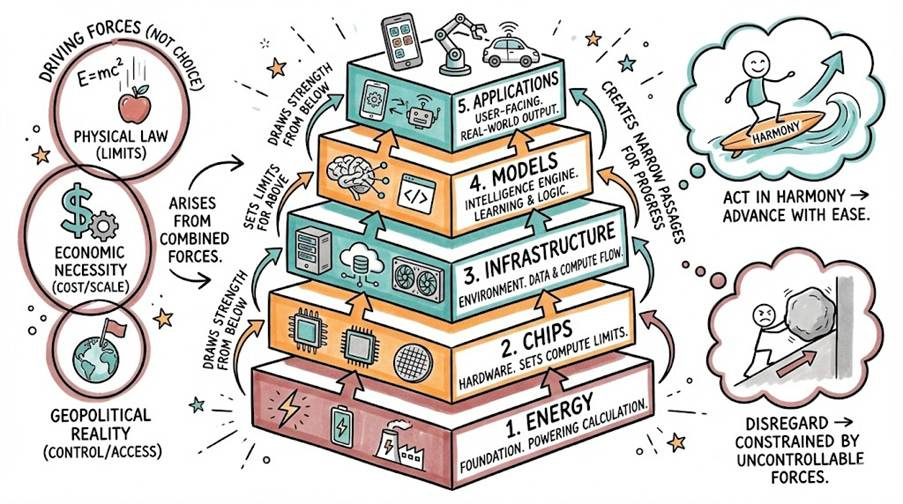
Energy may be understood as the true measure of intelligence, for what is called artificial intelligence is, in essence, the transformation of power into ordered calculation. To train a great model requires countless cycles of computation, and each cycle draws upon electricity, so that the hidden current beneath these systems grows vast—so vast that the houses of data now rival the needs of entire nations. In former times, men spoke of limits in knowledge and invention; today, the greater constraint lies in the securing of power itself. For only where energy is abundant, stable, and enduring can these systems flourish. If it is scarce or uncertain, costs rise without restraint, operations lose their balance, and the promise of gain turns to burden. Thus, those who govern these enterprises seek not only clever designs, but firm access to energy—forming long commitments, turning toward enduring sources, and settling where provision is secure. It becomes clear, then, that energy is no longer merely a resource among others, but the narrow gate through which all such ambitions must pass.
Wholesale Electricity Prices across the US
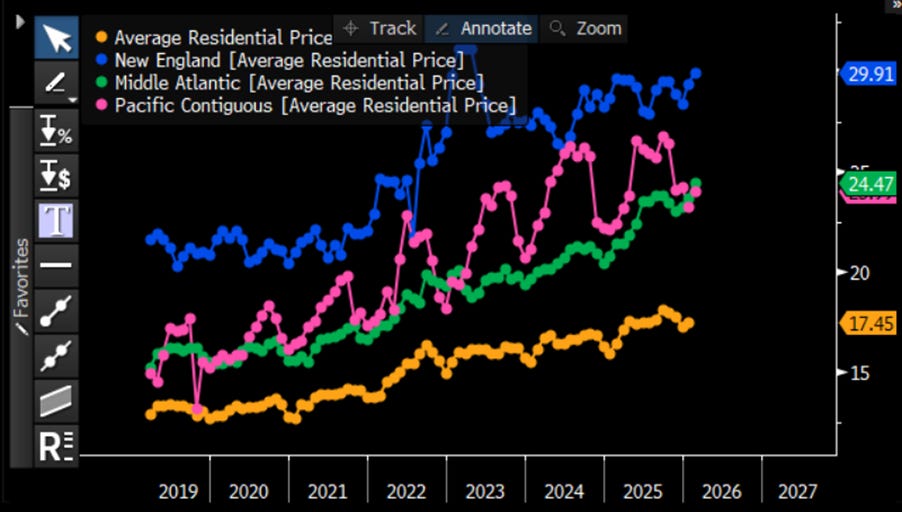
The AI boom has also unleashed a delightfully misunderstood creature: the “energy monster”—the only innovation that somehow gets smarter while consuming electricity like a small continent. No one really knows how much power AI needs now, let alone tomorrow, but the trend is clear: every efficiency gain is immediately reinvested into bigger, hungrier models, because restraint is apparently not part of the algorithm. Data centres are multiplying, grids are sweating, and consumers are discovering that their electricity bill is now indirectly training chatbots. In response, Big Tech has promised—very responsibly—to stop competing with households for power by… building their own energy empires. Naturally, this has led to bold ventures like space-based solar farms (because when in doubt, go orbital), ambitious bets on nuclear fusion (always about 20 years away, right on schedule), and geothermal experiments that sound suspiciously like repurposed oil drilling. In the meantime, however, reality remains charmingly old-fashioned: natural gas plants are being rolled out at scale to...
Read more and discover how to trade it here: https://themacrobutler.substack.com/p/the-hidden-costs-of-ai
Visit The Macro Butler Website here: https://themacrobutler.com/
Join The Macro Butler on Telegram here : https://t.me/TheMacroButlerSubstack
Register your interest to The Macro Butler World Economic Summit 2026 here:
https://themacrobutler.substack.com/p/the-macro-butler-world-economic-s…
You can contact The Macro Butler at info@themacrobutler.com

Disclaimer
The content provided in this newsletter is for general information purposes only. No information, materials, services, and other content provided in this post constitute solicitation, recommendation, endorsement or any financial, investment, or other advice.
Seek independent professional consultation in the form of legal, financial, and fiscal advice before making any investment decisions.
Always perform your own due diligence