





The Harvest of Chaos
Confucius never studied climate models, yet he would have understood ENSO immediately: when the Pacific Ocean loses balance, the whole village argues with the weather. El Niño warms the waters and sends droughts, floods, and disappointed farmers across the globe; La Niña cools them and simply redistributes the misery with equal generosity. In normal times, trade winds keep the Pacific in harmony — warm in the west, cool in the east — but like an overconfident central banker, nature eventually pushes too far in one direction. Scientists now track ENSO with satellites, equations, and supercomputers, yet the system still behaves like an ancient dragon: predictable enough to respect, unpredictable enough to humble mankind every few years.
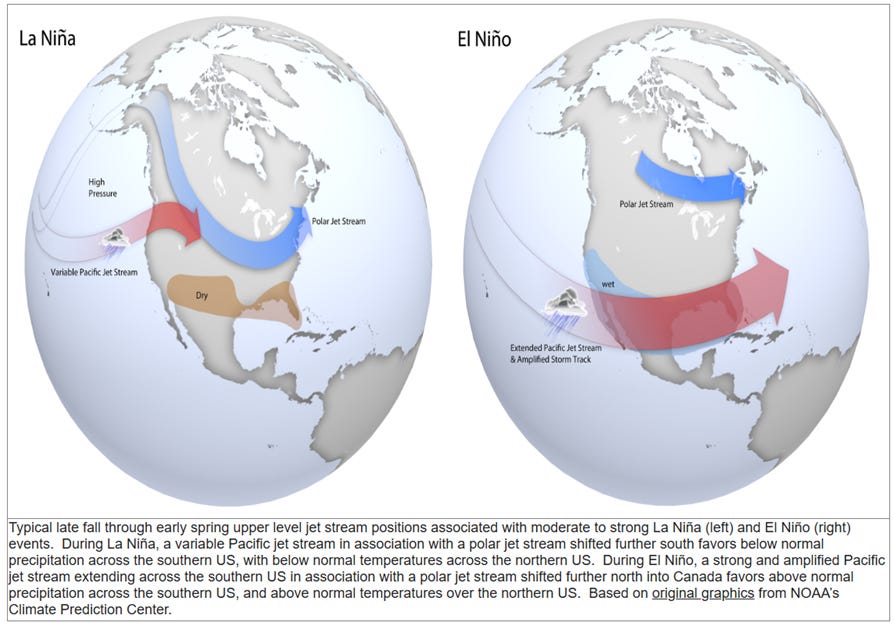
https://www.weather.gov/mhx/ensowhat
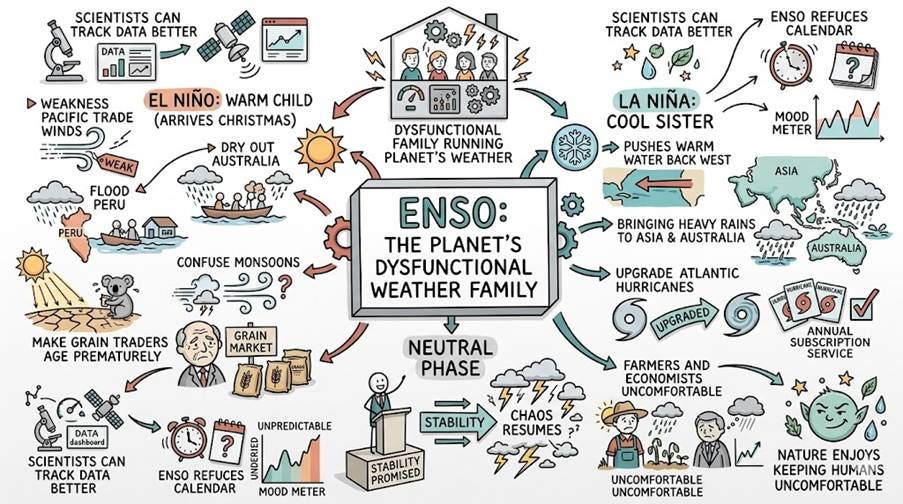
ENSO behaves like a dysfunctional family running the planet’s weather. El Niño, the “warm child,” arrives around Christmas, weakens the Pacific trade winds, and proceeds to flood Peru, dry out Australia, confuse monsoons, and make grain traders age prematurely.
La Niña, the “cool sister,” pushes the warm water back west, bringing heavy rains to Asia and Australia while upgrading Atlantic hurricanes from “seasonal inconvenience” to “annual subscription service.” Between them sits the neutral phase — the climatic equivalent of a politician promising stability before chaos resumes. Scientists can track these mood swings better than ever, but ENSO still refuses to follow a proper calendar, reminding humanity that nature enjoys keeping both farmers and economists slightly uncomfortable.
Agriculture is essentially humanity’s oldest weather derivative: every spring, farmers place a giant leveraged bet that rain will fall, the sun will behave, and temperatures will avoid having an existential crisis. ENSO enjoys sabotaging this arrangement. El Niño and La Niña can drown fields, delay planting, block harvests, wreck transport networks, or simply turn fertile land into an expensive dust collection. Too little rain shrivels crops, too much rain rots them, and a heatwave during pollination can erase an entire harvest faster than a hedge fund blowing up on margin. In farming, the difference between abundance and disaster is often just a few badly timed weeks of weather — and ENSO has a remarkable talent for arriving precisely at the wrong moment.
ENSO treats global agriculture like a rotating game of climatic musical chairs: every crop eventually loses a seat. Wheat may survive in one hemisphere while Australian fields bake like forgotten pizza dough; corn, famously dramatic during pollination, can see yields collapse after a few badly timed hot weeks in the US or Brazilian growing belts. Soybeans follow a similar script, with Argentina and Brazil regularly discovering that Mother Nature dislikes concentration risk as much as portfolio managers do. Rice, however, remains the true geopolitical powder keg. Since billions depend on Asian monsoons to flood their paddies at precisely the right moment, El Niño can turn rice markets into a global stress test, while La Niña often replaces drought with biblical flooding. On average, a strong El Niño trims global cereal production by only 2–4%, but averages are the economist’s favourite way of hiding the fact that some farmers enjoy bumper crops while others begin researching bankruptcy lawyers.
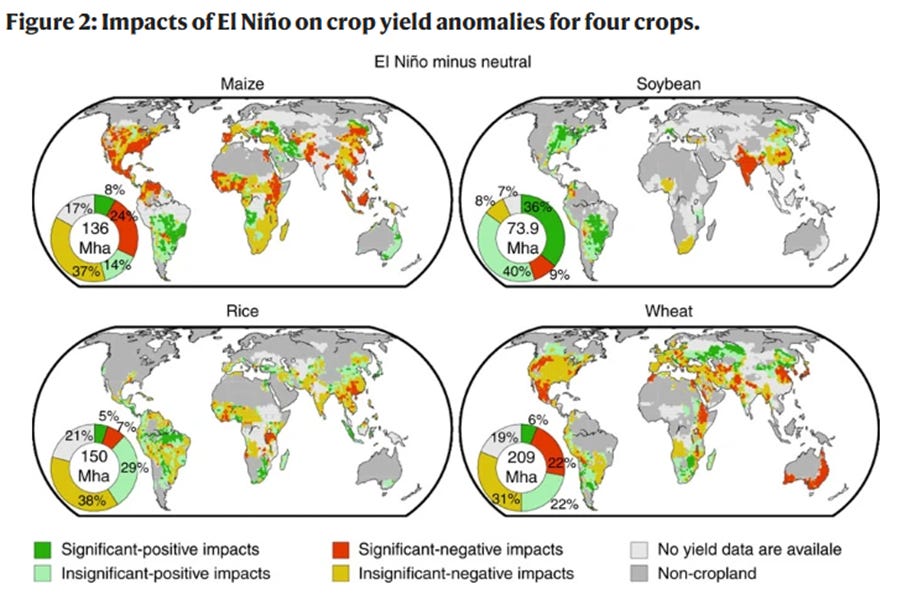
https://www.nature.com/articles/ncomms4712
The real danger of a Super El Niño is not that one farmer has a bad season — it is that the entire planet seems to misplace its harvest at the same time. Australia’s wheat dries out, India’s monsoon weakens, Brazil’s soybeans suffer, and the US Corn Belt starts resembling a convection oven. In normal times, markets can substitute one crop for another, like diners reluctantly switching from steak to chicken when prices rise. But when wheat, corn, soybeans, and rice all surge together, substitution becomes an economist’s fairy tale. Scarcity stops being an inconvenience and starts becoming a geopolitical event, with the poorest consumers discovering that inflation is far less amusing when it appears on a dinner plate rather than a Bloomberg terminal.
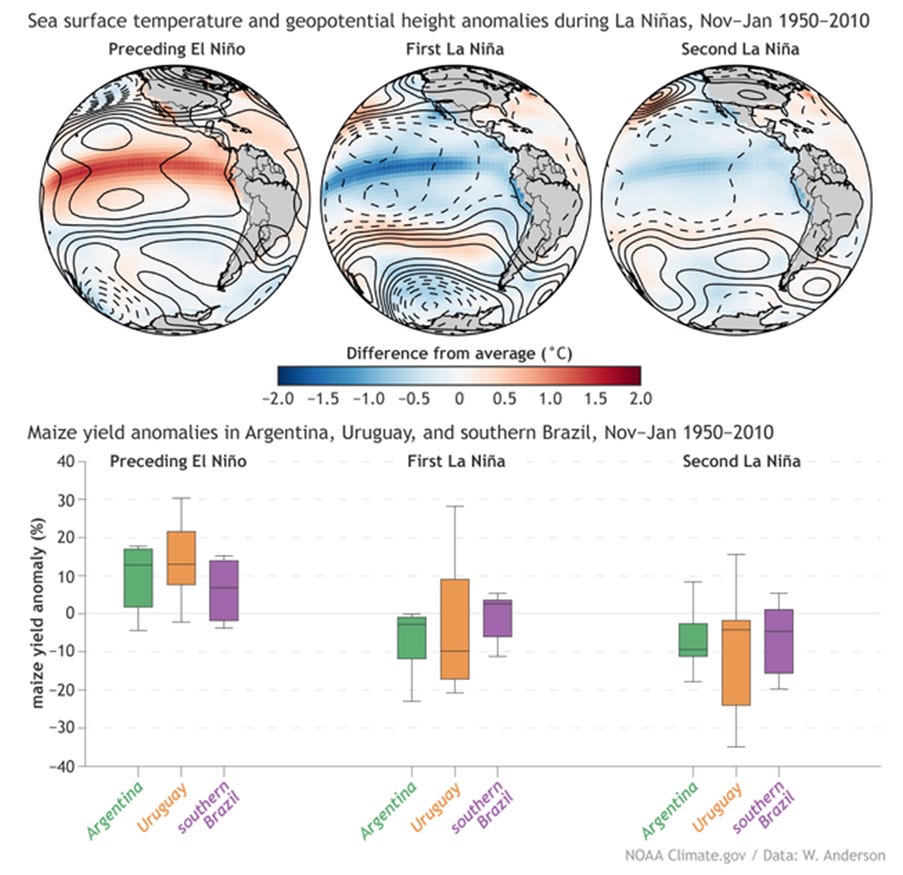
https://www.climate.gov/news-features/blogs/enso/enso-climate-conductor-global-crop-yields
The Super El Niño of 1877–1878 was nature’s reminder that civilization is only a few failed harvests away from panic, and that politicians armed with ideology can sometimes be more dangerous than drought itself. Monsoons collapsed across India and China, Brazil’s northeast turned to dust, and famine spread through much of the developing world, ultimately contributing to tens of millions of deaths. Yet El Niño was merely the spark; the true accelerant was a Victorian system that continued exporting food while people starved, proving that free markets can occasionally display the bedside manners of a tax collector at a funeral. Today’s world has better logistics, satellites, and humanitarian agencies, but large parts of Africa, South Asia, and the Middle East still remain one severe climate shock away from...
Read more and discover how to trade it here: https://themacrobutler.substack.com/p/the-harvest-of-chaos
Visit The Macro Butler Website here: https://themacrobutler.com/
Join The Macro Butler on Telegram here : https://t.me/TheMacroButlerSubstack
Register your interest to The Macro Butler World Economic Summit 2026 here:
https://themacrobutler.substack.com/p/the-macro-butler-world-economic-s…
You can contact The Macro Butler at info@themacrobutler.com

Disclaimer
The content provided in this newsletter is for general information purposes only. No information, materials, services, and other content provided in this post constitute solicitation, recommendation, endorsement or any financial, investment, or other advice.
Seek independent professional consultation in the form of legal, financial, and fiscal advice before making any investment decisions.
Always perform your own due diligence