





The Swarm Drone Age
The wise man knows that names often reveal only the surface of things, while their true nature unfolds through time. So, it is with the drone.
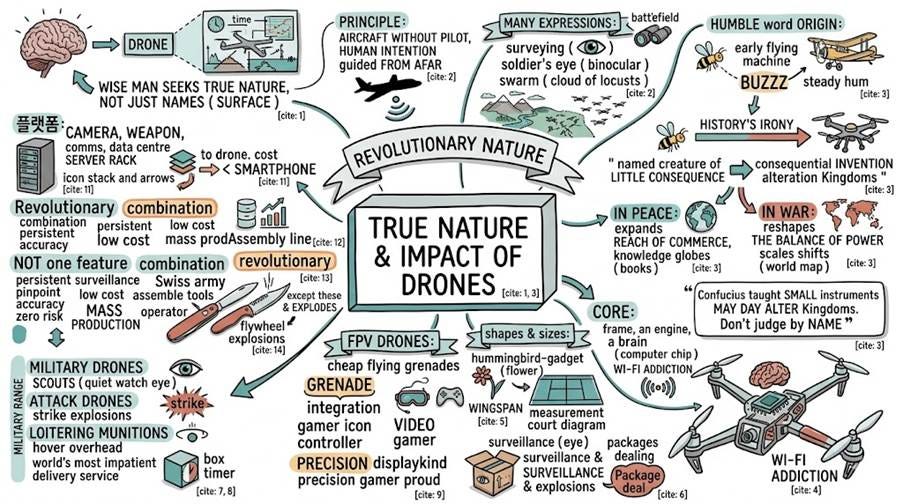
To many, it appears in different forms: a craftsman’s tool surveying mountains and rivers, a soldier’s eye observing distant battlefields, or a swarm crossing the heavens like a cloud of locusts. Yet all are expressions of the same principle: an aircraft that moves without a pilot aboard, guided instead by human intention from afar.
The word “drone” itself arose from humble origins, describing the steady hum of an early flying machine, much like the male bee whose purpose seems small and whose presence is marked only by its buzzing. Yet history often delights in irony. What was once named after a creature of little consequence has become one of the most consequential inventions of our age. In peace, it expands the reach of commerce and knowledge; in war, it reshapes the balance of power. Thus, as Confucius taught, one should not judge a thing by its appearance or name alone, for the smallest instruments may one day alter the course of kingdoms.
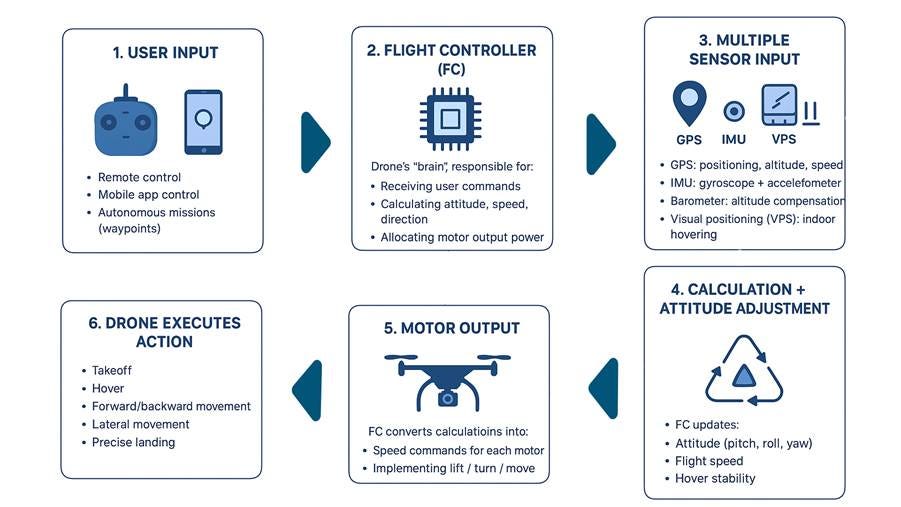
At its core, a drone is surprisingly simple: a flying frame, an engine, a brain, and a Wi-Fi addiction.
They come in all shapes and sizes — from hummingbird-sized gadgets to aircraft with wingspans larger than a tennis court. Some carry cameras, others carry missiles, and some carry both, because apparently surveillance and explosions are now a package deal.
Military drones range from scouts that quietly watch, to attack drones that strike, to loitering munitions that hover overhead like the world’s most impatient delivery service. Then there are FPV drones: cheap flying grenades piloted by someone wearing video goggles and displaying the kind of precision that would make a video gamer proud.
A drone is no longer just a flying machine. It is a camera, a weapon, a communications network, and a data centre squeezed into something that can cost less than your smartphone.
What makes drones revolutionary isn’t any single feature. It’s the combination of persistent surveillance, pinpoint accuracy, low cost, zero risk to the operator, and mass production. In short, they have become the Swiss Army knife of modern warfare — except these flies and occasionally explodes.
The drone industry has come a long way from its humble beginnings as a flying target. Early experiments during World War I produced aircraft like the British Aerial Target and the Kettering Bug, while the term “drone” emerged in 1935 from the DH.82B Queen Bee — proving that even military technology sometimes starts with a bee joke. The real breakthrough came during the Vietnam War, when drones such as the Ryan Firebee demonstrated that machines could perform dangerous reconnaissance missions without risking pilots. Israel later refined the concept, pioneering real-time battlefield intelligence and laying the foundation for modern surveillance drones. Then came the civilian revolution. In 2013, DJI launched the Phantom, turning aerial photography from a Hollywood budget item into a weekend hobby. Suddenly, everyone from farmers to wedding photographers wanted a drone. Today, the industry is racing toward autonomous flight, long-range BVLOS operations, medical deliveries, and infrastructure inspections. What began as a military experiment has evolved into a multi-billion-dollar industry, proving that sometimes the future arrives with a buzz rather than a bang.
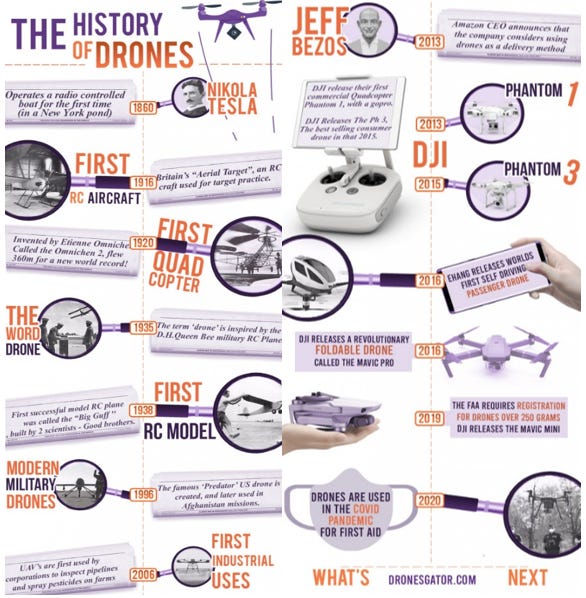
https://dronesgator.com/the-history-of-drones
The drone world is surprisingly simple. There are four main species:
Multi-Rotors — the Instagram influencers of aviation. They hover, pose for photos, inspect buildings, and rarely travel very far before asking for a battery recharge.
Fixed-Wing Drones — the marathon runners. They fly faster, farther, and longer, but unlike their multi-rotor cousins, they can’t stop and hover for a selfie.
Single-Rotor Drones — basically miniature helicopters. They carry heavier loads and stay airborne longer, but they also remind operators that spinning blades deserve respect.
Hybrid VTOL Drones — the overachievers. They take off like a helicopter and cruise like an airplane, refusing to choose between the two.
Drones are also classified by size, from palm-sized gadgets that can barely scare a pigeon to cargo drones large enough to make logistics companies smile. And then there are the jobs: photographers capturing sunsets, farmers spraying crops, racers pretending they’re fighter pilots, inspectors checking bridges, delivery companies chasing the dream of airborne pizza, and...
Read more and discover how to trade it here: https://themacrobutler.substack.com/p/the-swarm-drone-age
Visit The Macro Butler Website here: https://themacrobutler.com/
Join The Macro Butler on Telegram here : https://t.me/TheMacroButlerSubstack
Register your interest to The Macro Butler World Economic Summit 2026 here:
https://themacrobutler.substack.com/p/the-macro-butler-world-economic-s…
You can contact The Macro Butler at info@themacrobutler.com
Disclaimer
The content provided in this newsletter is for general information purposes only. No information, materials, services, and other content provided in this post constitute solicitation, recommendation, endorsement or any financial, investment, or other advice.
Seek independent professional consultation in the form of legal, financial, and fiscal advice before making any investment decisions.
Always perform your own due diligence