





From Rationing To Digital Permission: The Food Passport Grid Is Already Being Built
The coming food crisis is not only about higher prices, empty shelves, or broken supply chains. Those are only the visible symptoms. The deeper issue is much darker: even if the shelves are full, even if the product is available, and even if you still have money or credit, the final question may no longer be, “Can I afford this?” It may become, “Am I still allowed to buy this?”
A more detailed video version of this argument is available on my YouTube channel, Financial Argument.
But the core idea is simple: this crisis is worse than the 1970s, rationing has already begun, the digital infrastructure is already being built, and the next stage may combine shortages with much tighter digital controls.
That is the real meaning of the Food Passport.
Not a paper passport.
Not a dramatic announcement.
Not necessarily one single app with the words “Food Passport” on the screen.
A Food Passport is a system where identity, payment, eligibility, rationing, subsidies, quotas, and access are merged into one digital permission layer.
And that system is no longer theoretical.
The pieces are already being placed on the table.
First comes the crisis.
Then comes the shortage.
Then comes the public reaction.
Then comes the solution that was already waiting.
A system that promises stability while increasing control.
That is how rationing becomes normal. That is how digital ration cards become convenient. That is how emergency restrictions become permanent infrastructure. And that is how basic access to food, fuel, electricity, water, and transportation can gradually move from price-based access to permission-based access.
Most people are still watching oil prices, grocery bills, drought warnings, fuel lines, electricity restrictions, and supply-chain disruptions as separate events.
They are not seeing the operating system being built underneath them.
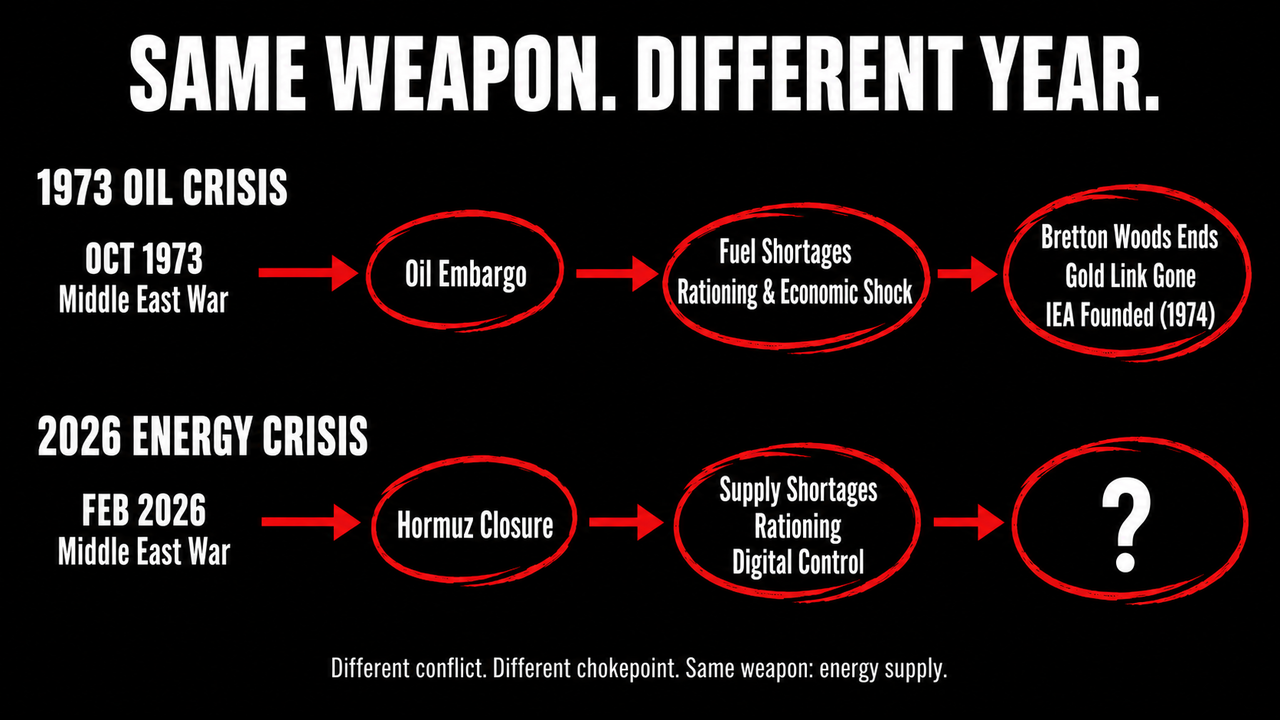
This Crisis Is Worse Than The 1970s
The 1970s oil crisis is remembered for inflation, fuel lines, rationing, economic pain, and political chaos.
But it was more than that.
It was a transition stage.
After that crisis, the world moved deeper into floating currencies, debt dependence, energy vulnerability, financialization, and centralized policy responses.
But the crisis we are facing now is worse because the tools are different.
In the 1970s, governments could ration with paper coupons, queues, price controls, and administrative rules.
Today, rationing can be enforced through phones, QR codes, digital ID wallets, electronic fuel cards, programmable payment systems, biometric authentication, CBDC-linked coupons, and centralized databases.
The old ration card is becoming digital.
The old queue is becoming a database.
The old coupon is becoming programmable.
And the old question — “how much can I buy?” — is becoming “what does the system allow me to buy?”
That is the difference.
The 1970s were analog.
This crisis is digital.
The Emergency Buffers Are Being Burned
At the strategic level, the U.S. is already under pressure.
The Strategic Petroleum Reserve is not an ordinary oil tank. It is the emergency reserve built to protect the country when the system comes under severe stress.
Yet the U.S. has already been drawing down that reserve at a pace that should make every serious observer uncomfortable.
While that reserve is being drained, China spent 2025 building a large crude oil buffer, buying discounted Russian, Iranian, and Venezuelan crude while prices were still relatively low.
Now the shock has arrived.
The U.S. is drawing down its emergency reserve.
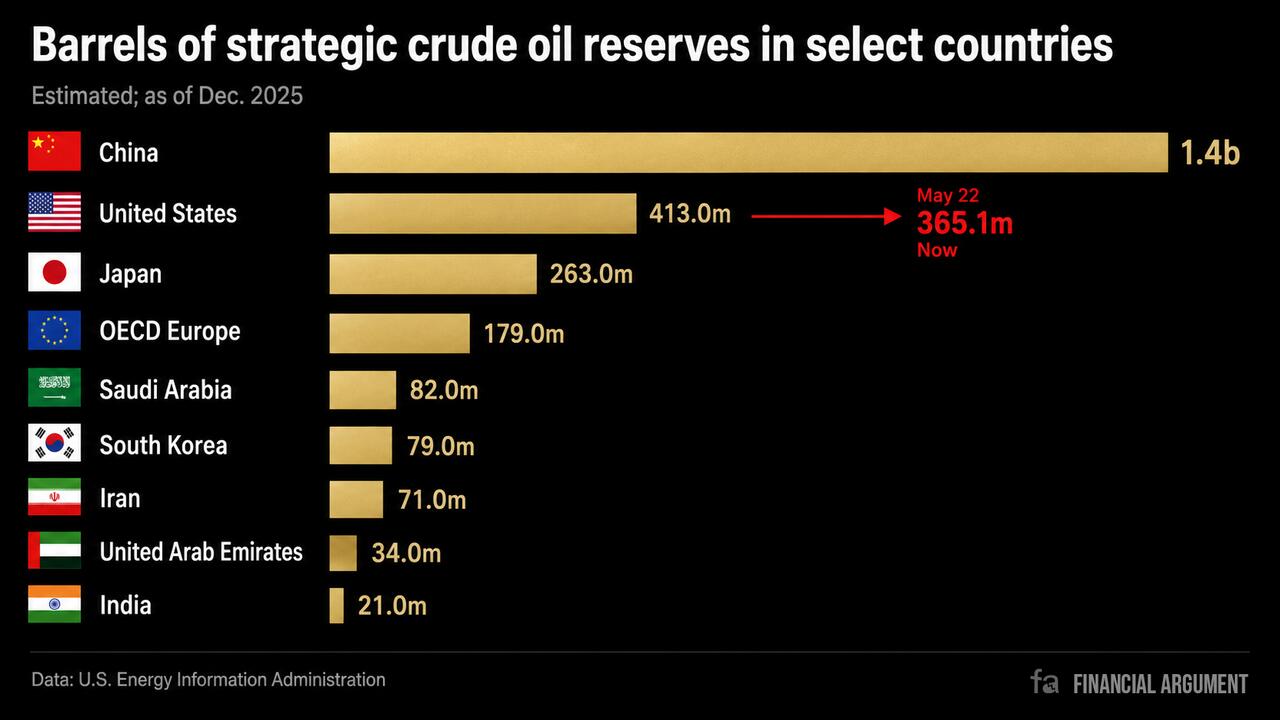
China is sitting on the stockpile it built before the crisis.
Iranian crude had already been positioned closer to Chinese buyers.
And energy routes toward China have been strengthened at the same time the world is being pushed into disruption.
One side is draining its emergency buffer.
Another side had already positioned itself before the shock began.
Do you really believe all of this is just coincidence?
This matters because rationing does not begin when the public finally sees an empty pump or an empty shelf.
It begins when the strategic buffers are already being used, when supply routes are already under pressure, and when governments begin preparing the public for controlled access.
And that is exactly where we are now.
Rationing Has Already Begun
Across the world, rationing is no longer a distant emergency scenario.
It is already appearing in different forms: fuel limits, electricity restrictions, water rationing, gas quotas, digital coupons, QR-code systems, and controlled access to essential supplies.
In Europe, Slovenia imposed daily fuel purchase limits. Italy was forced to ration jet fuel at several airports. Sevastopol reduced gasoline sales to 20 liters per vehicle. Sweden warned that fuel rationing may become necessary. And across Britain, many households are already being pushed into a softer form of rationing, cutting heat, food, and basic consumption as energy costs rise.
In Asia, the pattern is even clearer. Sri Lanka used a QR-code fuel rationing system. Bangladesh limited fuel sales and expanded blackouts. Myanmar restricted private vehicles by license plate numbers and later tightened the system with QR-code tracking. Nepal and the Maldives rationed cooking gas. India prioritized household LPG while restricting refill access. Taiwan imposed water rationing after its driest winter in decades. Iran already operates electronic fuel cards and gasoline quotas.
This is not only about fuel.
It is about the normalization of controlled access.
In Africa, the pressure is spreading through energy, fuel, water, and public services. Egypt ordered shops, restaurants, and cafes to close early while cutting government fuel use. Ethiopia rationed fuel and prioritized essential vehicles. South Sudan and Kenya moved into electricity rationing. Mali registered vehicles and limited how often they could refuel. Mauritius restricted non-essential electricity use. South Africa imposed emergency water rationing in affected areas.
Across the Americas and the Caribbean, the same pattern is visible. Cuba restricted gasoline to 20 liters per vehicle through an appointment system. Peru imposed natural-gas rationing after a pipeline disruption. Ecuador saw drivers waiting for days to buy limited amounts of fuel. Guyana faced shortages despite being an oil producer. Saint Vincent and Jamaica imposed water rationing. Venezuela activated electricity-saving measures as blackouts continued. Bolivia saw fuel shortages turn into rationing, long lines, and unrest.
Even the U.S. is not untouched.
There is no nationwide fuel rationing yet, but shortage pressure has already entered the supply chain, with reports of Nissan dealerships rationing motor oil as product availability tightens.
Australia and New Zealand have not fully entered public rationing yet, but both have already prepared emergency fuel-rationing frameworks. Fiji prepared power rationing before shifting the pressure onto households through higher electricity costs. Smaller Pacific island states are already facing fuel shortages that disrupt transport, food movement, work, school, and healthcare access.
So the pattern is now visible.
The shortages are being reported.
The restrictions are being announced.
The rationing systems are being prepared in public.
This is not happening in one isolated country.
It is happening across continents, across political systems, and across different types of economies.
The form changes from place to place.
Fuel limits in one country.
QR-code rationing in another.
Electricity restrictions somewhere else.
Water rationing in another region.
Gas quotas in another.
But the direction is the same:
Less open access.
More managed access.
Less abundance.
More permission.
And once populations accept controlled access during a crisis, the next step becomes much easier to sell.
The Digital Infrastructure Is Already Here
This is where the Food Passport idea becomes much more serious.
Because rationing alone is not the final stage.
Rationing plus digital identity is different.
Rationing plus programmable payments is different.
Rationing plus CBDC coupons is different.
Rationing plus behavioral enforcement is different.
In Europe, the digital ID wallet system is already being formalized. Every EU member state is required to provide at least one European Digital Identity Wallet. Officials call the system voluntary, but the infrastructure is being built to connect identity with official records and to be accepted wherever strong digital identification is required.
In the United Kingdom, the government announced a new Digital ID system, initially presenting it through Right to Work checks.
In India, Aadhaar already connects more than a billion people to a digital identity system used across banks, telecoms, government services, welfare access, and ration-related systems.
And then India launched a CBDC-based Digital Food Coupon pilot in Gujarat.
Read that carefully.
A digital identity layer.
A programmable digital currency coupon.
A defined group of eligible beneficiaries.
A defined quantity of foodgrains.
Authorized shops only.
Digitally traceable transactions.
At that point, the food can be programmed.
The access can be measured.
The transaction can be tracked.
Egypt shows the same direction from another angle. Its electronic ration card system already controls access to subsidized bread and essential commodities, while placing quotas on basic products such as sugar and cooking oil.
Canada showed another part of the model during the Freedom Convoy crisis, when the government demonstrated that access to the financial system could be frozen or suspended when authorities decided people had crossed the line.
Put the pieces together.
India shows that food access can be programmed.
Egypt shows that rationing can be digitized.
Europe and the U.K. show that digital identity infrastructure is being formalized.
Canada shows that financial access can be cut off.
And the global rationing wave shows that crisis conditions can make populations accept restrictions they would have rejected under normal circumstances.
That is the architecture.
That is the direction.
That is why this matters.
The Sales Pitch Will Be Convenience
The public will not be told:
“We are building a permission system for food, fuel, and money.”
They will be told:
“It is safer.”
“It is more efficient.”
“It prevents fraud.”
“It protects vulnerable people.”
“It makes benefits easier.”
“It reduces waste.”
“It helps manage shortages.”
“It is only temporary.”
That is how these systems are always sold.
Before people understand what the system can deny, they are trained to accept what the system can provide.
That is the danger.
A digital ID wallet does not need to begin as a Food Passport to become one.
A CBDC coupon does not need to begin as a control system to become one.
A ration card does not need to begin as punishment to become a permission layer.
A fuel limit does not need to begin as tyranny to normalize restricted access.
Systems rarely announce their final purpose on the first day.
They expand through crisis.
They deepen through dependency.
They become permanent through habit.
From Affordability To Permission
The next stage of this crisis is not only about inflation.
It is not only about oil.
It is not only about war.
It is not only about food prices.
It is about the slow movement from affordability to permission.
In the old economy, the question was whether you had enough money.
In the new system, the question may become whether your identity, score, status, location, purchase history, eligibility, quota, or political behavior allows the transaction to go through.
That is why the Food Passport matters.
Not because everyone will be handed a card tomorrow morning.
But because the infrastructure capable of creating one is already being installed.
The fuel rationing is visible.
The food rationing is visible.
The water rationing is visible.
The digital ID systems are visible.
The CBDC coupon pilots are visible.
The electronic ration cards are visible.
The financial freezing precedent is visible.
None of this is hidden anymore.
The only thing still missing is for the public to understand what it is looking at.
Because when the next crisis arrives, the system will not need to ask whether people want digital permission.
It will only need to say that digital permission is necessary to survive the crisis.
And by then, many people will already be holding the device that becomes their Food Passport.