





The Macro Butler’s Monthly Meditation : Depth Charge In The Abyss.
The Master observed that a man who does not know the depth of the well before he drinks from it is not thirsty — he is merely impatient. The seabed is not a floor. It is a mirror. It covers 361 million square kilometres — seventy-one percent of this Earth we claim to govern — and in it we see the full measure of our ignorance. From the sunlit continental shelves, shallow and familiar, it descends through slopes and abyssal plains to trenches that plunge eleven kilometres into the crust. It is the most varied terrain on this planet. It is also the terrain we understand least.
Consider this carefully: we have charted the surface of Mars in finer detail than we have charted the bottom of our own oceans. We have spent more effort studying a neighbour we can never visit than a foundation upon which all civilisation rests. The ancients called this ben mo dao zhi 魔道祖师 — inverting the root and the branch. We have mastered the ornament and neglected the origin.
A wise man does not mistake the surface for the whole. The fish who lives in the shallow waters believes the pond is the world. The general who studies only what he can see loses to the enemy who has studied what he cannot.
What lies below is not absence. It is everything we have not yet looked for — and everything that others have already found.

Think of the ocean floor as the world’s most passive-aggressive real estate market. The continental shelf is every coastal nation’s soggy front garden — 130 metres deep, stretching 200 nautical miles, stuffed with fish, oil, gas and internet cables, and legally yours under UNCLOS, which is essentially a United Nations document confirming that geography is fate and lawyers are expensive. Then the ground drops away — sharply, rudely — into the abyssal plain: cold, flat, three to six kilometres down, home to submarine cables, polymetallic nodules and every submarine that has ever wanted to be left alone. Go deeper still and you hit the hadal trenches, where the Mariana bottoms out at 10,935 metres. To put that in perspective: drop Everest in and you would need an additional two kilometres of rope to tag the summit — at which point you would presumably question your life choices. Cutting across all of this are the mid-ocean ridges, where tectonic plates slowly divorce each other, and the fracture zones that mark where ancient geological arguments were never resolved. These two features decide where the cables go, where the submarines hide, and where the chokepoints of global power inconveniently happen to be.
The ocean floor, in short, is 361 million square kilometres of terrain that controls civilisation — and we have mapped barely a quarter of it in high resolution. We know more about the dark side of the Moon. We are, as a species, doing fine.

In 2017, the Nippon Foundation and GEBCO launched Seabed 2030 with a mission to map the entire ocean floor by the end of the decade. The branding is immaculate — climate, biodiversity, sustainability, marine protected areas — the full quintet of words that make a bureaucrat reach for his cheque book without reading the footnotes. It is the institutional equivalent of putting a bow on a hand grenade and calling it a gift. Here is what the press release forgot to mention: the heaviest contributors to this noble scientific endeavour are not marine biologists in fleece jackets. They are the United States Navy, the Chinese PLA Navy, NATO hydrographic offices, and a charming constellation of “dual-use” technology firms whose defence contracts would cause their ESG ratings to spontaneously combust.
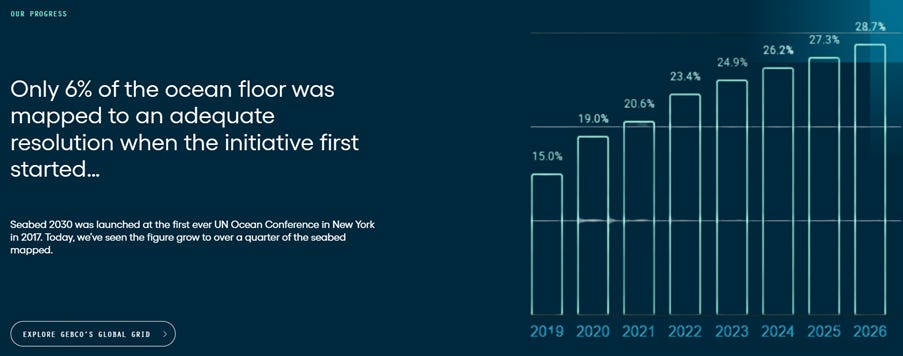
https://seabed2030.org/our-mission/
The logic is acoustic, which is a polite way of saying: sound is a weapon and the seabed is the ammunition. Ocean sound bends with temperature, salinity and pressure, carving channels where noise travels for thousands of kilometres and shadow zones where it vanishes entirely. A commander with a precise bathymetric map knows exactly where the enemy’s sonar goes blind — and, conveniently, where to park his own submarines, hydrophones and mines while he waits. Map the floor first and you do not merely know the terrain. You own it. Everyone else is just visiting.

https://seapower.navy.gov.au/subsea-and-seabed-warfare
America has been playing this game since the 1950s. SOSUS — a sprawling network of seabed hydrophones draped across the North Atlantic — spent decades eavesdropping on Soviet submarines with the patient dedication of a very well-funded gossip. The hardware is now declassified. The strategic logic never was; it simply got faster, quieter and considerably more expensive.
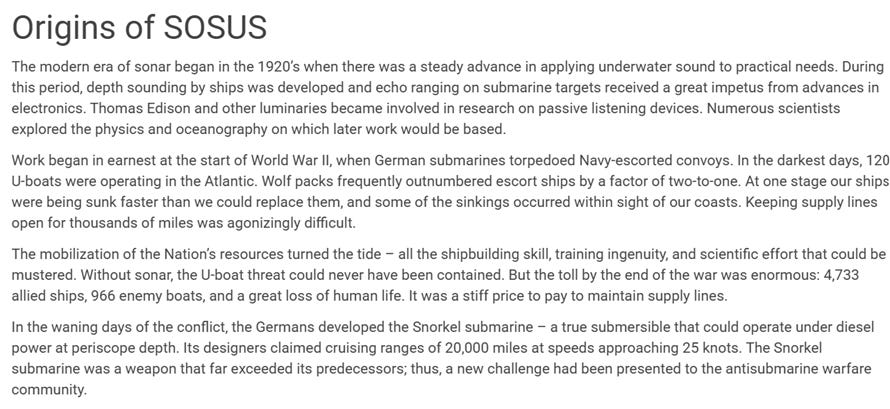
https://www.csp.navy.mil/cus/About-IUSS/Origins-of-SOSUS/
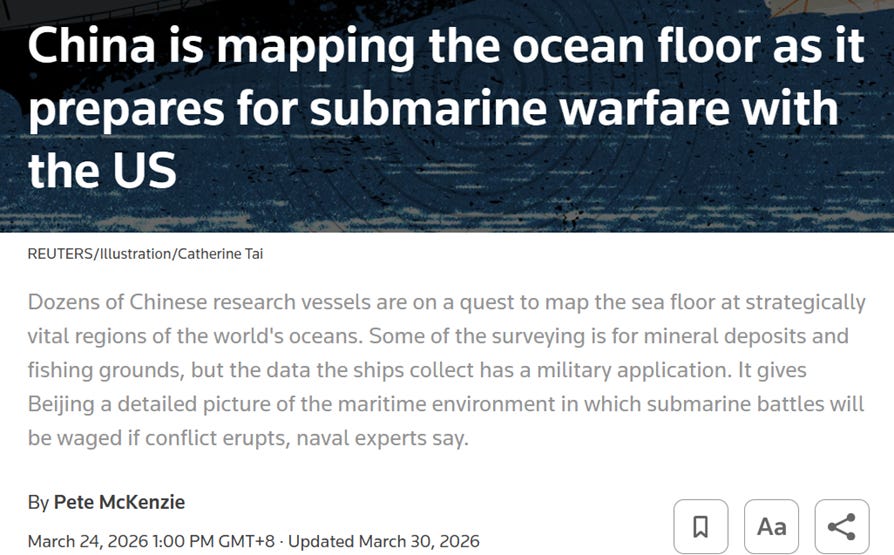
For fifteen years China has operated the most aggressive ocean-floor mapping programme on the planet and has done so with the subtlety of a man loudly whispering a secret. Its research fleet — the Xiangyanghong vessels, the Haiyang series, and their various cousins — works the South China Sea, the Western Pacific and, increasingly, the Indian Ocean in a state of permanent industriousness, bristling with multibeam sonar, autonomous submersibles and deep-sea landers. Pure science. Obviously.
The artificial-island programme in the South China Sea was, as luck would have it, also a mapping programme. Constructing facilities on Fiery Cross, Subi and Mischief reefs required exhaustive seabed surveys — and those surveys produced precisely the data a navy dreams about: topography, sediment composition, cable routes, acoustic pathways and optimal locations for tomorrow’s sensors. In the Indian Ocean, Beijing’s survey vessel tracks follow the path of the cables connecting Africa, the Gulf, India and Southeast Asia with the reliability of a bus timetable. Coincidence is not a category that survives this much repetition — much like the notion that China’s research fleet is primarily interested in coral.
The wake-up call arrived in September 2022 in the form of two pipelines and a very loud bang in the Baltic. Nord Stream was destroyed; no government has formally attributed it to anyone, which is itself a masterclass in collective diplomatic cowardice. The lesson, however, landed with unusual clarity: undersea infrastructure is not theoretically vulnerable, it is practically vulnerable, and a sufficiently…
Since January 1, 2026, The Macro Butler Monthly Meditation has become a subscribers-only edge.
Unlock the framework, understand the signals, and learn how to trade it—subscribe here to gain access.
https://themacrobutler.com/monthly-meditation/
Join The Macro Butler on Telegram here : https://t.me/TheMacroButlerSubstack
You can contact The Macro Butler at info@themacrobutler.com
Disclaimer
The content provided in this newsletter is for general information purposes only. No information, materials, services, and other content provided in this post constitute solicitation, recommendation, endorsement or any financial, investment, or other advice.
Seek independent professional consultation in the form of legal, financial, and fiscal advice before making any investment decisions.
Always perform your own due diligence.