





Mickey Maini: The Entropy Trap and Growing Market Stress
For your summer reading pleasure, here is a cross post from The Institutional Risk Analyst. This is one of our most popular interviews this year. Great book. -- Chris
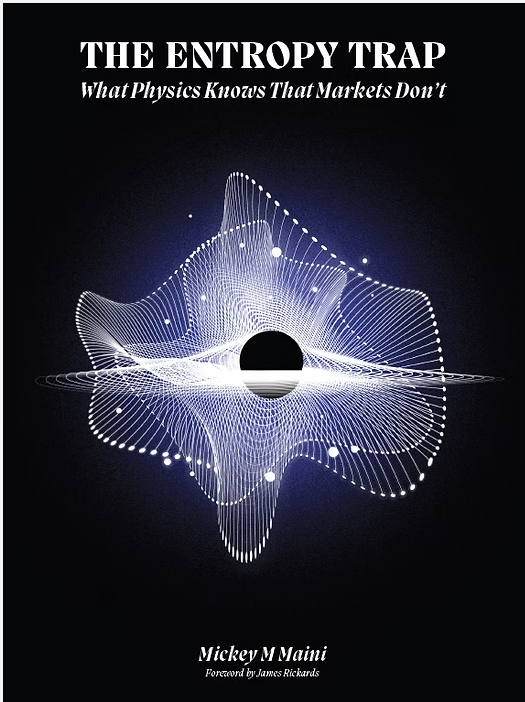
In this issue of The Institutional Risk Analyst, we feature a discussion with Mickey M. Maini, founder of Solstice Laboratory and author of The Entropy Trap: What Physics Knows That Markets Don't. Maini spent decades operating across global markets — first as a senior investment banker, then as the CEO of an emerging-market business that scaled from roughly $100 million to over $5 billion in value, and later as a family-office investor and founder of Solstice Laboratory. His framework, developed first as a private instrument to manage capital and now published as The Entropy Trap with a forward by Jim Rickards, treats markets the way physicists treat complex systems under stress. It does not begin with a forecast. It begins with measurement: level, velocity, acceleration, correlation, feedback loops, and whether stress is rising or falling. The central claim is simple: we are not in another normal cycle. We are in a structural reorganisation in which the old equilibrium is no longer recovering.
The IRA: Mickey, congratulations on the book and thank you for taking the time to speak with us today. Entropy is a word most people don’t understand, but it is a crucially important concept in science and also in history and finance. Entropy is a measure of disorder, randomness, or how spread out energy is within a system. In physics and chemistry, it explains why processes flow in one direction—like ice melting or hot coffee cooling—and dictates that natural systems naturally progress from organized states toward chaotic, more probable states over time. Tell us how you chose entropy as the title of your book, The Entropy Trap, and why you think that imagery is so relevant today for investors and policy makers?
Maini: Every system drifts toward disorder unless something is actively working to keep it together. In a financial system, that energy is credit, trust, policy support, liquidity, regulation, institutional credibility and political cooperation. Early in a cycle, adding complexity helps. More credit, more institutions, more globalisation, more policy tools — they all make the system look stronger. But every layer becomes something you have to maintain. More debt needs refinancing. More regulation creates workarounds. More monetary intervention creates asset inflation and moral hazard. Each intervention solves one problem and creates the next one. Eventually the cost of maintaining the old equilibrium rises faster than the system’s ability to pay it. That is the trap.
The IRA: You argue that we are not merely in another cycle today but are moving from stability to greater instability, a key aspect of entropy. Why does that distinction matter to investors and to markets, and what tells you which phase of the change process we are in at present?
Maini: A normal cycle bends and mean-reverts. Stress rises, policy responds, the old structure survives. Most of the time, that is what happens. Conventional macro is built for that world, and it works most of the time. A transition is different. The equilibrium itself changes. The old relationships stop holding. Bonds stop hedging equities. Liquidity disappears when it is needed. Policy works for shorter periods. Geopolitics starts driving supply chains. Technology starts changing the physical economy. The distinction matters because the playbook inverts.
The IRA: We have certainly have seen that phenomenon in the US economy since 2008. The use of aggressive interest rate policy and open market operations by the Fed to address policy issues has less and less impact. And the degree of speculation in the markets has grow greater and greater. We’ve actually adopted a barbell model to preserve value, on the one hand, but also maximize returns in the fiat world. When we talk to investors, the level of confusion is growing. How do you see the markets today?
Maini: The big challenge for investors and policy makers is to understand that we are not in a normal situation comparable to say 20 or 30 years ago. We are in a major transition. In a normal cycle, you buy the dip. In a transition, the rally may be a false equilibrium. The asset that protects you in one environment can damage you in the other. Getting the regime wrong is more dangerous than getting the timing wrong. What tells me we are in the second phase? Policy effectiveness has been decaying on a measurable curve. Each intervention costs more and buys less benefit and time. Cross-asset correlations are elevated. Stress velocity has not produced a sustained healing phase since 2008. None of those readings is consistent with a clean normal cycle. The old equilibrium is no longer recovering. It is being reorganised.
The IRA: Agreed. We see a level of confusion and dysfunction between economic sectors that were once strongly correlated. The companion observation is that many stock are driven solely by equity manager momentum, often in stark opposition to fundamental value and operating performance. We could make quite a list of idiosyncratic stocks from our WGA Bank Top 50 model portfolio. The link from the particular to the general seems to be broken. Conventional macro economics has been wrong on the same set of questions for years. Why does your framework read the system differently, and what does it actually measure?
Maini: Conventional macro measures depend upon debt-to-GDP, inflation, employment, growth, credit spreads. Those classical macro measurements work in normal conditions because the relationships between the levels are stable. They stop working when the relationships themselves are changing. That is what happens in a transition. Your experience benchmarking banks gives you a view of the particular, the micro economy so beautifully documented by US regulations. Levels can be smoothed. Sentiment can be managed. Reported numbers can lag.
The IRA: That is precisely the problem with economics in the US. There is an assumption of stability, of continuance. I’ve actually had economist friends look me in the eyes and tell us that the Treasury market will always be open. Since that conversation, the Treasury market has collapsed twice – December 2018 and March 2020 – yet we continue to model the economy like today is normal and stable. Our big worry is that the rate of change seems to be accelerating.
Maini: Motion is harder to smooth, to fit into a given narrative of the political economy. As a result, focusing on the Entropy Trap measures the volatility of policy and public sentiment. The Solstice framework measures motion rather than only levels of indicators. It measures the level of stress, the velocity at which stress is rising, the acceleration of that velocity, and the change in acceleration itself. It also measures whether risks that used to be separate are now moving together. Three examples make the point. Japan can carry very high debt because the system still has internal stability. Greece collapsed at a lower debt level because stress velocity was accelerating. The United States in 1929 had low federal debt, but private leverage was building underneath. The level alone was the wrong question. Motion told the truth. The level tells you where the car is. The derivatives tell you whether the driver still has control. That is what the framework adds.
The IRA: The Institutional Risk Analyst has been warning that private credit has become a ticking time bomb — that risk has migrated outside the regulated banking system into structures with longer lockups, slower marks, and opaque counterparty exposure to banks themselves. What does the Solstice framework currently read on this change in bank exposures to nonbank firms and the attendant risk?
Maini: The migration itself from banks to nonbanks is the signal. Healthy financial systems do not usually produce this kind of channel migration. Stressed ones do. Risk migrates toward weaker supervision, lighter capital treatment, slower marks and more opaque structures when the system is under stress. That is true in private credit, nonbank mortgage origination, structured credit, BDCs, insurance company alternatives and parts of commercial real estate finance. The framework currently reads private credit as one of the key propagation channels for the next phase of stress.
The IRA: So translated into risk manager, we’re going to see increased contagion risk from the nonbanks. Usually the trigger for a selloff is a surprise.
Maini: The exact trigger is unknowable. It could be a fund, a financing vehicle, a borrower cluster, a liquidity event, a bank line, or a valuation mark. But once the trigger fires, the risk does not stay private. It returns to the regulated system through committed credit lines, counterparty exposure, repo relationships, prime brokerage, warehouse lending, and confidence effects. That is the important part. The framework can tell you the system is brittle enough for cascade. It cannot tell you which institution or transaction starts it. That is where your IRA Bank Book and institutional plumbing work become essential. The system-level reading and the institution-level reading need each other for full understanding. But again, the migration itself is the signal.
The IRA: We have called silver our number one idea for 2026 even while preferring gold as a core holding. How does the framework read the gold-silver pair, especially in the context of some of the more pronounced bubbles in technology and AI?
Maini: Gold is the structural core. It is the major asset with no counterparty. It is no one else’s liability. That is why it returns to the centre of the system when trust in paper promises weakens. Central banks have been buying gold at historically elevated levels for several consecutive years. That is not retail behaviour. It is sovereign behaviour. The framework reads that as confirmation that trust in the existing reserve architecture is leaking.
The IRA: We are in agreement on gold as the basic trust asset. How do you view silver, which was the poor stepchild of gold in a monetary sense going back to the 1890s when first Europe and later the US abandoned silver coinage? Today silver is a crucial industrial asset for everything in tech but also an increasingly interesting monetary metal.
Maini: Silver is the kinetic version of the same trade. It has monetary properties like gold, but it also has growing industrial demand. Solar. Electrification. Electronics. AI infrastructure. Defence systems. All require silver. It is both a trust asset and a physical input. That makes silver more volatile, but potentially more asymmetric. In inflationary transitions, the gold-silver ratio has historically compressed. The timing is uncertain. The volatility is high. But the conditions for compression are present. The framework agrees with the broad preference: gold for the core, silver for the higher-beta expression. Gold comes first because the trust function comes first. Silver follows when the monetary trade and the industrial constraint trade converge. Gold is the anchor. Silver is the torque.
The IRA: Thanks Mickey. We’ll talk again soon.
Readers can learn more about Mickey Maini’s work and the research behind the framework at Solstice Laboratory. Additionally, The Entropy Trap: What Physics Knows That Markets Don’t is available now on Amazon, where readers can explore Maini’s full argument on systemic stress, phase transitions, and why today’s markets may no longer be operating inside a normal cycle. For more information on Mickey, the book, and Solstice Laboratory’s ongoing research, visit https://solsticelabs.com.