





Code Is the New Cure
For the whole of modern history, medicine has been a repair trade. You broke, a clever and exhausted human arrived late, charged expensively, and squinted at the damage like a detective handed a cold case and a stethoscope. Hippocrates dreamed of catching the disease while it still whispered. Every physician since has treated it after it screamed. Artificial intelligence, with the quiet confidence of a sage who has already read the ending, proposes to finally honour that dream — to find the patient before the patient finds the emergency room.
As Confucius did not quite say: the wise physician treats the illness that has not yet arrived. The foolish one bills for the one that has.
This is not a technology story wearing a lab coat. It is an economics story that borrowed one. The day medicine shifts from treating illness to predicting it, the largest cost centre in the developed world — healthcare, that elegant tax on the audacity of being alive — begins, at last, to misbehave in a useful direction. A population caught earlier, dosed more precisely, and spared the hospital bed is not merely healthier. It works longer, retires later, and stops consuming the three things ageing societies are running out of fastest: nurses, beds, and patience. Everyone knows that the cycle controls the Fed. Biology, it turns out, controls the budget.

Print this on the masthead of every health ministry on earth and read it twice: for the first time in modern history, medicine may be shifting from treating diseases after they emerge toward predicting and preventing them before they turn fatal. Every number that follows is a footnote to that sentence. The footnotes are expensive.
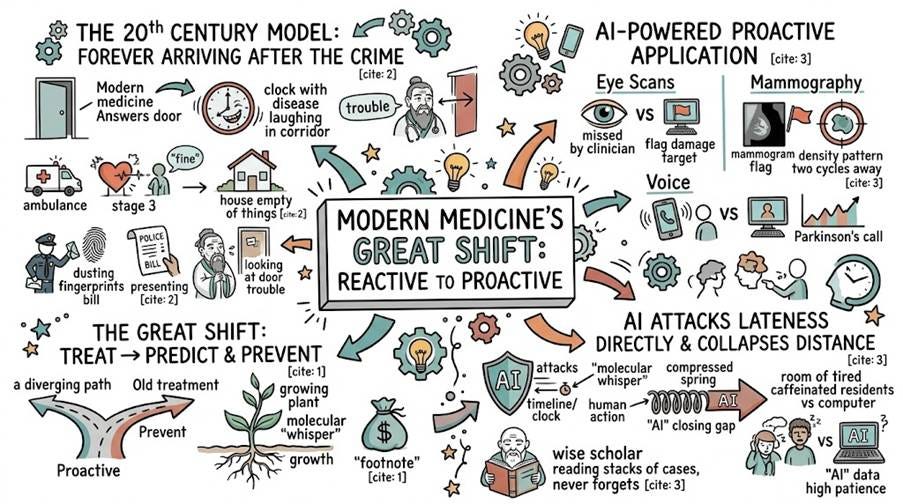
Confucius observed that a man who does not think ahead will find trouble at his door. Modern medicine built its entire career answering the door.
The twentieth century’s healthcare system was reactive by design, by habit, and — one suspects — by billing preference. Symptoms appeared, patients presented, diagnoses were delivered, and the disease had already been running the clock for years, laughing quietly in the corridor. Cancer is caught at stage three because stage one felt fine. Heart disease arrives by ambulance. Dementia is named only after the thief has emptied several rooms and moved on to the silverware. Medicine’s great tragedy has never been a shortage of cures. It has been a structural, almost constitutional lateness — the profession forever arriving after the crime, dusting for fingerprints, charging for the visit.
Artificial intelligence attacks that lateness directly, and with considerably less sentimentality than the brochures suggest. It does not invent new organs or negotiate with mortality. What it does — with the tireless patience of a scholar who has read every case file ever written and forgotten none of them — is collapse the distance between the first molecular whisper of disease and the moment a human being can act. A model trained on millions of retinal scans sees diabetic damage a clinician would wave through for years. A mammography algorithm flags the density pattern that becomes a tumour two screening cycles from now. A voice model hears the Parkinson’s in a phone call the patient has not yet thought to mention. This is not magic. It is pattern recognition performed at a scale and patience no roomful of exhausted residents — however gifted, however caffeinated — could ever match.
The Master said: to know what you know and know what you do not know — that is knowledge. The algorithm, it turns out, reads the body the way the Master read a room.
The economic consequence is large and under-appreciated. Preventive spending is cheap. Late-stage rescue is ruinous. The most expensive patient in any system arrives at the emergency room as a full catastrophe when a forty-dollar blood panel a decade earlier would have rewritten the story entirely. Move the intervention forward in time and you do not merely save a life — you delete a cost. Multiply that deletion across a billion ageing citizens and you are no longer discussing medicine. You are discussing the single largest efficiency dividend available to the modern state.
One clarification, because the word prevention has been so abused by supplement salesmen and cold-shower evangelists that the serious reader flinches at its arrival. This is not describing lifestyle homily. This is describing a mechanical capability that did not exist five years ago — detecting the specific molecular signature of a specific disease in a specific individual, early enough and cheaply enough to matter, at a scale that reaches ordinary people rather than only the expensively monitored. The novelty is not the aspiration. Hippocrates had the aspiration. The novelty is that the aspiration has finally acquired an engine.
As the sage wisely did not add: the superior physician sees the illness coming. The inferior one sees only the bill. Until now, only the inferior one was right.
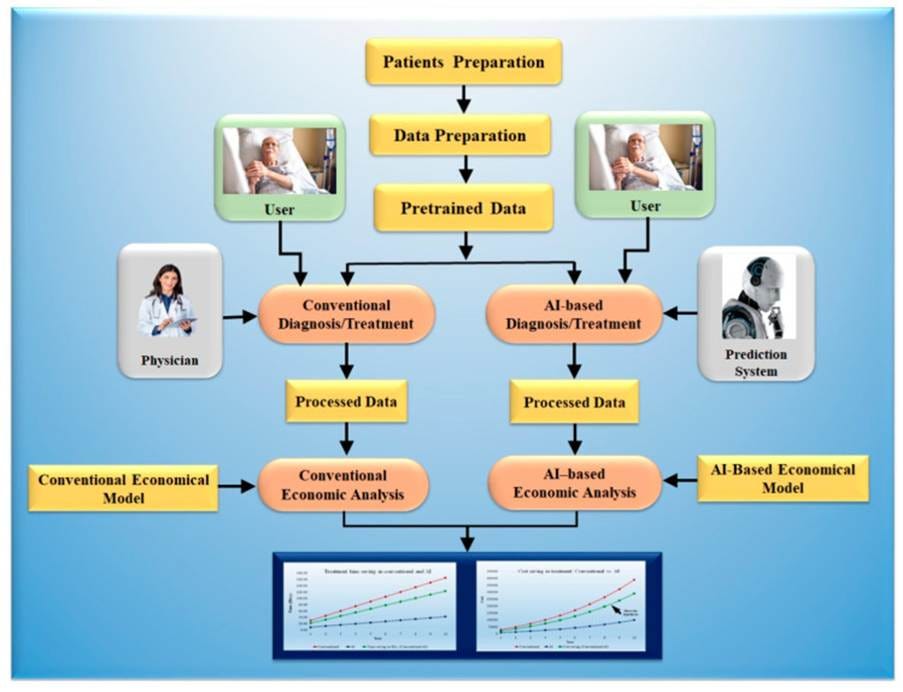
https://pmc.ncbi.nlm.nih.gov/articles/PMC9777836/
The reason this inversion is only possible now is unglamorous, which is fitting — the most important things usually are. The reason is data. A single hospital stay produces a torrent: vital signs by the second, imaging files by the gigabyte, genomic sequences running to three billion base pairs, lab panels, pharmacy records, and the endless telemetry of a body wired to machines like a anxious houseplant. A genome alone is three billion letters. No clinician reads three billion letters over morning coffee. Most are lucky to read their emails.
The cruel paradox was this: medicine accumulated more information than at any point in its history while remaining, at the actual bedside, starved of insight. The signal existed. It was buried under a mountain of its own making. A radiologist reading a hundred scans a day cannot hold the subtle prior that reframes today’s image. A GP with nine minutes per patient cannot cross-reference a new symptom against a decade of records and ten thousand recent papers. The knowledge was there. The bandwidth was not. The library had everything; the librarian had nine minutes.
Artificial intelligence is, at its honest best, not a replacement for medical judgement — it is a solution to a bandwidth crisis. It ingests the deluge and returns the two or three things that actually matter for this patient, today. The machine does not tire at scan ninety-nine. It does not forget the 2019 footnote. It does not have a difficult morning and wave something through. It reads everything, remembers everything, and — crucially — never mistakes exhaustion for certainty.
The hard truth: the machine is only as good as the data it eats, and healthcare data is notoriously fragmented, inconsistent, locked in...
Read more and discover how to trade it here: https://themacrobutler.substack.com/p/code-is-the-new-cure
Visit The Macro Butler Website here: https://themacrobutler.com/
Join The Macro Butler on Telegram here : https://t.me/TheMacroButlerSubstack
Register your interest to The Macro Butler World Economic Summit 2026 here:
https://themacrobutler.substack.com/p/the-macro-butler-world-economic-s…
You can contact The Macro Butler at info@themacrobutler.com

Disclaimer
The content provided in this newsletter is for general information purposes only. No information, materials, services, and other content provided in this post constitute solicitation, recommendation, endorsement or any financial, investment, or other advice.
Seek independent professional consultation in the form of legal, financial, and fiscal advice before making any investment decisions.
Always perform your own due diligence