War And Memory

War And Memory
The week handed us both halves of that title. From the Persian Gulf: fresh attacks on tankers in the Strait of Hormuz, revoked Iranian oil-sales waivers, and crude back above $75. From memory: a record Samsung quarter that got sold anyway, another round of contract-price hikes, and—by Friday—the largest U.S. listing ever by a foreign company, as SK Hynix's $26.5 billion ADR offering priced at $149 and opened at $170.
In between, the tape compressed a full cycle into five sessions: a record Dow close Monday, a global chip rout Tuesday, an oil spike Wednesday, a semiconductor-led rebound Thursday, and a quiet Friday grind higher that left the S&P 500 above where the whole episode started—with Meta logging its best week since early 2024 and Nvidia up 4% into the close.
So how do you trade a week like that? Same answer as always: watch the evidence, not the headlines, and stick with your process.
Sold The News
Monday opened with SemiAnalysis floating another bearish AI-hardware note—this one claiming Nvidia's Kyber architecture could slip by up to a year. Nvidia's response: "Our roadmap is intact." The market sided with Nvidia, and the Dow closed at a record above 53,000.
Then Samsung estimated a nearly 19-fold increase in Q2 operating profit—and chip stocks sold off around the world, with the KOSPI falling hard enough to trigger circuit breakers. When a record quarter gets sold that hard, the problem is expectations and positioning, not demand.
That's a tradeable distinction. Volatility spiked in exactly the names where the fundamentals kept improving, so Tuesday's alert harvested it: three bullish, defined-risk options trades on AI-hardware names—in AI networking, AI compute, and storage—each entered at a net credit. When the FUD does the pricing, you can get paid to take the other side.
🚨 Harvesting The AI Whipsaw 🚨
— Portfolio Armor (@PortfolioArmor) July 7, 2026
Taking advantage of the FUD and volatility. https://t.co/AZUnA2MQz3
Oil Piled On
Wednesday brought the war half of the title: tanker attacks in the Strait of Hormuz and the U.S. revoking Iran's oil-sales waivers sent crude up more than 6%, with Brent back above $75. Energy and defensives caught a bid while the Nasdaq fell 1.2%. The market had spent three weeks pricing the ceasefire as a peace; this week it repriced it as a ceasefire.
Chaotic tapes reward extra discipline, so Wednesday's alert added a new screen to our process: bullish trade candidates now also have to be trading above their 50-day exponential moving average. A stock can look "not overbought" simply because it has fallen hard and paused; the 50-day EMA check keeps us from catching those knives. Wednesday's two trades sat on opposite ends of our barbell: a high-convexity micro-cap in RF components and Open RAN, and an AI-infrastructure name.
🚨 AI Infrastructure And Open RAN 🚨
— Portfolio Armor (@PortfolioArmor) July 8, 2026
Bullish options bets on two names that pass our tighter technical screens to avoid falling knives. https://t.co/aPt9cLmKg1
The Demand Data Went One Way
While the tape whipsawed, the evidence kept stacking up on the same side. Penguin Solutions reported record revenue, up 48%, raised guidance, and tied both directly to AI-driven demand for memory and infrastructure; the stock jumped more than 25%. TrendForce reported memory makers have notified customers of another round of Q3 contract-price hikes. And SK Hynix's U.S. ADR offering was reportedly more than seven times oversubscribed. We covered all three in More Evidence The AI Boom Has Legs.
🐧 More Evidence The AI Boom Has Legs 🐧
— Portfolio Armor (@PortfolioArmor) July 9, 2026
Penguin Systems sells into the physical layer of the AI buildout. $PENG
Its blockbuster quarter shows that the demand is real.https://t.co/CwGfLuTDq2
By Thursday, semis were leading the market again, with Micron up 4.5% and oil falling back. Thursday's alert took three swings at the AI stack, spanning market caps from micro to large: enterprise AI and data-center hardware, RF components, and advanced semiconductor packaging and test. When the morning orders didn't fill into the rally, we adjusted rather than chased—same strikes, updated pricing—and the enterprise-AI trade filled at a net credit later in the day.
🚨 Three Swings At The AI Stack 🚨
— Portfolio Armor (@PortfolioArmor) July 9, 2026
Bullish options bets on three layers of the AI stack, spanning market caps from micro to large. https://t.co/eNKettZiwQ
Hands Up
Thursday afternoon, the CEO of humanoid robotics company 1X posted a demo of his robot's new tendon-driven hands—25 degrees of freedom, "nearing or surpassing human-level dexterity"—and it ran up millions of views overnight. His framing was the interesting part: for seventy years, robotics worked around the hand problem. The humanoid bet is the reverse—it lives or dies at the fingertips. And dexterous hands are an actuator-density story: every finger joint needs a tiny motor, a drive, a sensor, and precision control.
Introducing NEO’s 25 Degrees of Freedom, tendon-driven hands — nearing or surpassing human-level dexterity, strength, speed, and reliability.
— Bernt Bornich (@BerntBornich) July 9, 2026
For seventy years, robotics worked around the hand problem. The humanoid bet is the reverse: it lives or dies at the fingertips. pic.twitter.com/Dz1KMykUCy
Friday morning, that theme came to us through our process: a precision-motion company in exactly that space hit our technical buy zone, reclaiming a key moving average in the premarket. It led Friday's alert, alongside two more names from the chip whipsaw—a foundry and a packaging-and-test house.
🚨 Hands Up 🚨
— Portfolio Armor (@PortfolioArmor) July 10, 2026
Humanoid dexterity meets our screens. Plus, two more bullish bets on the AI-hardware supply chain.https://t.co/D75p7lZQEs
Then the closing bell on the week's memory thesis: SK Hynix's ADRs opened 14% above their offering price and held the gain. Wars remind markets that physical supply matters. Memory is where the AI buildout's economics keep showing up first.
Exits: Thirteen For Thirteen
We had thirteen full or partial trade exits this week—all winners (our losing options exits tend to collect on OpEx days, because winners tend to trigger our pre-set exit orders before expiration; July OpEx is next Friday).
Stocks or Exchange Traded Products
Shares of Sivers Semiconductors (SIVEF). Bought for $2.24 on 4/15/2026; sold half for $6.75 on 5/14/2026; sold one-third of the remaining shares for $7.61 on 5/28/2026; sold the remaining shares for $4.20 on 7/8/2026. Profit: 170%. Signal: Market Watchers.
Options
Put spread on Cemex (CX 0.40%↑). Entered at a net credit of $0.47 as part of a 4-leg hybrid combo on 2/24/2026; exited at a net debit of $0.12 on 7/10/2026. Profit: 74% on premium collected (23% on max risk). Signal: PA Top Names.
Put spread on BlackBerry (BB -3.79%↓). Entered at a net credit of $0.61 as part of a 3-leg combo on 5/20/2026; exited at a net debit of $0.12 on 7/6/2026. Profit: 80% on premium collected (55% on max risk). Signal: Market Watchers.
Call calendar on uniQure (QURE -4.16%↓). Entered at a net debit of $5.57 as part of a 4-leg hybrid combo on 6/5/2026; exited at a net credit of $10.00 on 7/8/2026. Profit: 80%. Signal: Multibaggers.
Put spread on Ovintiv (OVV 0.25%↑). Entered at a net credit of $1.14 as part of a 4-leg hybrid combo on 4/16/2026; exited at a net debit of $0.20 on 7/7/2026. Profit: 82% on premium collected (24% on max risk). Signal: Chartmill.
Put spread on Calumet (CLMT 1.36%↑). Entered at a net credit of $1.08 as part of a 4-leg hybrid combo on 5/1/2026; exited at a net debit of $0.20 on 7/10/2026. Profit: 81% on premium collected (22% on max risk). Signal: PA Top Names.
Short call on Fluence Energy (FLNC -3.68%↓). Sold-to-open for $2.45 as part of a 4-leg hybrid combo on 6/12/2026; bought-to-close for $0.20 on 7/8/2026. Profit: 92% on premium collected. Signal: Market Watchers.
Put spread on Bioventus (BVS -4.89%↓). Entered at a net credit of $1.71 as part of a 4-leg hybrid combo on 3/18/2026; exited at a net debit of $0.20 on 7/6/2026. Profit: 88% on premium collected (191% on max risk). Signal: Chartmill.
Short call on AstraZeneca (AZN -2.22%↓). Sold-to-open the September 18th, 2026 $230 call for $5.14 as part of a 4-leg hybrid combo on 4/16/2026; bought-to-close that call for $0.20 on 7/10/2026. Profit: 96% on premium collected. Signal: PA Top Names.
4-leg hybrid combo on Twist Bioscience (TWST -3.33%↓). Entered at a net debit of $2.25 on 2/27/2026; exited the July 17, 2026 $45/$40 put spread at a net debit of $0.20 on 6/4/2026; exited the October 16, 2026 $57.50 / short July 17, 2026 $65 call calendar at a net credit of $10.00 on 7/6/2026. Profit: 336% on premium outlay (104% on max risk). Signal: Multibaggers.
4-leg hybrid combo on GlobalFoundries (GFS 1.40%↑). Entered at a net debit of $2.40 on 3/3/2026; exited the July 17, 2026 $45/$40 put spread at a net debit of $0.20 on 5/5/2026; exited the call calendar at a net credit of $13.50 on 7/9/2026. Profit: 454% on net debit (147% on max risk). Signal: Multibaggers.
4-leg hybrid combo on Moderna (MRNA -10.72%↓). Entered at a net debit of $1.15 on 4/7/2026; exited the July 17, 2026 $42/$37 put spread at a net debit of $0.20 on 6/17/2026; exited the call calendar at a net credit of $7.00 on 7/10/2026. Profit: 491% on net debit (92% on max risk). Signal: PA Top Names.
3-leg combo on Opera (OPRA -1.84%↓). Entered at a net debit of $0.75 on 12/1/2025; exited the April 17, 2026 $12.50/$10 put spread at a net credit of $0.15 on 2/27/2026; sold half of the July 17, 2026 $15 calls for $4.50 on 5/4/2026; sold the remaining half for $5.40 on 7/6/2026. Profit: 580% on premium outlay (134% on max risk). Signal: Chartmill
The one worth walking through is Moderna, because it shows the arithmetic of our hybrid structures cleanly. We entered the 4-leg combo in April for a $1.15 net debit. In June, we exited the put spread for $0.20. This week, with the stock through both call strikes, we sold the call calendar—both call legs together—for a $7.00 net credit. Total profit: 491% on the net debit, or 92% on max risk. Three other exits this week came from the same maneuver, on uniQure, Twist Bioscience, and GlobalFoundries—the last two at 336% and 454% on their entry costs.
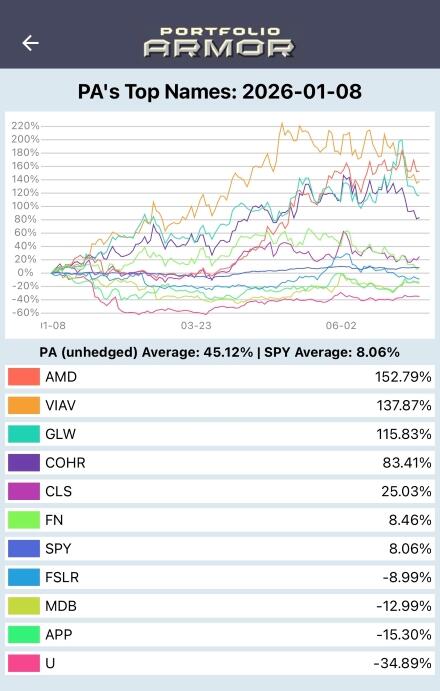
That's the pattern we're trying to repeat: let the short legs finance the position, harvest them when they decay, and leave the long side room to work. It's also why our weekly Top Names remain the first place we look for candidates: the January 8th cohort just finished its six months up 45.12%, versus 8.06% for SPY.
Process Over Prediction
War headlines. A record quarter sold hard. A record listing bought hard. A market still deciding who captures the AI buildout's economics.
We don't need to predict which headline hits next. We need a process that can handle them: stay bullish where the thesis is intact, tighten the screens when the tape demands it, use option structures to lower cost and define risk, harvest premium when it decays, and give the winners room to run.
If you'd like a heads up in real time when we place our next trades, you can subscribe to our trading Substack/occasional email list below.
And if you're scared and want to hedge, we're here for you for that too.