





All Roads Lead to The Empire's Last Pothole
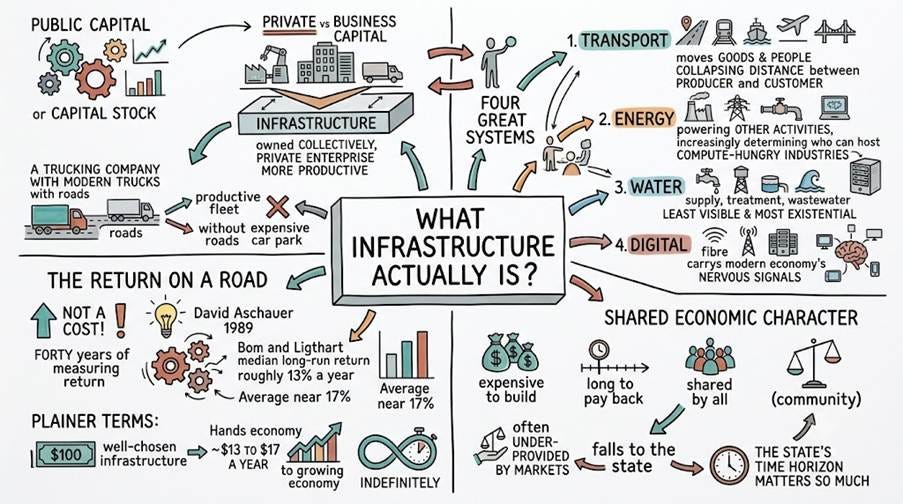
What the ancients called the root; the moderns call infrastructure — the common capital that lies beneath all private labour. As a house cannot stand without its foundation, so no enterprise prospers alone: the merchant may own the finest cart, yet without the road he owns only a burden. Roads and rails to carry, grids and pipes to nourish, canals and cables to bind the realm together — these are costly to raise, slow to repay, and shared by all, and for this reason the market neglects them as a man neglects the well until the day of his thirst; the duty of provision therefore falls to the state, and with it the harder duty of patience. Yet to build is not to spend but to plant.

Were infrastructure a mere expense, the frugal ruler would starve it and rest easy. But it is not an expense — it is among the most generous of investments, which is precisely why its neglect costs so dearly. Scholars have argued for decades over the precise measure of its yield, yet none dispute its direction: it gives more than it takes. The careful reckonings of recent study place the long-run return near thirteen parts in a hundred each year, and by some measures nearer seventeen — a hundred coins laid in the road returning thirteen to seventeen coins, year upon year, without end. Such is the nature of the root: tend it once, and it feeds the tree forever.
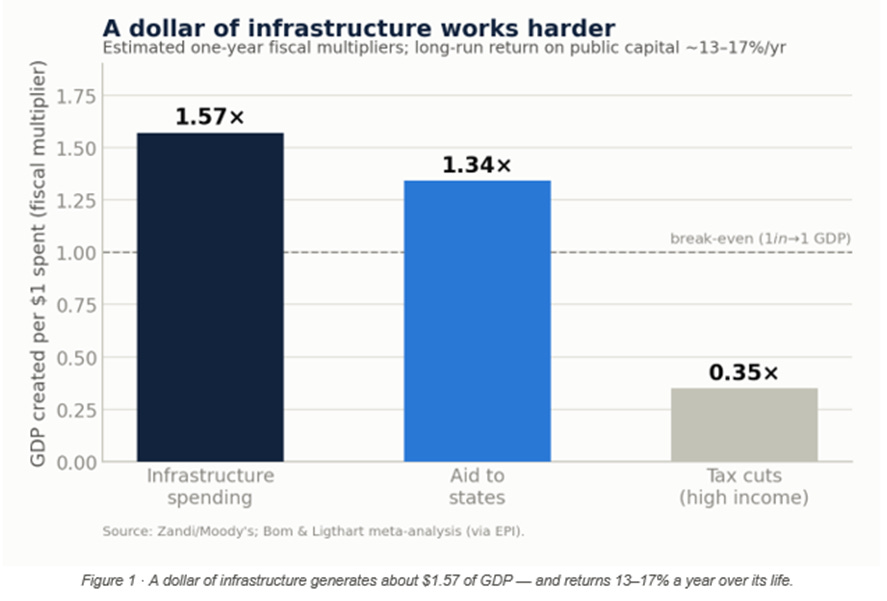
The short-run arithmetic is just as favourable. Moody’s Mark Zandi estimated the fiscal multiplier on infrastructure spending at roughly 1.57 — every dollar of it generating about a dollar and a half of GDP — comfortably ahead of aid to states and multiples of the return on high-income tax cuts. This is the crucial asymmetry the rest of this letter turns on: the money spent building is recouped many times over, and the money not spent is not saved. It is merely converted into a slower, less visible, and ultimately larger bill.

No people have grasped so completely as Rome that power is not merely willed but built — that dominion, to endure, must first be poured into matter. We remember the legions, but the sword is only power’s argument; the road was its premise. Rome governed the known world not because it commanded more men than its rivals, but because it had collapsed the distance between will and world — between the order given in the capital and its execution at the frontier. Empire, Rome understood before it could articulate the thought, is a problem of motion disguised as a problem of loyalty.
The scale of this understanding still humbles the mind: a network exceeding 400,000 kilometres, of which some 80,500 were stone laid upon foundation, cambered against the rain, built with the strange humility of things made to outlast their makers. Twenty-nine great roads reached outward from the centre like reasons from a first principle; 372 lesser ones bound 113 provinces into a single argument for order. The Via Appia, begun in 312 BC, was the first sentence of that argument. And in 20 BC, Augustus raised in the Forum a gilded stone — the Milliarium Aureum — from which every distance in the empire was thereafter measured, as though the world itself required a fixed point from which to be understood. It is no accident that the phrase survives: all roads lead to Rome. A civilisation had made itself the centre not by declaring it, but by building the geometry that made it true.
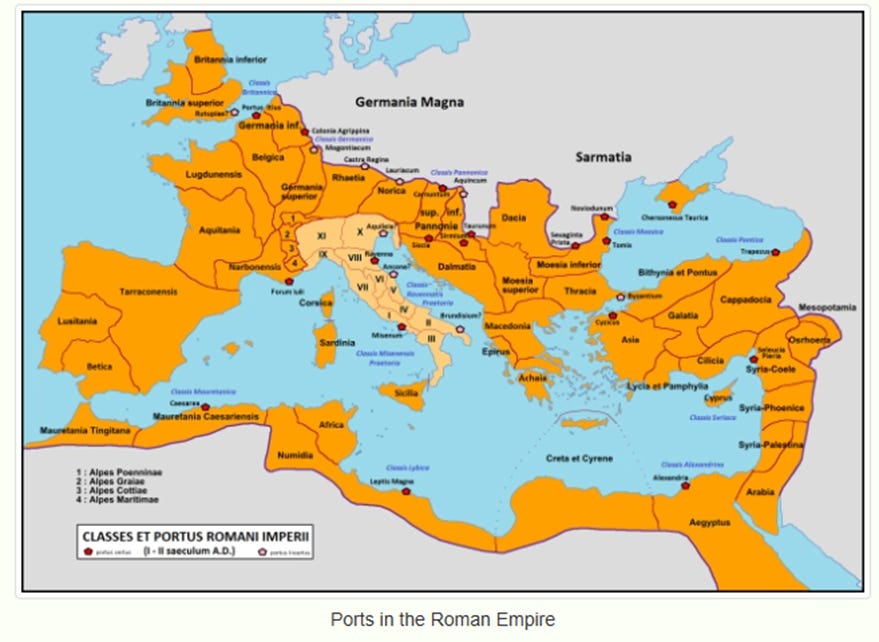
https://factsanddetails.com/world/cat56/sub408/item2053.html
The roads were, as one historian put it, “thoroughly military in aim and spirit” — ancient air superiority, minus the air. But their real genius was bureaucratic: the same pavement that marched the legions out hauled the wine and marble back, got a governor’s memo to Rome before it went stale, and let the taxman find you no matter which of three continents you were hiding on. The aqueducts did for cities what the roads did for the empire — mainly, allow a million people to live somewhere without everyone dying of thirst or each other’s sewage. Rome didn’t dominate the ancient world despite its infrastructure budget. The infrastructure budget was the empire; the togas were just merchandising.
Here’s the bit finance ministers should read twice, ideally out loud, to themselves, in a mirror. The roads didn’t vanish when Rome declined — nobody torched the Appian Way in a fit of pique. They just quietly stopped getting fixed, because potholes are the one budget line nobody notices being cut until, decades later, an army can’t get through one. Whether the empire crumbled and then the roads did, or the other way round, is a chicken-and-egg question with an unusually well-documented chicken. Rome didn’t fall and then let its roads decay. It let its roads decay, and then, with...
Read more and discover how to trade it here: https://themacrobutler.substack.com/p/all-roads-lead-to-the-empires-last
Visit The Macro Butler Website here: https://themacrobutler.com/
Join The Macro Butler on Telegram here : https://t.me/TheMacroButlerSubstack
Register your interest to The Macro Butler World Economic Summit 2026 here:
https://themacrobutler.substack.com/p/the-macro-butler-world-economic-s…
You can contact The Macro Butler at info@themacrobutler.com

Disclaimer
The content provided in this newsletter is for general information purposes only. No information, materials, services, and other content provided in this post constitute solicitation, recommendation, endorsement or any financial, investment, or other advice.
Seek independent professional consultation in the form of legal, financial, and fiscal advice before making any investment decisions.
Always perform your own due diligence.