





Before the Barrel
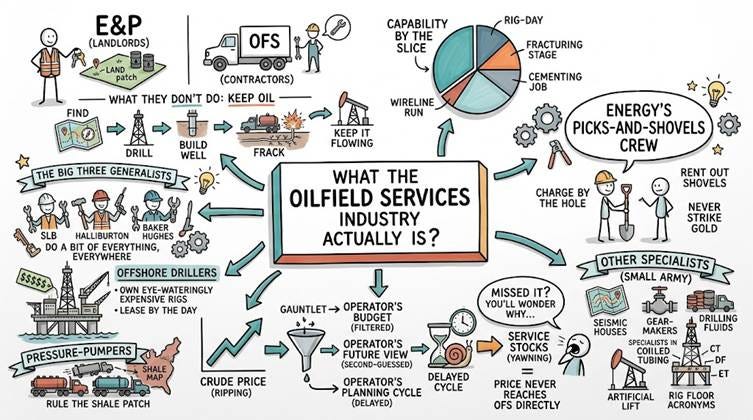
If the exploration-and-production (E&P) companies are the landlords of the oil patch — they own the dirt, the reserves and the barrels — then the oilfield services (OFS) industry is the contractor, the tool-rental yard and the guys who actually show up in the trucks. Service firms find the oil, drill for it, build the well, frack it and keep it flowing for years. What they don’t do is keep the oil. They sell capability by the slice: a rig-day here, a fracturing stage there, a cementing job, a wireline run. Think of them as energy’s picks-and-shovels crew — never striking gold themselves, just renting out the shovels and charging by the hole.
That one distinction explains almost everything. An E&P company gets paid when a barrel sells; a service company gets paid for showing up and doing the job. So, the oil price never reaches OFS directly — it has to survive a gauntlet first: filtered through the operator’s budget, second-guessed by the operator’s view of the future, and delayed by the operator’s famously unhurried planning cycle. Grasp that relay race and you understand the sector; miss it, and you’ll keep wondering why service stocks yawn while crude rips.
The cast list is sprawling: the Big Three generalists (SLB, Halliburton, Baker Hughes) who do a bit of everything, everywhere; the offshore drillers who own eye-wateringly expensive rigs and lease them by the day; the pressure-pumpers who rule the shale patch; plus seismic houses, gear-makers and a small army of specialists in coiled tubing, drilling fluids, artificial lift and every other acronym on the rig floor.
What ties this circus together is one shared nerve: they all live and die by their customers’ drilling budgets. When operators green-light more wells, everybody sells more — more rig-days, more horsepower, more sand — and because the cost base barely moves in the short run, that extra revenue lands on the bottom line with a very satisfying thud. When operators slam the brakes, the same math runs in reverse, only faster and with more crying. It’s a capital-intensive, feast-or-famine business whose cycles make roller coasters look like gentle suggestions — glorious on the way up, stomach-dropping on the way down.
The service industry was born the day drilling got too complicated for one stubborn wildcatter and a lot of optimism. When the Spindletop gusher blew in on the Texas coast in 1901 — spraying oil for nine days before anyone could cap it — it launched the petroleum age and, almost immediately, a second business: selling the tools, pipe and know-how to do it again on purpose. From then on, the oil world had two tribes: the people who owned the oil, and the people who sold them the shovels.
In 1909, Howard Hughes Sr. patented the roller-cone bit that could actually chew through hard rock, collected the royalties, and — fun fact — bankrolled a dynasty of movies and aviation on the proceeds. In 1919, Erle P. Halliburton started pumping cement down wells to glue the casing to the rock, turning well-building from a dark art into a service you could invoice. And in 1927 the Schlumberger brothers dangled an electrical probe down a hole in France and read the rock like an X-ray. Drill bit, cement, measurement — the entire modern industry was sketched out before anyone had a television.
The post-war boom put the sector on steroids. Commercial hydraulic fracturing arrived in 1949, proving you could engineer a reservoir’s output rather than just pray for it. As the easy onshore barrels dried up, the industry waded into the water — the Gulf of Mexico, then the North Sea — and invented the offshore drilling contractor: a company that owns a spectacularly expensive rig and rents it out by the day, like a yacht that occasionally strikes oil. Then the 1973 and 1979 oil shocks sent prices vertical, money poured in, and everyone had a wonderful time.

Naturally, it ended in tears. Oil collapsed in the mid-1980s, the U.S. rig count fell by roughly three-quarters, drilling contractors went bankrupt in batches, and a whole generation of rigs was scrapped or mothballed. The survivors did what survivors do — they merged. This is the crucible that forged the giants: Schlumberger swallowing specialists, Halliburton eventually pairing with Dresser, and Baker International joining Hughes Tool in 1987 to become Baker Hughes.
From the 1990s, operators quietly outsourced their brains to the service companies, which became the real keepers of drilling technology — directional and horizontal drilling, measurement-while-drilling, rotary steerable systems, 3-D seismic. The big bang came in 2000s North America, when horizontal drilling married multi-stage fracking and the two of them unlocked shale, turning the U.S. into the world’s largest oil and gas producer. And shale is a service company’s dream: a shale well isn’t so much discovered as manufactured, out of pipe, cement, sand, water and horsepower — nearly all of it supplied by, you guessed it, the service crew.
The latest chapter is about discipline, mostly learned the hard way. The 2014–16 crash and the 2020 pandemic shock did enormous damage, forced yet more consolidation (regulators blocked a Halliburton–Baker Hughes merger in 2016), and nudged the survivors toward spending restraint, digitalisation and side hustles in geothermal, carbon capture and electrification. Schlumberger even rebranded to the sleeker “SLB” in 2022. But strip away the makeover and the business is exactly what it was a century ago: sell activity, and live or die by the customer’s budget.
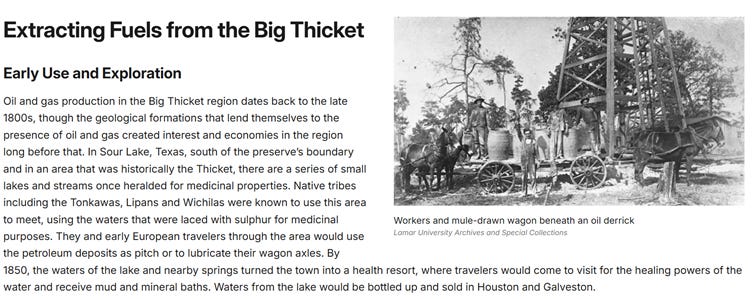
https://www.nps.gov/bith/learn/historyculture/oil-gas-industry.htm
A well isn’t a single heroic act — it’s a to-do list, and the OFS industry is just the specialists who each own one line of it. The chain runs from taking a photo of rock nobody has ever seen, to drilling and building the hole, to giving it a chemical pep talk, and finally to babysitting it for the next few decades. Every link has its own economics, its own rivals, and its own moment in the cycle when the phone starts ringing.
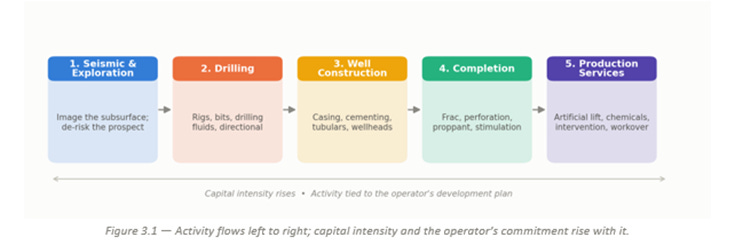
Before anyone buries a dollar’s worth of steel, they’d quite like to know what’s down there. Seismic services thump acoustic energy into the ground and listen for the echoes, building 2-D, 3-D and eventually 4-D pictures of rock no human will ever see — using vibrator trucks on land or streamer-towing ships at sea, then a lot of computers to turn the noise into a map. It’s the most exploration-driven corner of the business, which is a polite way of saying it’s the first budget operators axe when they get nervous and the last, they restore when they cheer up. Pure-play seismic has historically been one of the loneliest jobs in the patch.
Target chosen, time to make a hole. Drilling services cover the rig itself (owned by contractors, rented by the day) plus everything that makes it work: bits, drilling “mud” that lubricates and keeps downhole pressure in check, and the directional and measurement-while-drilling gear that can steer a wellbore two miles down and several miles sideways to hit a target the size of a room. The day-rate is the most-watched price in the whole industry, swinging with every shift in rig supply and demand — and offshore, where a top-tier drillship can bill several hundred thousand dollars a day, the swings will give you vertigo.
Drilling makes a hole; construction makes a well. Steel casing goes in and gets cemented to the rock to wall off geological zones, protect the drinking water and give the well a spine. This is the world of casing and tubing, cementing crews and pumps, wellheads, and — offshore — the subsea trees and blowout preventers perched on top to keep everything under control. It’s also where reputations live or die: when a well ends up on the evening news, it’s almost always a failure of construction or...
Read more and discover how to trade it here: https://themacrobutler.substack.com/p/before-the-barrel
Visit The Macro Butler Website here: https://themacrobutler.com/
Join The Macro Butler on Telegram here : https://t.me/TheMacroButlerSubstack
Register your interest to The Macro Butler World Economic Summit 2026 here:
https://themacrobutler.substack.com/p/the-macro-butler-world-economic-s…
You can contact The Macro Butler at info@themacrobutler.com

Disclaimer
The content provided in this newsletter is for general information purposes only. No information, materials, services, and other content provided in this post constitute solicitation, recommendation, endorsement or any financial, investment, or other advice.
Seek independent professional consultation in the form of legal, financial, and fiscal advice before making any investment decisions.
Always perform your own due diligence.