





THE REAL BULL...
Everyone claims to know a bull market when they see one. Far fewer can say precisely what one is, what actually causes it, or how to tell a durable trend apart from a noisy bounce.
A bull market is a price that keeps rising, shrugging off the occasional face-plant along the way. You’ve heard the shorthand — “up 20% from the lows” — but that’s a symptom, not a diagnosis. A 20% pop inside a long decline isn’t a bull market; it’s a dead cat with good hang-time. The real thing has structure and stubbornness: higher highs, higher lows, month after month, with buyers happily paying up every time the sellers try to slam the door.
It also helps to say which bull you mean. “The market” isn’t one animal — stocks, bonds, oil, metals and gold each run their own cycle, and they rarely agree on anything. Gold can be throwing a party while equities stare at the wall and oil quietly files for bankruptcy. So, whenever someone says, “the bull market,” ask them: which one, and versus what?
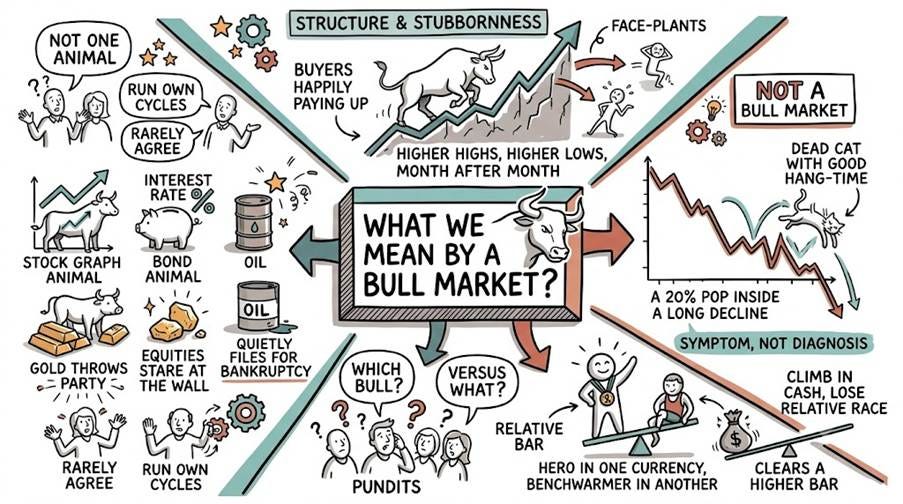
That “versus what?” is the bit most pundits skip — and it’s exactly where the real work hides. An asset can look like a hero in one currency and a benchwarmer in another or climb in cash terms while quietly losing a race to every rival. A genuine bull market clears a higher bar: it has to look good no matter how you slice it.

Bull markets aren’t just random noise that happened to wander uphill. They leave fingerprints and spotting them is most of the job. The biggest tell is the shape of the trend itself.
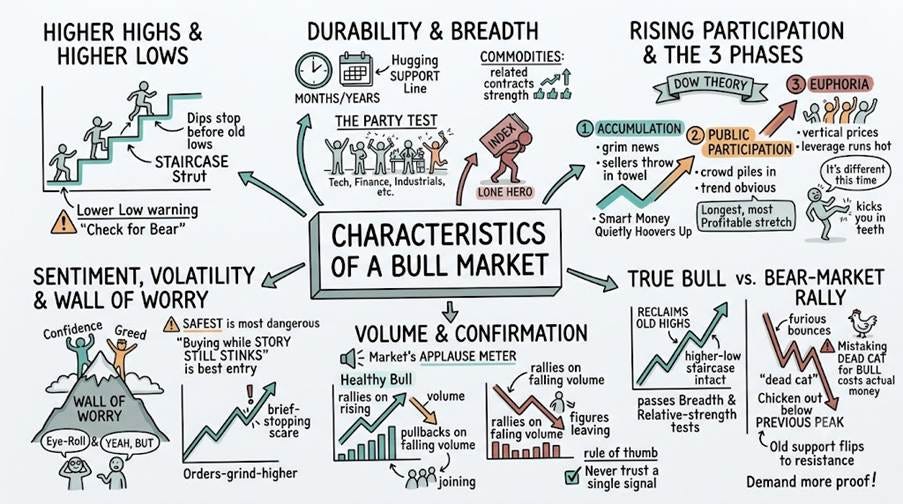
Picture a staircase, not a ramp. Prices climb, stop to catch their breath, dip a little — then charge off again to a new peak, while each dip refuses to sink as low as the last one. That’s the signature strut of a bull market: onward and upward, with the occasional dramatic sigh. As long as the staircase keeps rising, the bull is alive and well. The moment it starts building steps that go down — a lower low that actually sticks — that’s your cue to check whether the bull has quietly wandered off to become a bear.
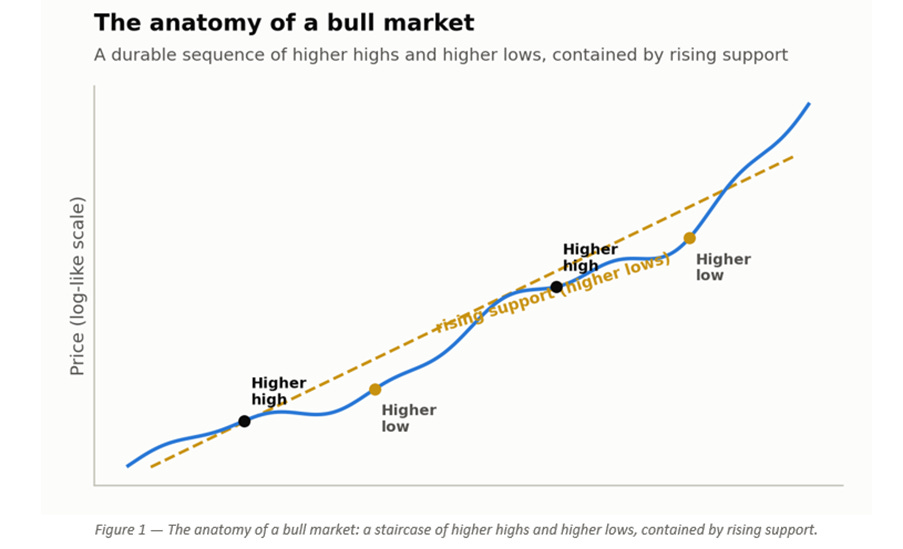
Bull markets run on a calendar of months and years, not a stopwatch. A one-week moonshot that fizzles by Friday means nothing; a trend that’s hugged its rising support line for eighteen months is making a speech. Then there’s breadth — the party test. In a healthy stock bull market, everyone’s invited: most sectors, most names, not just four mega-caps carrying the whole index on their backs. In commodities, it shows up as strength rippling across related contracts. When the crowd thins out and a lone hero is doing all the heavy lifting while everything around it sags, the bull is starting to feel its age.
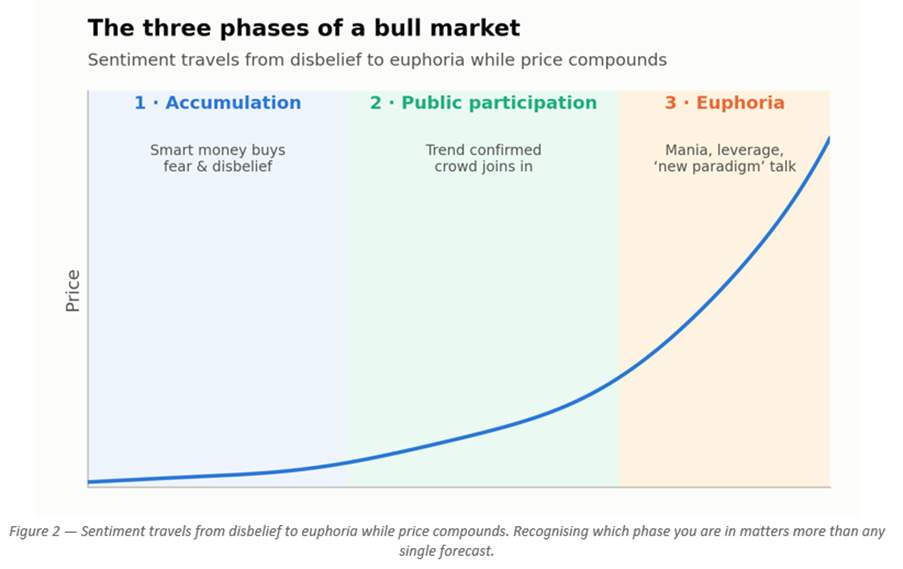
Old-school market lore, courtesy of Dow Theory, splits a bull market into three phases — and it endures because it describes people, not decades. First comes accumulation: the news is grim, everyone’s fed up, and the smart money quietly hoovers up shares from sellers who’ve thrown in the towel. Next is public participation: the trend gets obvious, the fundamentals actually show up, and the wider crowd piles in — the longest, most profitable stretch, and the one everyone wishes they’d caught earlier. Finally, euphoria: prices go vertical, leverage runs hot, and the crowd insists “it’s different this time.” It feels fantastic. It’s also where the bull kicks you in the teeth.
Bull markets love to “climb a wall of worry“ — and the worry is the whole point. Early on, nobody believes it: every rally is met with an eyeroll and a “yeah, but.” That’s actually the good news, because it means most people are still sitting on the sidelines with cash to eventually throw in. A healthy bull tends to grind higher in polite, orderly steps, occasionally interrupted by a heart-stopping scare that’s over before you’ve finished panicking. Only late in the game does the eye-rolling turn to confidence, and confidence to full-blown greed. The cruel joke: the moment everything feels safest is usually the most dangerous, and the entry that makes your stomach churn — buying while the story still stinks — is usually the best one.
One last thing worth eyeballing: volume, the market’s applause meter. In a healthy bull, the crowd shows up loudly to buy and slips out quietly during the dips — rallies on rising volume, pullbacks on falling volume. When that flips late in the trend — rallies on a whisper, sell-offs on a roar — it’s a hint the conviction is leaking out. Volume never runs the show by itself, but it’s a handy backup singer, telling a well-supported climb apart from one wheezing along on fumes. The rule of thumb: never trust a single signal on its own — make several of them agree before you believe the story.
The priciest mistake in the business is mistaking a bear-market rally for the real thing. Downtrends don’t slide politely downhill; they’re punctuated by furious bounces that claw back a chunk of the losses and feel, in the moment, exactly like sunrise. Spoiler: it’s a false dawn. A bear-market rally usually chickens out below the previous peak, stalls right where old support has flipped into resistance, and — the giveaway — only looks good through one lens: maybe strong in the local currency but not confirmed across currencies and not beating other assets. A genuine bull does the opposite: it reclaims old highs, keeps its higher-low staircase intact on the dips, and passes the breadth and relative-strength tests all at once. When in doubt, demand more proof, not less. Waiting a bit costs you a sliver of upside; mistaking a dead cat for a bull costs you actual money.
If the characteristics tell you what a bull market looks like, the causes tell you why it bothered to show up — and knowing the drivers helps you guess whether it’s here for a long weekend or a long stay. No single force pulls this off alone; bull markets are usually a group
The heavyweight champion of bull-market drivers is capital chasing the best expected return. Money is relentlessly comparison-shopping: it piles into wherever it thinks it’ll be treated best and abandons whatever looks stingy. So, when the expected return on cash and bonds gets crushed — central banks cut rates, yields sag, safe stuff stops paying — capital goes hunting for a better deal, and its flows lift whatever it lands on. For hard assets there’s a twist: what matters is the real expected return — what’s left after inflation takes its cut. When cash quietly loses purchasing power, a lump of metal that pays no interest suddenly wins the beauty contest by simply not losing, and the flows rotate toward gold. Falling real expected returns on everything else have long been gold’s favourite kind of weather.
Beneath the money tide sit the plain old fundamentals. For stocks it’s earnings; for oil it’s how much gets pumped versus burned; for gold it’s central banks stocking up, and investors wanting in. A bull market with staying power usually has a real supply-and-demand story holding it up — supply getting tighter, demand grinding higher, or both at once. And when solid fundamentals show up at the same party as easy money, the two get along famously and the drinks are on the house.
Markets are just people in a trench coat, and people move in herds. Once a trend gets going, nerves settle, cash pours in, and rising prices lure in even more buyers — a feedback loop that can carry a bull market way past what the fundamentals alone would ever sign off on. Don’t sneer at momentum; it’s a real, stubborn feature of markets, and it’s why trends run longer than every clever sceptic swears they can. The catch: the same herd instinct that powers the climb is exactly what turns the eventual exit into a stampede.
One more cause earns its own spotlight because it fools the most people: the currency the asset is priced in. A big chunk of what looks like a roaring bull market is sometimes just the measuring stick shrinking — the denominator falling, not the...
Read more and discover how to trade it here: https://themacrobutler.substack.com/p/the-real-bull
Visit The Macro Butler Website here: https://themacrobutler.com/
Join The Macro Butler on Telegram here : https://t.me/TheMacroButlerSubstack
Register your interest to The Macro Butler World Economic Summit 2026 here:
https://themacrobutler.substack.com/p/the-macro-butler-world-economic-s…
You can contact The Macro Butler at info@themacrobutler.com

Disclaimer
The content provided in this newsletter is for general information purposes only. No information, materials, services, and other content provided in this post constitute solicitation, recommendation, endorsement or any financial, investment, or other advice.
Seek independent professional consultation in the form of legal, financial, and fiscal advice before making any investment decisions.
Always perform your own due diligence.