





AI Profits Meet 4.7% Yields

The AI Spending Question Changed
Thursday’s 2.8% Nasdaq rally broke the worst stretch of the current momentum unwind. Microsoft had its best session since 2008 after its results showed AI spending driving cloud growth and operating profit. Semiconductors and other AI-stack names recovered part of Wednesday’s losses.
Amazon added another confirmation after the close. As we noted in Thursday’s Top Names post, AWS revenue rose 37% year over year—its fastest growth in 18 quarters—and Amazon’s AI and chips businesses each passed a $25 billion annual revenue run rate. On Friday, Amazon shares jumped 15.3% after profit more than tripled from a year earlier.
The market’s question has shifted from whether AI demand exists to which companies can turn the spending into adequate returns—and how much investors should pay for that proof.
A Rally With A Bond-Market Problem
Friday showed how selective that judgment remains. Apple fell 7.4% despite beating profit expectations after its revenue-growth outlook disappointed and management cited an AI-driven component squeeze. Micron swung from a 6.4% gain to a 6.5% loss before finishing down 5.9%.
The inflation constraint didn’t disappear. Brent crude rose 1.2% to $87.93, and the 10-year Treasury yield climbed to 4.71% from 4.68% on Thursday. That left the market trying to capitalize future AI profits at a higher discount rate while energy and shipping costs remained exposed to the war with Iran.
The S&P 500 still gained 0.7% Friday, the Dow added 0.5%, and the Nasdaq rose 1%. For the week, those indexes gained 1%, 1%, and 1.6%, respectively. Korea’s Kospi delivered the most violent rebound, surging 17.9% Friday after its memory leaders were crushed earlier in the week—but it still lost 22% in July.
Friday’s rebound left plenty of damage beneath the surface. Nine of the ten names in our latest rankings have direct exposure to semiconductors, memory, chip testing, optical networking, AI compute, or robotics. The physical buildout remains the strongest theme in our system. The week also reinforced the lesson from our hedged AI comparison: leverage, liquidity, and position size can overwhelm a sound thesis.
How We Traded It
Monday: In A Winner Returns, A Rally Fails, our bearish premium-consumer-brand trade filled. A proposed re-entry in a previous biotech winner didn’t.
🚨A Winner Returns, A Rally Fails
— Portfolio Armor (@PortfolioArmor) July 27, 2026
A bullish re-entry in a previous biotech winner, plus a bearish options bet on a premium consumer brand.https://t.co/igUJCOjltQ
Tuesday: Buying Catalysts, Selling A Rally produced two fills: a bullish commercial gene-therapy trade and a bearish earnings structure tied to residential construction. We repriced the previous bullish re-entry, but the second order didn’t fill either.
🚨 A Biotech Binary And An Earnings Short
— Portfolio Armor (@PortfolioArmor) July 29, 2026
A bullish Phase 3 bet and a bearish earnings trade in an AI software market leader.https://t.co/3PfGaVYhHb
Wednesday: In Wednesday’s alert, our bullish Phase 3 biotech trade and bearish AI-software earnings structure both filled. Our AI Recovery screens had produced no names the night before, so we kept dry powder for more specific catalysts.
Thursday: Before The Recovery Signal was a calculated exception on an AI optical bottleneck we’d traded successfully twice before. The stock ran away from our short-dated order, and a longer-dated replacement didn’t fill either. We didn’t chase either structure.
Friday: Earnings and a new long-term supply agreement materially improved one setup. In Paying More For Stronger Evidence, we entered a longer-dated AI-bottleneck hybrid below our limit and re-entered a former silicon-photonics winner below our maximum price.
🚨Paying More For Stronger Evidence
— Portfolio Armor (@PortfolioArmor) July 31, 2026
A second swing at an AI bottleneck, plus a photonics reentry.https://t.co/VdU1DpePuz
That gave us seven fills and four unfilled or canceled structures. We’d pay more after the evidence improved; we wouldn’t abandon our limits simply to be in the market.
Exits
Entries are only half the process. Friday’s Exits post recorded ten partial options exits: nine winners and one defined loss.
The $15/$12 Lightwave Logic put spread reached its full defined loss after the short put was assigned and the long put was exercised. The long call from the original combo remains open. By contrast, the SiteOne bearish put diagonal returned 31% after the company missed earnings and the shares fell sharply; its short call spread remains open.
Together, those exits show why we manage multi-leg trades one piece at a time. We defined the downside before entry, monetized a fast directional move, and kept the remaining optionality where the thesis still had room to work.
Stocks or Exchange Traded Products
None.
Options
Put spread on Lightwave Logic (LWLG 2.06%↑). Entered at a net credit of $1.60 as part of a 3-leg combo on 5/13/2026; exercised and assigned on 7/30/2026. Loss: 100% of max risk (88% on premium collected). Signal: Market Watchers.
Put diagonal on SiteOne Landscape Supply (SITE 0.25%↑). Entered the August 21st/September 18th, 2026 $95/$100 put diagonal for a $3.83 net debit as part of a 4-leg inverted hybrid combo on 7/28/2026; exited the diagonal for a $5.00 net credit on 7/29/2026. Profit: 31%. Signal: Bearish Rally Failure.
Short calls on Knowles (KN -1.48%↓). Sold-to-open the September 18th, 2026 $50 call for $1.46 as part of a 4-leg hybrid combo on 6/26/2026; bought-to-close for $0.20 on 7/28/2026. Profit: 86% on premium collected. Signal: Market Watchers.
Short calls on United Microelectronics (UMC -4.10%↓). Sold-to-open the October 16th, 2026 $37 call for $1.55 as part of a 4-leg hybrid combo on 7/10/2026; bought-to-close for $0.20 on 7/28/2026. Profit: 87% on premium collected. Signal: Market Watchers.
Short calls on CPS Technologies (CPSH -6.10%↓). Sold-to-open three October 16th, 2026 $15 calls for $1.72 as part of a 4-leg hybrid combo on 6/11/2026; bought-to-close for $0.20 on 7/27/2026. Profit: 88% on premium collected. Signal: Multibaggers.
Put spread on Cogent Biosciences (COGT -5.37%↓). Entered at a net credit of $1.91 as part of a 4-leg hybrid combo on 4/27/2026; exited at a $0.20 net debit on 7/31/2026. Profit: 90% on premium collected. Signal: Market Watchers.
Short calls on Spire Global ( SPIR -2.92%↓). Sold-to-open the October 16th, 2026 $28 call for $2.51 as part of a 4-le hybrid combo on 5/19/2026; bought-to-close that call for $0.20 on 7/28/2026. Profit: 92% on premium collected. Signal: Market Watchers.
Short calls on Bitdeer Technologies (BTDR -7.40%↓). Sold-to-open two September 18th, 2026 $25 calls for $2.55 as part of a 4-leg hybrid combo on 6/18/2026; bought-to-close those calls for $0.20 on 7/27/2026. Profit: 92% on premium collected. Signal: Market Watchers.
Short calls on Viavi Solutions (VIAV -2.33%↓). Sold-to-open the September 18th, 2026 $70 call for $4.34 as part of a 4-leg hybrid combo on 5/19/2026; bought-to-close that call for $0.20 on 7/29/2026. Profit: 95% on premium collected. Signal: Market Watchers.
Short calls on Applied Digital (APLD -9.61%↓). Sold-to-open the October 16th, 2026 $65 call for $5.10 as part of a 4-leg hybrid combo on 6/4/2026; bought-to-close that call for $0.20 on 7/29/2026. Profit: 96% on premium collected. Signal: Market Watchers.
Evidence Before Exposure
The AI buildout finished the week with stronger operating evidence than it began with. The tape stayed violent, oil and yields remained restrictive, and the market rewarded only some participants.
We separated thesis from entry. We took defined-risk trades where catalysts and payoff geometry lined up, left orders unfilled when the market moved beyond our limits, and returned to a former winner only after earnings materially improved the evidence.
When another recovery candidate clears our screens and offers an attractive defined-risk structure, paid subscribers will get the trade alert. You can follow our entries, adjustments, and exits on The Portfolio Armor Substack and define your downside on stocks and ETFs with the Portfolio Armor web app.
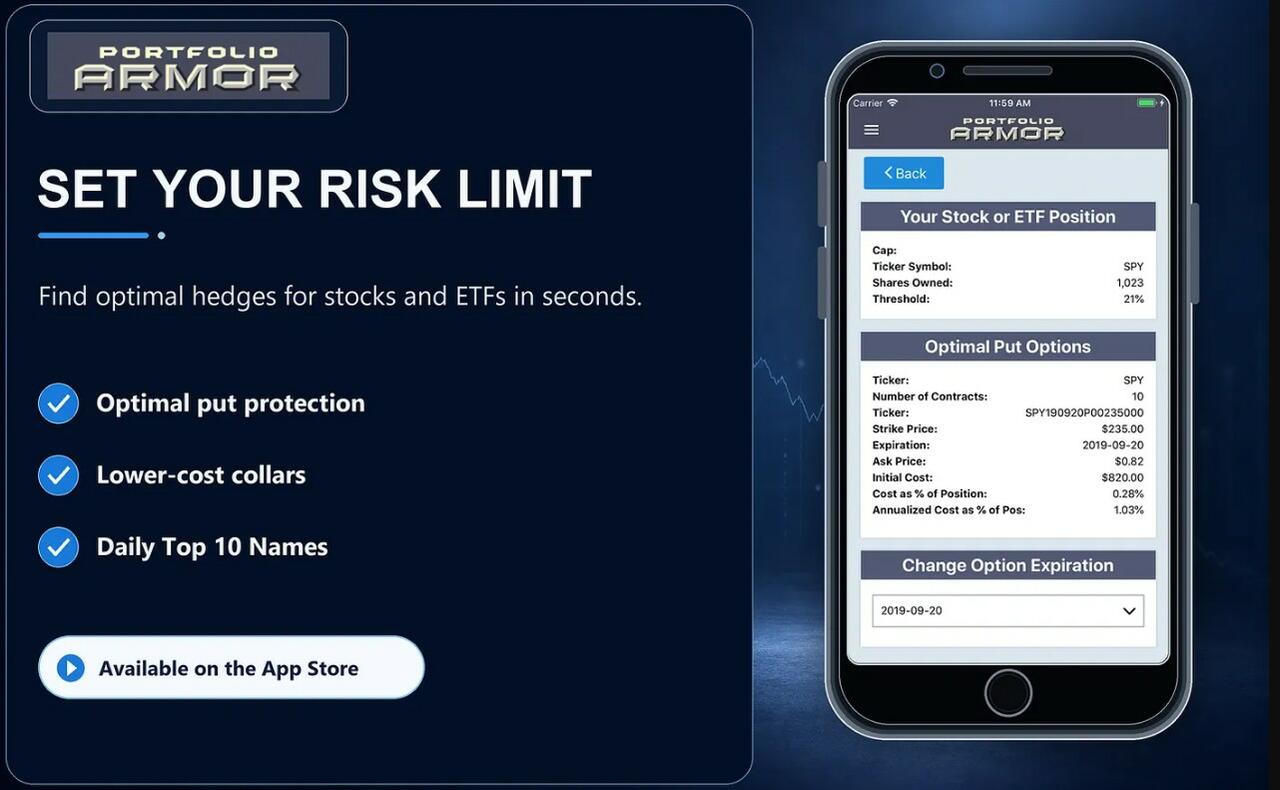
If you just want to hedge individual securities, you can use the iPhone app.
And if you are a trader, you can subscribe to our trading blog below.