





Continues here


What is Really Going on With the Yen?
Contents
- Japan’s Yen Defense Faces a Credibility Test
- A More Forceful Intervention
- The Carry Trade Comes Under Pressure
- Markets Continue to Test Tokyo
- The Bank of Japan Remains Central
- Questions Over the BOJ’s Resolve
Japan’s Yen Defense Faces a Credibility Test
Authored by GoldFix
Japan’s latest intervention to support the yen carried more force than previous efforts, producing a sharp reversal in the currency and attracting unusual assistance from the United States. Bloomberg Opinion’s John Authers argues that the episode could have broader consequences for global markets, particularly for investors who have borrowed cheaply in yen to finance positions in higher-yielding currencies. However, intervention by the Japanese Ministry of Finance may still prove insufficient without a clearer shift in policy from the Bank of Japan.
A More Forceful Intervention
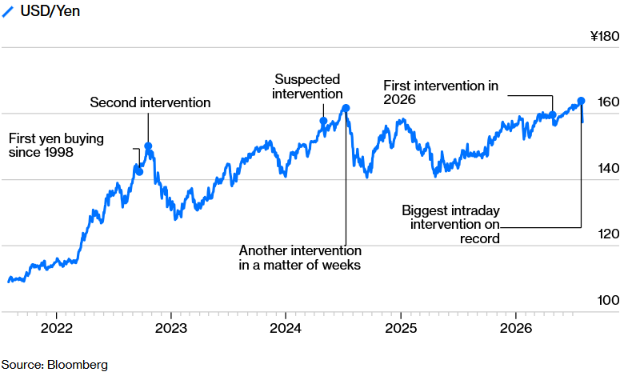
Japan’s Ministry of Finance has repeatedly intervened in currency markets during the past four years as the yen weakened toward levels not seen in four decades. Those operations have generally failed to produce a lasting change in direction. Since its first yen-buying operation in September 2022, the ministry has spent at least $255 billion attempting to support the currency, excluding the amount used in the latest intervention.
The most recent action appeared more significant. The intervention pushed the yen to its strongest level since May, while the estimated $52.8 billion spent on July 31 would represent the largest single-day currency intervention in Japan’s history. Authers says the timing and scale of the operation suggest that officials have increased their determination to prevent further depreciation.
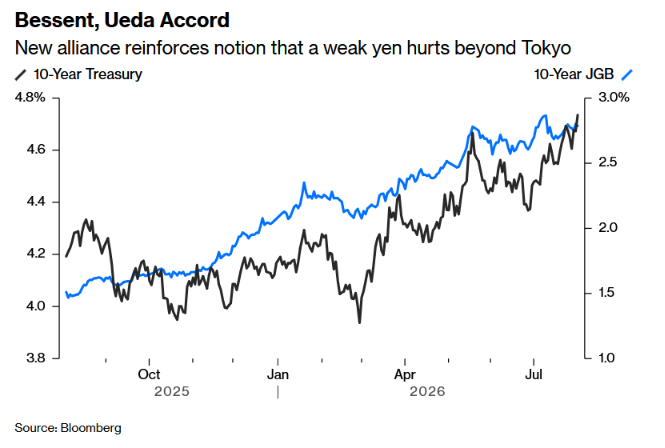
The operation also received support from Washington. US Treasury Secretary Scott Bessent appeared to back Japan’s efforts, with American authorities reportedly conducting rate checks and selling euros to purchase yen. Mizuho Bank’s Masayuki Nakajima said the involvement could reflect growing US concern that further yen weakness, or greater instability in Japan’s bond market, might eventually spill into the US Treasury market.
The Carry Trade Comes Under Pressure
The intervention matters beyond Japan because the yen has long been a major funding currency for the global carry trade. Investors borrow yen at relatively low interest rates and use the proceeds to purchase assets or currencies offering higher yields, including the Mexican peso. According to Authers, this strategy has been an unusually reliable source of returns and has strongly outperformed the total return of the S&P 500 during the past five years.
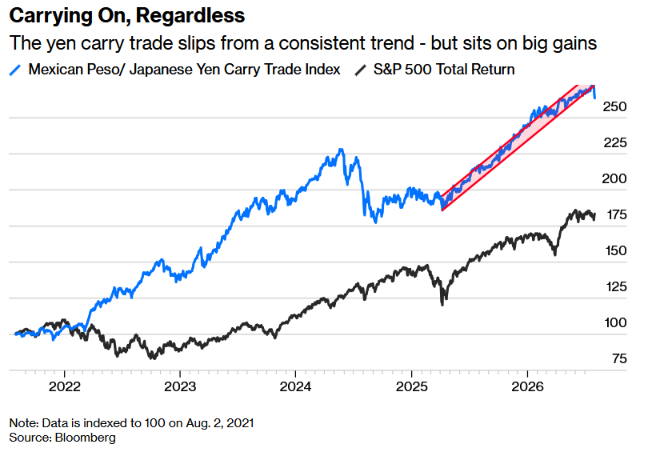
A sustained rise in the yen could force investors to reverse those trades. Traders who borrowed in yen would need to sell their higher-yielding holdings and repurchase the Japanese currency, potentially accelerating its appreciation and creating losses across other markets. A similar unwind contributed to significant market disruption two years ago.
The latest intervention has already interrupted what had been a remarkably steady advance in the carry trade. While the move has not yet developed into a broader liquidation, it demonstrates how quickly a stronger yen can threaten positions that depend on continued currency weakness.
Free Posts To Your Mailbox
Contributor posts published on Zero Hedge do not necessarily represent the views and opinions of Zero Hedge, and are not selected, edited or screened by Zero Hedge editors.
Loading...