





When The House Of Debt Falls
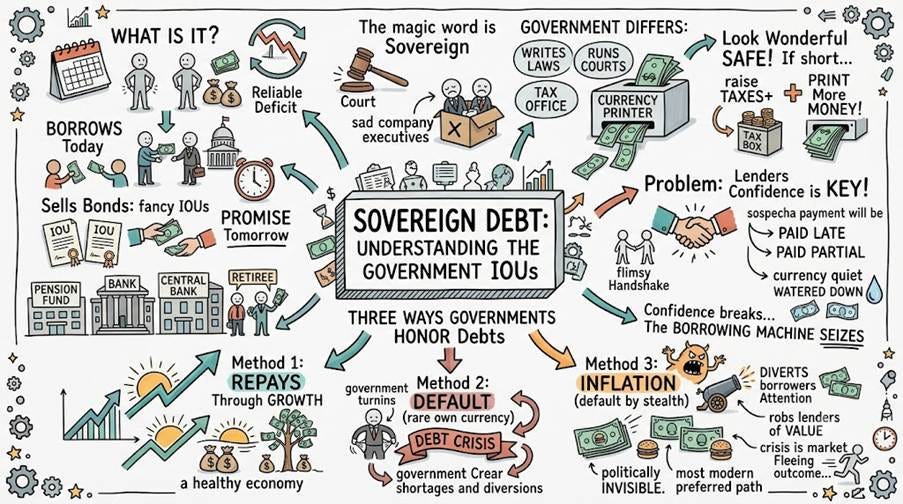
Sovereign debt is just a government borrowing money because it spent more than it collected — which, let’s be honest, describes almost every government, every year, with the reliability of a hangover. To cover the gap, it sells bonds: fancy IOUs promising to pay you back later, with a little interest for your patience. Pension funds, banks, central banks, and retirees all line up to hand over cash today for a promise about tomorrow. What could possibly go wrong?
The magic word is “sovereign.” A company that can’t pay gets hauled into bankruptcy court, stripped for parts, its executives escorted out with a sad cardboard box. A government can’t. It writes the laws, runs the courts, commands the tax office, and — crucially — owns the currency printer. That’s what made government debt look so wonderfully safe: if it runs short, it can raise your taxes, and if that fails, it can simply print more of the stuff it owes you. Unbeatable, really.
Which is exactly the problem. Since no court can force a government to pay, the whole arrangement rests on something flimsier than a contract: confidence. Lenders play along as long as they believe they’ll be repaid in money that’s still worth something. But the day they start to suspect they’ll be paid late, paid partially, or paid in currency quietly watered down to homeopathic strength — that’s the day the music stops, the borrowing machine seizes up, and everyone remembers that an IOU is only as good as the person who wrote it.
There are really only three ways a government can honour its debts, and understanding them is the key to everything that follows. The first is the honest way: it runs a healthy economy, collects rising tax revenue, and pays lenders back in sound money. This is repayment through genuine growth.
The second is default — the government simply refuses to pay in full, restructuring or writing down what it owes. This is what we normally call a debt crisis, and it is rare among large economies that borrow in their own currency, because a third option is almost always available first.
That third option is inflation — the government creates shortages and bombs its neighbours to divert the attention of its borrowers. It repays the bond in full, in nominal terms, but in currency that buys far less than it did. The lender is repaid the number written on the bond but robbed of its value. This is default by stealth, and it is the path most modern governments quietly prefer, because it is politically invisible in a way that an outright default never is. A crisis, when it comes, is usually the market’s attempt to price in which of these three outcomes is coming — and to flee before it arrives.
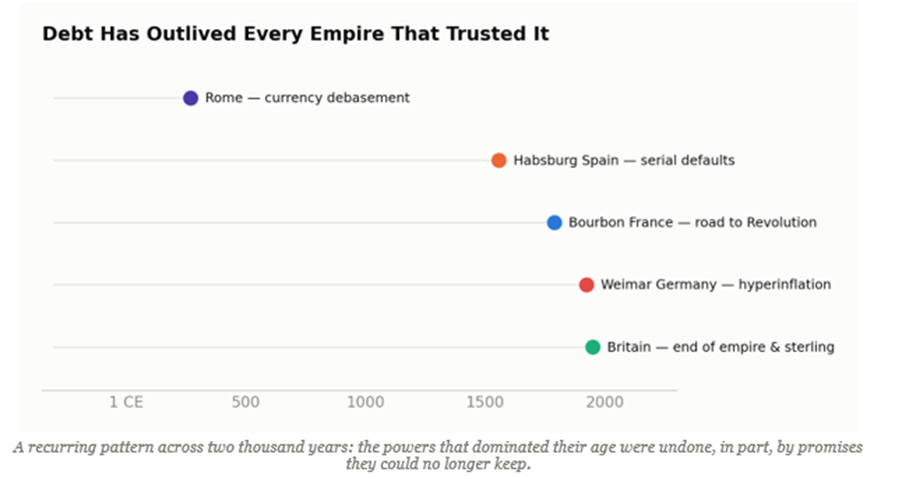
Sovereign debt crises feel like a modern invention — something cooked up by central bankers, spreadsheets, and men who say “quantitative easing” without laughing. They’re not. This particular disease is ancient. It’s buried every empire that was absolutely certain it was the exception — and they were all certain.

Rome didn’t sell bonds, but it had the classic problem: legions to pay, a bloated bureaucracy, and a capital full of citizens expecting free grain. Expenses up, revenue not so much. Rome’s clever fix was to quietly shave its currency. The silver denarius, nearly pure under Augustus, got clipped and cut so many times that by the third century it was basically a copper slug wearing a thin silver coat of paint. The result was one of history’s first great inflations: prices exploded, soldiers refused to be paid in shiny disappointment, and the trust holding the empire together evaporated. Debasement didn’t kill Rome by itself — but no empire outlives the moment people stop believing in its money.
Sixteenth-century Spain was the richest power in Europe, its vaults literally overflowing with New World silver. It also defaulted on its debts in 1557, 1560, 1575, 1596, and kept the streak alive well into the next century. The moral — and it’s one of the best in all of finance — is that no amount of income can outrun a spending problem. Spain’s fortune didn’t save it; it bankrolled exactly the endless holy wars that bankrupted it. The bankers who financed the party got wiped out too, and Spain’s golden century faded into a very long hangover.
No debt crisis has ever punched above its weight quite like eighteenth-century France’s. Decades of pricey wars — including, awkwardly, funding America’s revolution — left the crown spending over half its revenue just on interest. Reform was impossible, because the nobles who had money flatly refused to be taxed. Cornered, Louis XVI summoned the Estates-General in 1789 for the first time in 175 years, purely to scrounge up cash. That meeting turned into the French Revolution, the king turned into a cautionary tale via guillotine, and the revolutionaries who took over promptly printed their new currency, the assignat, straight into oblivion. Enter, eventually, a short man with big ambitions named Napoleon.
Buried under First World War reparations it couldn’t honestly pay, the Weimar Republic reached for the printing press with both hands. By late 1923 prices were doubling every few days, and Germans were hauling cash in wheelbarrows and burning banknotes for heat — the paper being worth more as kindling than as money. The middle class’s savings simply vanished, and the political fallout from a state that couldn’t protect its people’s money threads directly into the very dark decade that followed. Same recipe, again: couldn’t pay, wouldn’t default, printed instead — and the bill came due in something far worse than money.
Not every reckoning ends in guillotines or wheelbarrows. Britain came out of the Second World War victorious and quietly insolvent, its debt north of 250 per cent of output and its treasury on an American allowance. No drama, no default — just a slow, dignified decline: the empire wound down, the pound was devalued, sterling handed the reserve-currency crown to the dollar, and growth settled into a long shrug. It’s arguably the most useful case for today’s great powers, because it proves a debt crisis doesn’t have to be a bang. It can be a slow leak, narrated entirely in the soothing language of “adjustment” and “reform” — the kind of turning point historians only spot decades later, once everyone’s gone home.
It’s comforting to imagine a debt crisis as a tidy technical affair: a missed payment here, a downgrade there, a scary red line on a trading screen. But every one of those abstractions is really a fight over who goes without. The pensioner whose check gets frozen. The saver watching inflation quietly pick their pocket. The taxpayer asked to pay more for visibly less. The bondholder told to take forty cents and be grateful. The teacher, nurse, or soldier whose salary gets “reprioritized.” A debt crisis is, at bottom, a brawl over which of these people gets thrown overboard — and brawls like that have a nasty habit of climbing out of the finance ministry and into the street.
The usual road from debt to unrest is paved with austerity. A government that can no longer borrow freely — nudged either by its own math or by a bailout’s fine print — starts slashing spending and hiking taxes into an already sinking economy. Pensions trimmed, wages frozen, fuel and bread subsidies quietly withdrawn. To the bond market, this is “responsible fiscal adjustment.” To the citizen who suddenly can’t afford to heat the house or get to work, it’s a betrayal with a spreadsheet attached. The result is depressingly consistent: protests, strikes, and governments collapsing like folding chairs. Greece spent years in the streets after 2010 while its old political parties quietly imploded; the same script has run from Argentina to Sri Lanka, where a single subsidy cut was often just the match dropped on a very large pile of accumulated grievance.
Choose the printing press instead and the damage is quieter — at first — but no less corrosive. Inflation is the one tax that never went through a legislature, never appeared on a ballot, and never asked anyone’s permission. It hits hardest exactly the people least able to dodge it: those on fixed incomes, those whose pay checks trail prices, those whose modest savings sit politely in a bank account rather than in property or stocks. It quietly rewards debtors and mugs savers, pampers the asset-rich and fleeces the cash-poor. Bit by bit it dissolves the unspoken deal between a country and its people — the quaint idea that saving is smart and that money earned today will still buy something tomorrow. And when people stop believing that, they tend to stop believing a lot of other things too — which is precisely the sort of trust stable democracies are built on.

There’s also a darker link between going broke and going to war. A government staring down financial collapse and a furious public is a government with its back against the wall — and cornered governments have discovered, over and over, that nothing unites a squabbling population quite like a villain across the border. A war conveniently distracts from the mess at home, justifies emergency powers and a quiet pause on normal politics, and even doubles as economic “stimulus” a bankrupt treasury could never otherwise get away with. Financial historians have long noticed the grim rhyme between eras of monetary chaos and the outbreak of...
Read more and discover how to trade it here: https://themacrobutler.substack.com/p/when-the-house-of-debt-falls
Visit The Macro Butler Website here: https://themacrobutler.com/
Join The Macro Butler on Telegram here : https://t.me/TheMacroButlerSubstack
Register your interest to The Macro Butler World Economic Summit 2026 here:
https://themacrobutler.substack.com/p/the-macro-butler-world-economic-s…
You can contact The Macro Butler at info@themacrobutler.com

Disclaimer
The content provided in this newsletter is for general information purposes only. No information, materials, services, and other content provided in this post constitute solicitation, recommendation, endorsement or any financial, investment, or other advice.
Seek independent professional consultation in the form of legal, financial, and fiscal advice before making any investment decisions.
Always perform your own due diligence.