





Scandium: The Critical Metal Nobody’s Ever Heard Of, But Everyone Needs
Last week we covered the flurry of critical minerals deals the Trump administration announced at the mining roundtable. This week, let’s slow down and zoom in on just one of those metals, because scandium is a perfect case study in how something almost nobody has heard of turns into a genuine national security headache.
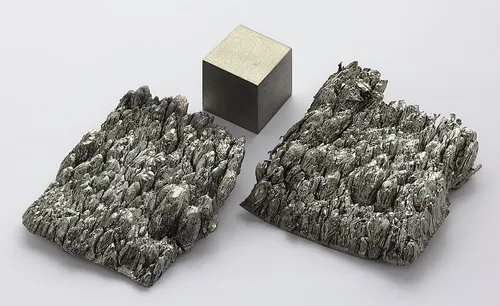
Scandium is element number 21 on the periodic table. It’s a soft, silvery white metal. It’s not technically a lanthanide at all. It sits in Group 3 right next to yttrium, and only gets lumped in with the 15 lanthanides as a “rare earth” because it behaves the same way chemically and shows up in the same ore deposits. Chemists call this classification by convention. For our purposes, it trades and gets regulated exactly like the rest of the rare earth family.
That classification matters a lot more than you’d think. In April 2025, China’s Ministry of Commerce placed export licensing requirements on seven rare earth elements as payback for President Trump’s tariffs: samarium, gadolinium, terbium, dysprosium, lutetium, yttrium, and scandium. China piled on five more elements that October. As of today, the original April restrictions on scandium have never been lifted. Every export still needs case by case approval out of Beijing.
So why does this matter?
Scandium’s whole appeal is what it does to aluminum. Added in small amounts, it produces an alloy that’s dramatically stronger, lighter, and more heat and corrosion resistant than standard aircraft-grade aluminum. Nothing else does this as well. That’s why scandium-aluminum alloys end up in fighter jets, hypersonic vehicles, and spacecraft, anywhere engineers are fighting for every gram of weight while the metal still has to survive brutal heat and stress.
There’s a second use case that’s growing fast: solid oxide fuel cells. Scandium-stabilized zirconia lowers the operating temperature of these fuel cell stacks and extends their working life. Bloom Energy (NYSE: BE), whose fuel cells are increasingly being deployed to power AI data centers on-site, says it’s the single largest consumer of scandium oxide in the world.
Put simply, with scandium you’ve got one metal sitting at the intersection of two of the biggest priorities in Washington right now: national defense and the AI buildout.
Here’s the problem: the market is tiny. Total global scandium production is only about 80 tonnes a year, according to the USGS. Copper, for comparison, runs over 22 million tonnes annually.
Scandium isn’t scarce because there isn’t any in the ground. It’s scarce because nobody mines it on purpose. It’s recovered as a byproduct of titanium dioxide processing, uranium mill tailings, and nickel laterite operations. That means global scandium supply gets decided by production choices made in completely different commodity markets.
That thin supply is exactly why pricing behaves the way it does. The Shanghai Metals Market benchmark sat at $3,333 per kilogram as of early August 2026, down from $3,748 the month before, but still multiples above where it traded before the April 2025 export controls hit. Because annual output is so small, a single multi-tonne aerospace or fuel cell contract can move spot prices 30% in a single quarter.
And demand keeps climbing. Forecasts have global scandium demand crossing 117 tonnes a year by 2026-2027, well ahead of current production. Market size estimates vary by research firm, ranging from roughly $600 million to just over $1 billion for 2026, with most projecting the market to roughly double or more by the early 2030s.
China’s grip on this market is hard to overstate. China’s share of global scandium supply is estimated anywhere from 66% to 90% depending on the source, with most estimates clustering around 80-85%. Same story we’ve walked through with every other critical mineral in this series. China doesn’t just produce the raw material. It controls the processing step that turns raw material into something usable. That’s the actual bottleneck. And unlike some of the other rare earths caught up in the April and October 2025 controls, scandium’s restrictions never got rolled back in the partial thaw after Trump and Xi met later that year. The licensing regime is still fully active today.
The West isn’t starting from zero here, though. A few projects are chipping away at this. Rio Tinto has been producing scandium oxide since 2022 at its Sorel-Tracy, Quebec facility, extracted as a byproduct of its existing titanium dioxide operations. Current nameplate capacity is 4 tonnes a year, and a C$25 million investment from the Canada Growth Fund is set to raise that to 9 tonnes. ElementUS Minerals landed a $29.9 million Department of Defense award in November 2025 to build out domestic gallium and scandium production. And Scandium Canada has been pushing its own aluminum-scandium alloy IP, filing a patent application in September 2025 to commercialize alloy technology on the downstream side of the business.
Even with these projects moving forward, none of it closes the gap between where supply sits today and where demand is headed. That’s exactly why Washington has been moving so fast on this one metal specifically.
Scandium checks every box for a genuinely critical mineral. No real substitute for what it does. A Chinese supply chain Beijing has already shown it’s willing to weaponize. Demand curves in defense and AI infrastructure that keep getting steeper. It’s a small market in dollar terms, but a metal this tightly held by one rival, with this little slack in the system, is exactly the kind of thing that turns into a real problem fast.
We will be detailing a small cap scandium company and four other critical minerals plays with close ties to the Trump administration’s agenda in a new Special Investment Report that will be going out shortly.
To reserve your copy, join our daily market commentary, Gains Pains & Capital to make sure your account is ready to go once we publish it late this week.
Graham Summers, MBA
Chief Market Stragtegist
Phoenix Capital Research