





The Shelter Aftershock
What’s behind the numbers?
After June’s much-celebrated “peace-driven disinflation,” the seventh CPI print of the year shuffled in like a nothingburger — +0.1% MoM, +3.4% YoY, bang in line with consensus, and about as thrilling as watching paint insist it’s still wet.
Energy delivered its second-best impression of a well-behaved houseguest, decelerating from +1.0% to a positively saintly +0.95% — its lowest reading since last March, back when a major energy chokepoint was helpfully weaponized. Food and core goods barely twitched from June, mustering all the dramatic tension of a stage crew rearranging the furniture in the dark while the audience, bless them, mistakes the intermission for the grand finale.
Which is exactly where we are: the interlude of Act Two of Inflation Wave Two — that cozy pause where the orchestra catches its breath, the conductor loosens his bow tie, and every commentator with a Bloomberg terminal rises to solemnly pronounce the concert over. It isn’t. Once the fertilizer shortages and the freshly re-energized energy shock finish their unhurried stroll through the supply chain and into the data, “temporary” — the most durable adjective in the English language — may finally be handed the early retirement it has spent the better part of four years dodging with genuinely Olympic agility.
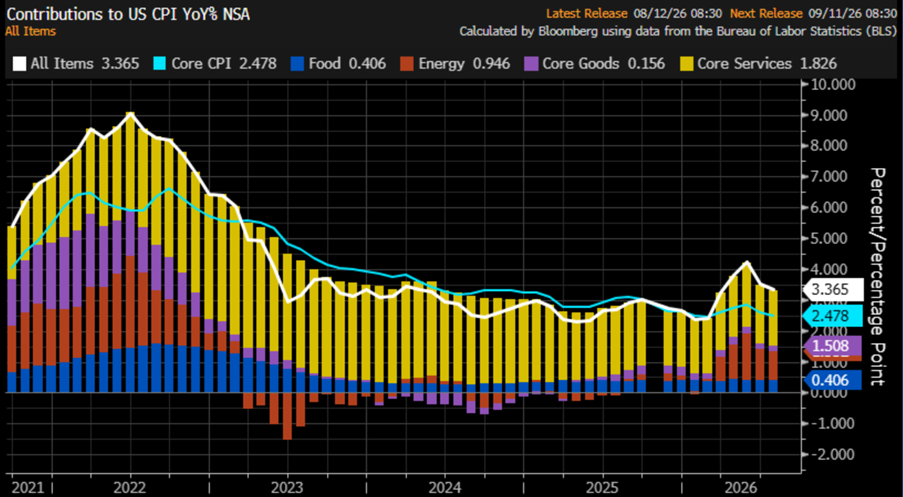
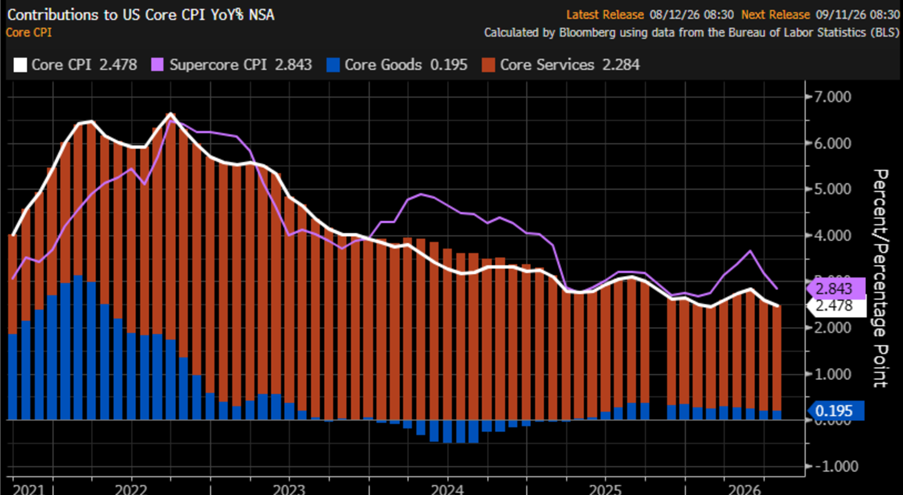
Core CPI served up another gripping episode of “nothing to see here“: +0.2% MoM and +2.5% YoY, once again precisely in line with forecast — because inflation persistence has apparently been quietly rebranded from “a problem” into “a heartwarming sign of economic resilience.” The real headliner stayed core services — that 76%-of-the-basket colossus policymakers have been solemnly promising is “normalizing” since roughly the Obama administration — which dutifully cooled to +2.28% from June’s +2.39%, its lowest since last February, and triggered the customary chorus of premature back-patting from anyone with a press release to file and a deadline to hit.
The official line is that everything remains perfectly manageable — and it is, so long as nobody commits the rookie blunder of asking what comes next. What the data is too polite to shout is that fertilizer shortages, energy spikes, and petrochemical supply-chain chaos simply haven’t shown up in the official numbers yet — and they are famously not early risers. They’ll turn up eventually, disheveled and unapologetic, long after the consensus has booked the soft-landing venue, ordered the cake, and printed the banner. So, take this statistical intermission for what it is: a brief, pleasant lull between acts — the kind where the crowd mistakes the hush for the encore — right before the second wave crashes through the narrative like an uninvited guest who read the soft-landing forecast, laughed out loud, and helped himself to the champagne.
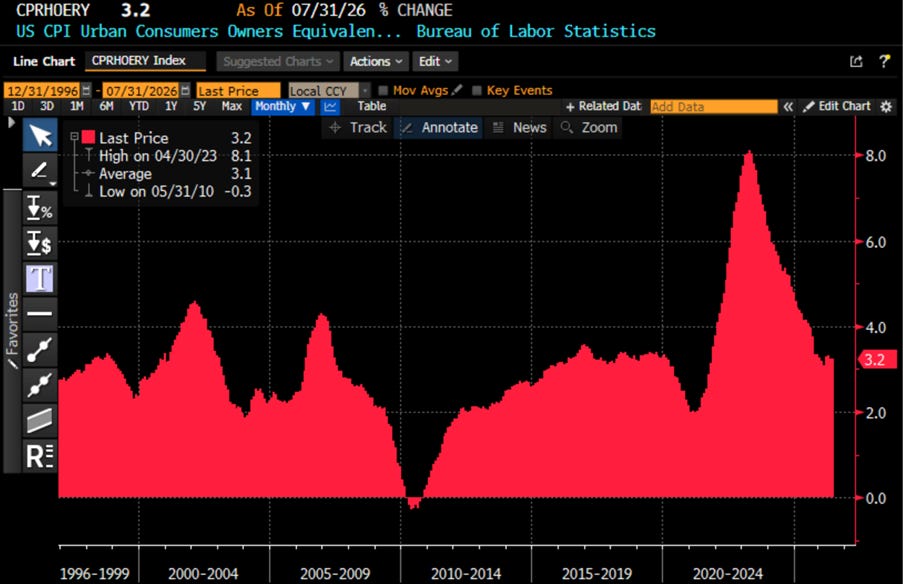
Cue the recurrent shadow of everyone’s favorite zombie metric: Owners’ Equivalent Rent — the number that measures the rent you would, in theory, charge yourself to live in the house you already own, computed with all the solemnity of peer-reviewed science by the Bureau of Labor Statistics — which held steady at a dignified +3.2%, a hair under June’s +3.3% annualized pace, thereby confirming that shelter inflation has now officially “stabilized” at a level that would have had institutional defibrillators charging five years ago. This is, naturally, being lapped up as a victory. The zombie is no longer sprinting; it’s merely shuffling toward you, arms outstretched — and in 2026 that apparently clears the bar for success. That OER keeps draining household purchasing power like a slow puncture in a life raft is deemed entirely beside the point. The crucial triumph is that the number failed to accelerate — which, in modern central-bank dialect, translates roughly as “nothing to see here, right up until there catastrophically is.”
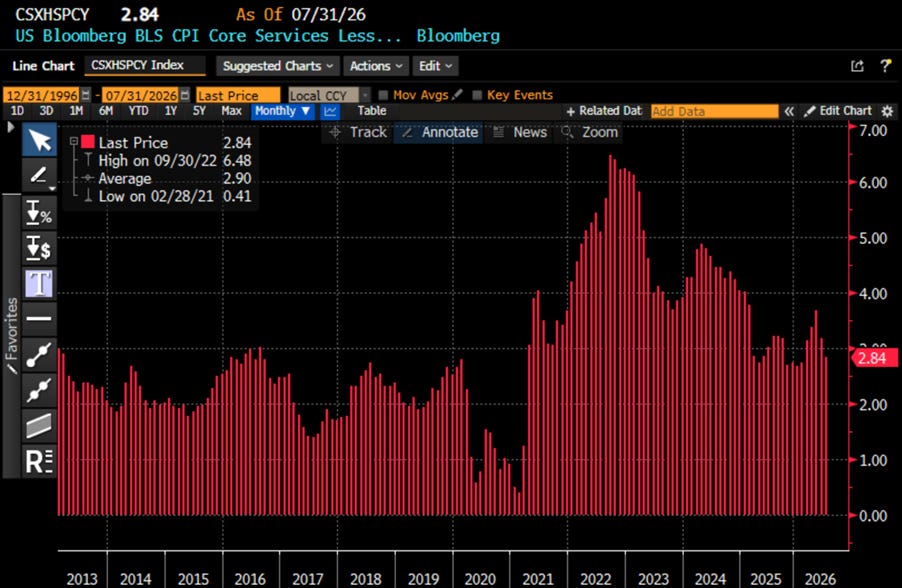
And here, polishing off the trophy cabinet, struts SuperCore CPI — core services ex-housing, or as the Fed prefers, “the only inflation metric that truly matters, until it doesn’t, at which point we’ll commission another one” — decelerating from June’s +3.17% YoY to a refreshing +2.84%, a pace last spotted back in December, which the consensus is celebrating with all the enthusiasm of a man cheerfully noting his house is only moderately on fire. This, lest we forget, is the very metric the Fed spent two years billing as the truest, purest, most spiritually enlightened signal of underlying price pressure — right up until it parked itself stubbornly above 3% and flatly declined to come home to 2%, a target destined to remain a theoretical aspiration for roughly as long as the empire keeps financing wars it can’t afford and printing the money to pretend it can.
Translation: Mission was never Accomplished. What we had was a smoke break between inflation waves, and the cigarette has just been stubbed out on the pavement. But by all means, carry on with the victory sermon — ideally while politely averting your eyes from rent, food, goods, energy, insurance, and the dangerous radical extremism of basic arithmetic. Refill the daily hopium prescription, compliment the emperor on his magnificent new wardrobe, and extend — as one always must — the professional courtesy of pretending that this time, against every scrap of historical precedent, the second wave will somehow be different.
Thoughts.
July’s CPI will be once again marketed, with all the subtlety of a campaign rally, as another glorious triumph in the war against inflation — courtesy of the Empire’s “tiny and totally successful” Middle East ceasefire, declared won approximately one hour into Day One, yet somehow still rattling global oil supply routes 165 days later and counting. For ordinary Americans not fortunate enough to be employed by the Malthusian Washington Swamp plutocracy, however, grocery prices will continue their inspiring upward journey, and energy costs will keep reminding everyone that “disinflation” was less an economic phenomenon and more a seasonal marketing campaign with a limited run.
Inflation didn’t die. It stopped to tie its shoes, caught its breath, and is now lacing up for Wave Two — arriving less than five years after Wave One finished its victory lap, which in inflation-cycle terms is practically a sprint. Meanwhile, policymakers and their market cheerleaders keep toasting “transitory” with one hand while quietly assembling the next geopolitical adventure package with the other.
And here is the part that never makes the press release: inflation and collapsing institutional trust move together like synchronised swimmers in a controlled demolition. The more households feel the squeeze at the checkout, the petrol pump, and the utility meter, the louder the official narrative insists that everything is “resilient,” “stable,” and “well anchored” — which are also the precise words one uses to describe a building immediately before it develops structural problems.
US Umbrella inflation Index (Average of CPI; Core CPI; PPI; Core PPI; Core PCE, 1-year consumer inflation expectations)
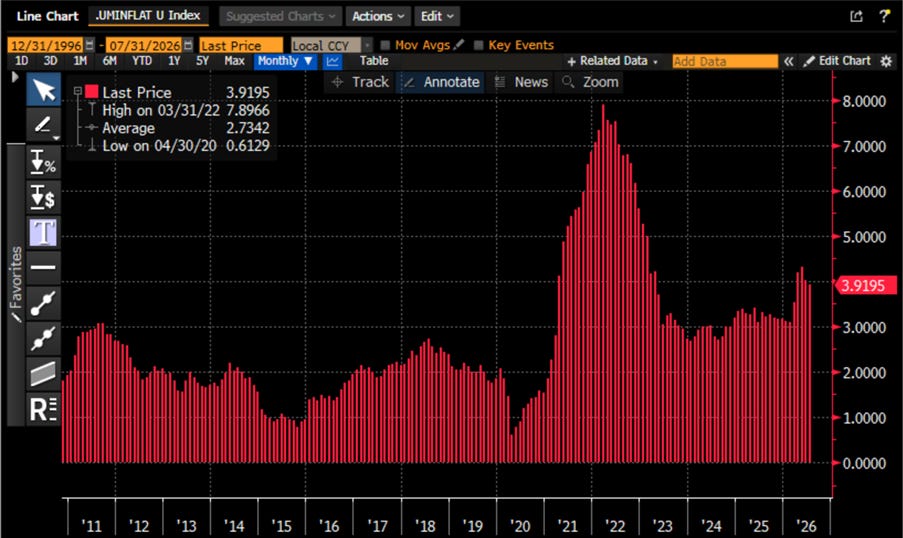
Instead of daydreaming about 2% inflation like it’s a campaign bumper sticker, seasoned investors — unlike certain Wall Street strategists still mainlining spreadsheet hopium at an industrial drip rate — retain the ability to perform elementary-school arithmetic, which remains, for now, unregulated.
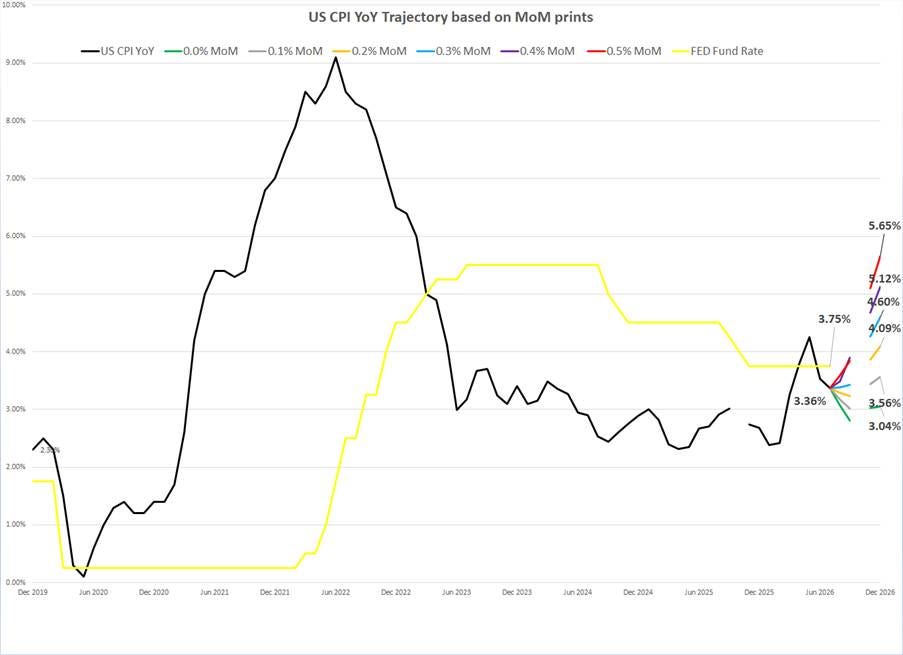
The math is straightforward to the point of embarrassment. For the 3% CPI target to materialise by year-end, monthly prints would need to run at 0.0% from here onward — best of luck engineering that while a freshly politicised Fed chair gets ceremonially crowned, geopolitical conflicts spread faster than a viral TikTok conspiracy thread, and the energy market takes its cues from whichever drone strike happened before breakfast. Meanwhile, if monthly CPI keeps printing at the rather more realistic 0.2%+, the destination isn’t “price stability” — it’s somewhere between 3.6% and 4.6% by December, gift-wrapped in complimentary media excuses and emergency talking points delivered, as always, with an impressively straight face.
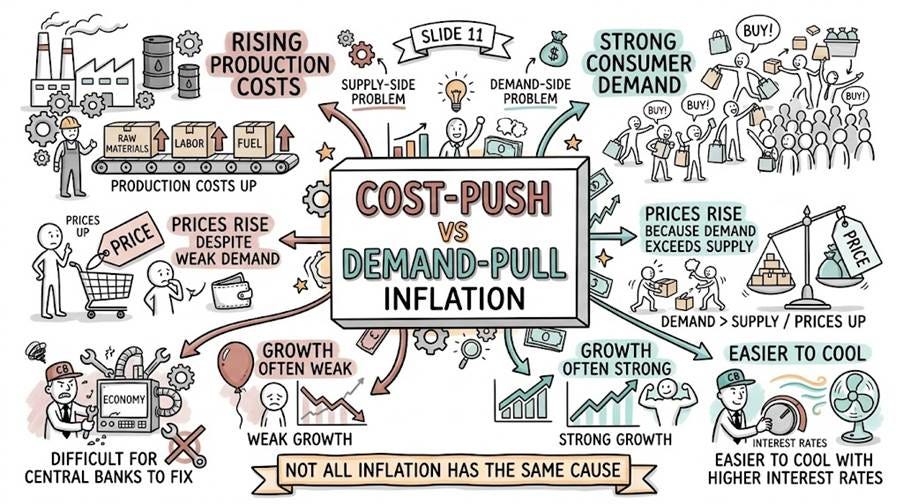
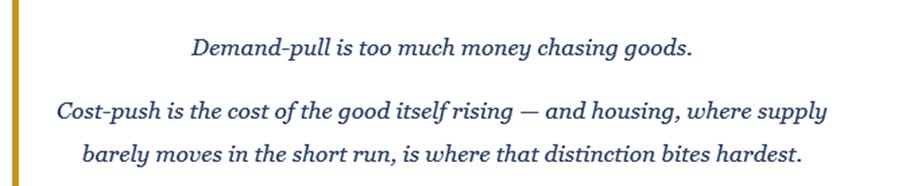
Economists like to sort inflation by whodunit. Demand-pull is the crowd-pleaser: too much money chasing too few goods. Wages jump, stimulus lands, credit gets cheap, everyone feels rich — and shoppers cheerfully bid prices up. Inflation yanked upward by a mob of eager buyers.
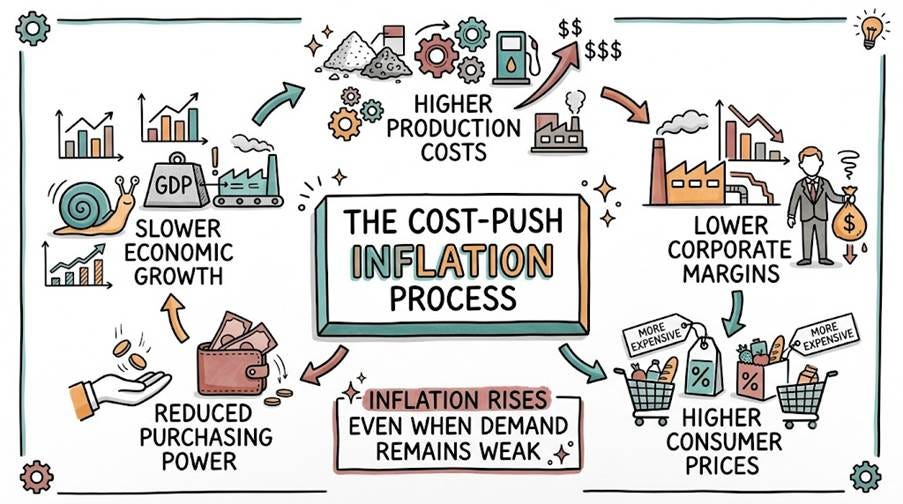
Cost-push is the grumpier cousin. Here the trouble starts on the supply side: it simply gets pricier to make or move the stuff, and producers pass the tab along whether or not anyone’s demand budged. The classic villain is a supply shock — an oil embargo, a failed harvest, a currency face-plant that makes imports dearer. Costs rise, firms guard their margins, prices ripple outward. The nasty part: cost-push can show up while the economy is shrinking, which is why it gives central bankers indigestion. The 1970s — prices up, jobs down, sideburns everywhere — is the poster child.
And it doesn’t need oil. Anything that raises the cost of getting a good in front of a buyer will do: wages sprinting past productivity, a fresh tariff, an insurance or lumber spike — or, our case today, a sudden crowd of extra buyers elbowing for a supply that can’t grow overnight. Pile more claimants onto something you can’t quickly make more of, and the price of winning it climbs for everybody. In housing that’s not a metaphor: it’s the extra rent you cough up for the same apartment, or the higher bid you wave to close on the very same house.
There’s a semantic quibble worth waving at: a sudden crowd of buyers is technically a demand shift, and a purist might slap a “demand-pull” sticker on it. But when supply is basically frozen — as the housing stock is over any timeframe shorter than a couple of years — extra demand doesn’t conjure new houses; it just jacks up the price of the ones already standing. To a household, that feels exactly like a cost shock: shelter gets pricier, the cost of living follows, and the pain can leak into wages and other prices from there. For the family budget and the CPI’s shelter line, the label is trivia; the outcome isn’t. So throughout this issue we use cost-push in that functional sense — pressure arriving through the supply-starved price of a must-have good, not through everyone suddenly having fatter wallets.
The term got its 1970s baptism the hard way. Twice — 1973 and again in 1979 — oil embargoes sent crude to the moon, and since energy touches nearly everything, the bill landed on the whole economy. Prices climbed while output stalled and unemployment rose: stagflation, the combo that mugged the era’s textbooks and sent central bankers back to the drawing board.
The plot reruns whenever a key input spikes for supply-side reasons — the food-price jumps of 2008 and 2011, the freight-and-semiconductor circus of 2021–2022, a currency swan-dive that makes imports dearer. Every time, the shove comes from the cost of supplying things, not from buyers flush with cash. Housing makes the guest list because supply is its permanent bottleneck — and, as the rest of this issue argues, a stampede of people bidding for a fixed set of homes lands the same punch as a classic input-cost shock: a higher price, handed straight to the buyer.
Housing is where cost-push logic struts around at its cleanest, for three reasons. You can’t microwave a house. Land has to be entitled, permits pried loose, financing arranged, materials sourced, crews booked — and in most desirable metros, zoning and review pile on years before a single shovel touches dirt. Economists have a name for this foot-dragging: the elasticity of housing supply, or how eagerly new construction shows up when prices rise. In the short run that eagerness is roughly zero, and in supply-choked coastal and Sun Belt metros it stays stubbornly low for years. So, when demand climbs against a supply curve standing bolt upright, the adjustment lands almost entirely on price, not on the number of homes. The steeper the supply curve, the larger the share of any demand increase that ends up in price. A metro that can build freely absorbs newcomers with only...
Read more and discover how to trade it here: https://themacrobutler.substack.com/p/the-shelter-aftershock
Visit The Macro Butler Website here: https://themacrobutler.com/
Join The Macro Butler on Telegram here : https://t.me/TheMacroButlerSubstack
Register your interest to The Macro Butler World Economic Summit 2026 here:
https://themacrobutler.substack.com/p/the-macro-butler-world-economic-s…
You can contact The Macro Butler at info@themacrobutler.com

Disclaimer
The content provided in this newsletter is for general information purposes only. No information, materials, services, and other content provided in this post constitute solicitation, recommendation, endorsement or any financial, investment, or other advice.
Seek independent professional consultation in the form of legal, financial, and fiscal advice before making any investment decisions.
Always perform your own due diligence.