





The Alchemy of Crude
Crude oil is the ultimate slacker: worth almost nothing in the ground, a small fortune at the pump. Everything in between is the oil and gas value chain — a globe-spanning relay race where every stage slaps on some cost, adds a little value, and hands the barrel to the next runner (tip jar included). Analysts split it into three acts: upstream, midstream and downstream. Control all three and you’re “integrated” — industry-speak for owning the whole racetrack so nobody else skims your margin.
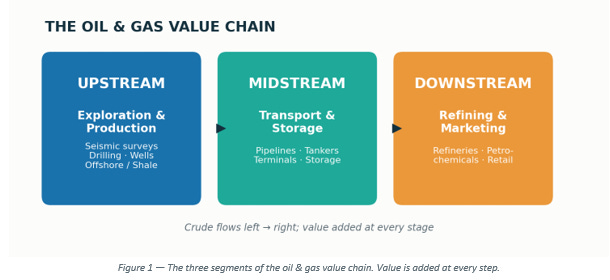
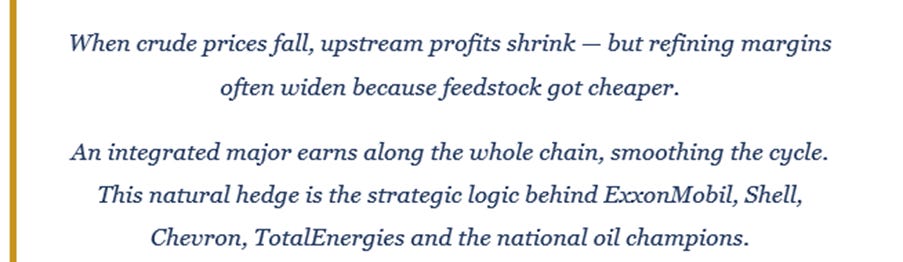
Upstream is the treasure hunt, minus the treasure map. Geologists fire sound waves kilometres into the earth, squint at the echoes, and bet millions that a particular blob of rock has been quietly hoarding hydrocarbons for a few million years. Drill the exploration well and — plot twist — it’s often dry. Strike oil, and you build the platforms, wells and subsea gear to haul it up. Upstream is where the biggest fortunes and the biggest faceplants happen, all riding on one number: the price of crude. Which is exactly why the smart money bolts on a downstream business that cheers up when crude gets cheap.
A barrel stuck in the Permian is about as useful as a fridge in Antarctica. Midstream is the plumbing that fixes that — pipelines, tankers, rail and tank farms moving molecules from “middle of nowhere” to “your gas tank.” It’s the industry’s quiet earner: paid by the barrel moved, not the barrel’s mood, so it shrugs off price swings. It’s also where geopolitics gets spicy — chokepoints like the Strait of Hormuz can rattle global prices just by being glared at.
Downstream is where crude finally gets a job. Refining turns the raw goop into fuels and petrochemicals; marketing sells them through the shiny stations with the famous logos. Refining is this newsletter’s beating heart — capital-hungry, fiendishly technical, and usually scraping by on thin margins… right up until supply tightens, the crack spread goes vertical, and refiners print money (see: 2026). And that Shell or Chevron sign on the forecourt? The glamorous tip of an unglamorous chain that started with a sound wave, years ago and half a world away.
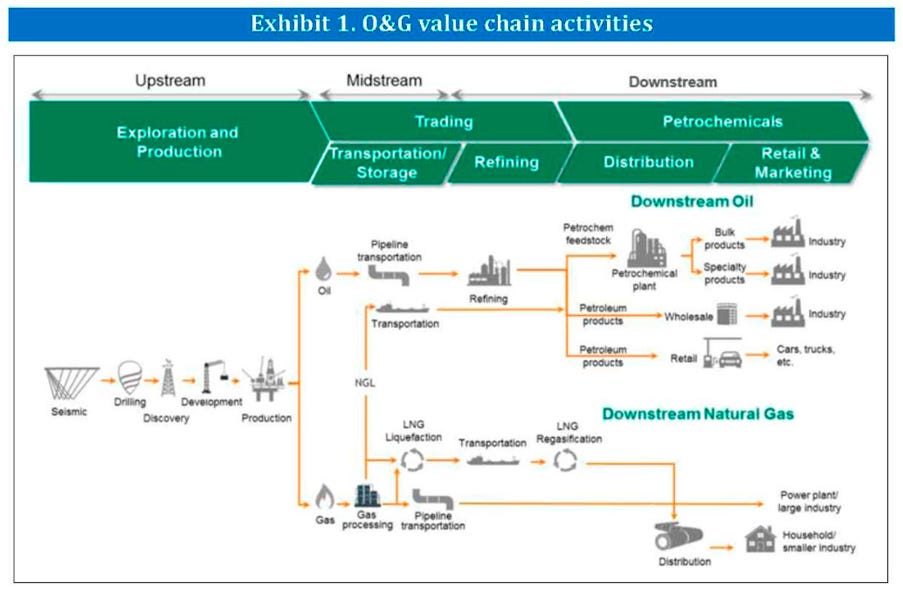
https://emcombustion.es/en/oil-and-gas-value-chain-focus-on-oil-refining/
A modern refinery is basically a small city that never sleeps — towers, furnaces, reactors and a spaghetti bowl of pipes, running 24/7/365. The mission sounds simple and is anything but: take a dirty, moody, low-value goop and turn it into clean, precise, high-value products that pass tests fussier than a Michelin inspector. It pulls this off with four tricks — separation, conversion, reforming and treating — that between them coax a single barrel into the raw material behind 2,500-plus everyday things. Medieval alchemists tried to turn lead into gold and failed; refiners turn sludge into jet fuel and do it before lunch.
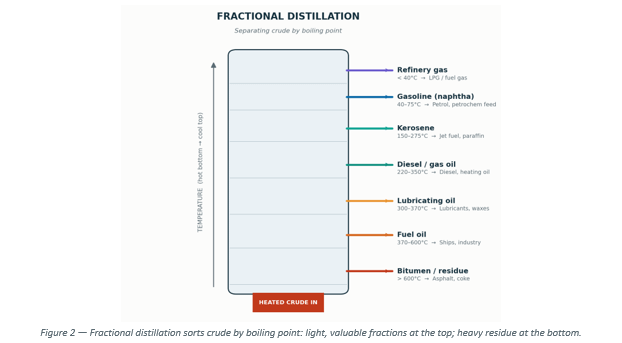
It all starts with heat — lots of it. Crude gets blasted to 350–400°C and shoved into the bottom of a towering distillation column. Here’s the trick: crude isn’t one thing, it’s a molecular mosh pit of hydrocarbons in every size, and each size boils at its own temperature. As the hot vapour climbs the column and cools, every family bails out at the floor where the temperature suits it — like partygoers drifting to the room with the right vibe. Featherweight gases float to the top; heavier stuff settles lower; the stubborn, tar-like residue never bothers to evaporate and slumps out the bottom. One elegant step, and the barrel is sorted into refinery gas, naphtha (gasoline), kerosene, diesel, lube oils, fuel oil and residue. That bottom-of-the-barrel sludge then heads to a vacuum unit, where dropping the pressure coaxes out a bit more without cooking it into chaos. But distillation only sorts the barrel — it leaves you with too much cheap heavy gunk and not nearly enough of the good light stuff people actually pay for. Closing that gap is the entire reason the rest of the refinery bothers to show up.
The market wants gasoline, diesel and jet fuel — but most crude, left to distillation alone, hands you a depressing pile of heavy fuel oil and gunk nobody’s excited about. Enter conversion units, which take big, lazy molecules and smash them into smaller, lighter, far more lucrative ones. This is “cracking,” and yes, it’s as violent as it sounds. The workhorse is the fluid catalytic cracker (FCC), which throws a powdered catalyst and serious heat at heavy gas oil until it shatters into gasoline. Hydrocracking goes full overachiever — adding hydrogen at high pressure to turn the stubborn stuff into squeaky-clean premium diesel and jet fuel. And at the very bottom, the coker mugs the tar-like residue for its last drops of liquid, leaving behind a lump of solid petroleum coke. How much conversion muscle a refinery has is what separates the sophisticated money-printers from the simple also-rans — and it’s exactly what the Nelson Complexity Index (coming up) is keeping score of.

Not every molecule needs a beating — some just need a makeover. Catalytic reforming takes weedy, low-octane naphtha and reshuffles it into buff high-octane aromatics fit for premium gasoline, tossing off free hydrogen the refinery happily recycles elsewhere. Alkylation works the opposite way, gluing tiny gas molecules into bigger high-octane blend stock. Isomerisation just rearranges the furniture for a few extra octane points. Together, these units are the refinery’s mixing desk — the knobs that decide whether you get regular or premium at the pump, and whether your diesel is welcome in Europe or politely turned away at the border.
Crude comes with baggage — sulphur above all, plus nitrogen, metals and salts that poison catalysts, chew through equipment, and are exactly what regulators love to police. Hydrotreating is the cleanup crew: run the streams over a catalyst with some hydrogen and the sulphur exits as hydrogen sulphide, which a sulphur recovery unit then turns into solid sulphur the refinery actually sells (one man’s pollutant is another man’s product line). Thanks to ultra-low-sulphur fuel specs and marine rules like IMO 2020, deep desulphurisation went from “nice to have” to...
Read more and discover how to trade it here: https://themacrobutler.substack.com/p/the-shelter-aftershock
Visit The Macro Butler Website here: https://themacrobutler.com/
Join The Macro Butler on Telegram here : https://t.me/TheMacroButlerSubstack
Register your interest to The Macro Butler World Economic Summit 2026 here:
https://themacrobutler.substack.com/p/the-macro-butler-world-economic-s…
☀️ SUMMER SPECIAL — 15% OFF
Ready to understand your money and the markets better?
This summer, take your financial knowledge to the next level with The Macro Butler Financial Academy.
Learn the principles behind:
📈 Investing & Portfolio Building
🌍 Economics & Market Cycles
💡 Smarter Financial Decision-Making
Whether you’re starting your investment journey or looking to sharpen your financial knowledge, The Macro Butler gives you the framework to think differently about money.
🎓 Get 15% OFF when you subscribe.
⏳ Limited Time Offer — Available until September 15, 2026.
👉 Start Learning Now

https://themacrobutler.com/financial-academy/
You can contact The Macro Butler at info@themacrobutler.com

Disclaimer
The content provided in this newsletter is for general information purposes only. No information, materials, services, and other content provided in this post constitute solicitation, recommendation, endorsement or any financial, investment, or other advice.
Seek independent professional consultation in the form of legal, financial, and fiscal advice before making any investment decisions.
Always perform your own due diligence.