





China doesn't want you to know how much gold it owns
China has spent years accumulating gold. That much is public knowledge.
The People's Bank of China reports its monetary gold reserves, but those figures capture only one part of a much larger and more opaque picture. China is also a major gold producer, a major importer, and home to enormous private demand. Other state-linked institutions may hold gold outside the central bank's reported reserves.
Nobody outside the Chinese state can say with certainty how much of the country's gold ultimately belongs to the government.
But perhaps uncertainty is the point.
The mystery may be more valuable than the number
Dominic Frisby, author of The Secret History of Gold, argues that China's true state holdings could be dramatically larger than officially reported.
His estimate isn't something that can be independently verified. It relies on piecing together domestic mine production, imports, Shanghai Gold Exchange withdrawals, and assumptions about how much gold ultimately belongs to the state.
The precise figure, however, may be less interesting than the incentive structure.
Suppose China really does control substantially more gold than it acknowledges. Why announce it?
Doing so could alert markets to the scale of Chinese accumulation.
It could invite uncomfortable questions about Beijing's long-term monetary ambitions.
And if China intends to continue buying, advertising the strategic importance it places on gold hardly helps it accumulate quietly.
Secrecy preserves options.
Gold is an asset without someone else's promise attached
The attraction becomes clearer when gold is compared with conventional foreign exchange reserves.
Foreign government bonds are assets, but they're also liabilities of foreign governments. Bank deposits depend on banks. Access to international payment systems depends on institutions that can restrict that access.
Physical gold held within your own borders has no foreign issuer on the other side of the transaction.
That characteristic became harder to ignore after Western governments froze hundreds of billions of dollars in Russian central-bank assets following the invasion of Ukraine.
For reserve managers elsewhere, the lesson didn't require approving or disapproving of Russia's actions. It was simply that foreign reserves can become geopolitical instruments.
Gold can't solve that problem easily, but gold held domestically changes the nature of it.
For a country seeking greater freedom of action within a dollar-centered financial system, that makes bullion uniquely useful.
When might China reveal its hand?
There's another reason Beijing might prefer ambiguity today: China still operates extensively within the existing monetary order.
It owns substantial dollar assets, and depends heavily on international trade. Deliberately undermining confidence in the dollar could therefore damage Chinese interests along with American ones.
That makes an immediate monetary confrontation unnecessary and potentially self-defeating.
But circumstances change.
Imagine a future geopolitical crisis involving sanctions, frozen reserves or restricted access to payment networks. Alternatively, imagine Beijing seeking to increase international confidence in the renminbi as a reserve asset.
Suddenly, revealing unexpectedly large gold holdings could serve a purpose.
Gold sitting silently in a vault is a reserve asset. Gold disclosed at a strategically useful moment can become a statement about financial credibility.
That may explain why asking how much gold China owns misses the more interesting question: when would China benefit from telling us?
China doesn't need a gold standard
None of this requires Beijing to introduce a gold-backed currency.
In fact, Frisby doubts China will adopt a traditional gold standard, which would impose constraints that modern governments generally prefer to avoid.
There's a much less dramatic path.
Gold can simply become more important at the margins of the international monetary system: more central-bank reserves, more settlement infrastructure, deeper domestic markets, and greater credibility for countries attempting to reduce their dependence on foreign liabilities.
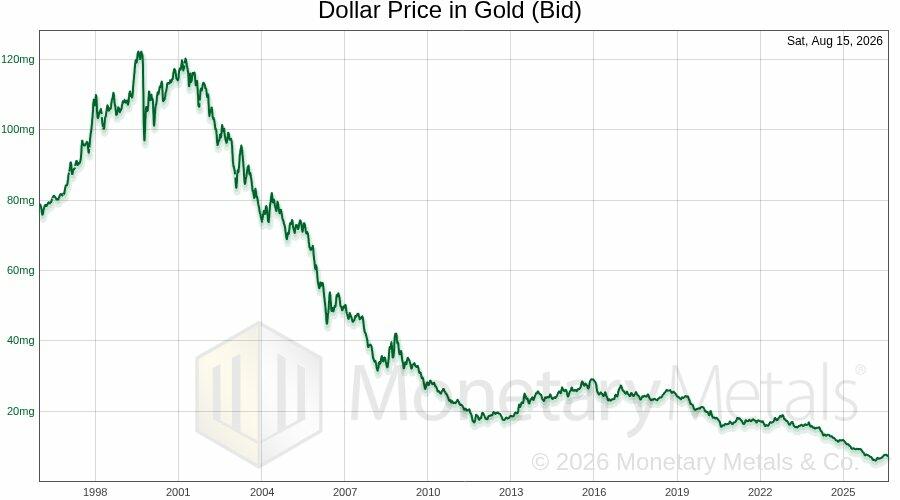
Under that scenario, there's no announcement that the dollar era has ended. There may not even be a singular moment when the monetary order visibly changes.
Instead, governments gradually insure themselves against a world in which financial relationships become less trustworthy.
China's gold strategy makes more sense through that lens.
Beijing may not be accumulating gold because it expects the existing monetary system to disappear.
It may be accumulating gold because it wants more freedom to operate if that system becomes less cooperative.
Watch our conversation with Dominic Frisby, author of The Secret History of Gold: Myth, Money, Politics and Power. Our discussion covers everything from China's secret accumulation to silver, Bitcoin, and ETFs.