





Gold sits inside the commodity complex, but the World Gold Council argues that investors should not treat it like a conventional commodity allocation. Its latest report Gold: the most effective commodity investment (see attached at bottom), finds that gold differs from energy, industrial metals, and agriculturals in its supply structure, sources of demand, liquidity, and behavior across economic cycles. Those differences have historically translated into stronger long-term returns, lower vol, better diversification, and more consistent protection during periods of market stress.
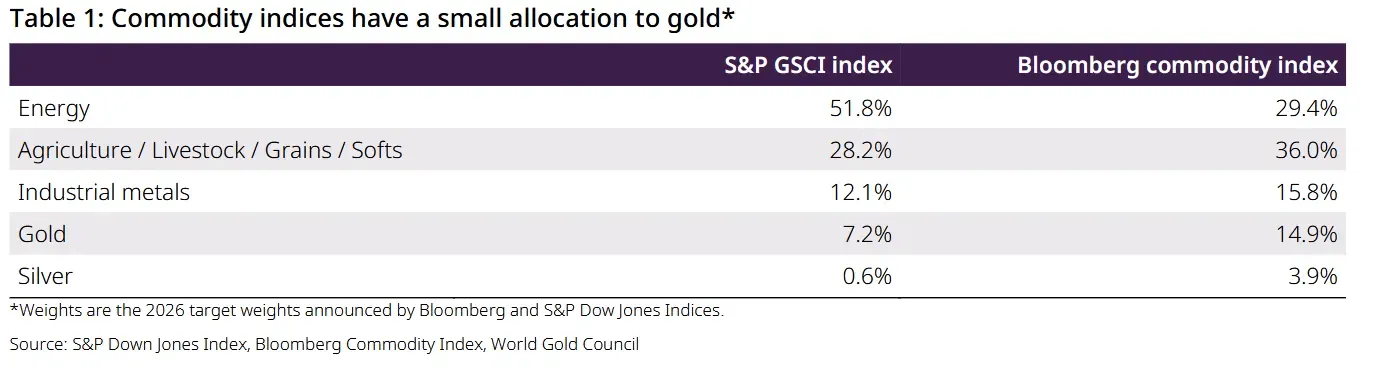
The report argues (and we agree) gold is underrepresented because conventional commodity indices don’t fully capture the depth or structure of its market. The S&P GSCI gives gold a 7.2% weighting and the Bloomberg Commodity Index 14.9%, but those methodologies rely heavily on futures and/or production. Gold also trades through large OTC and ETF markets and has an enormous above-ground stock that can continuously be recycled, sold and reallocated. Index weights can thus understate gold’s strategic portfolio role.
Gold is Different Than The Others
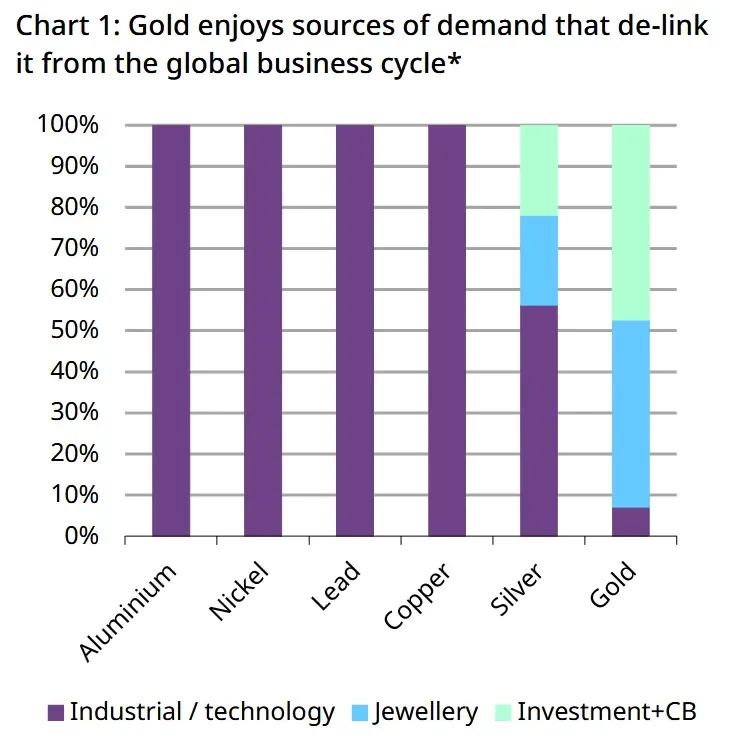
Most commodities are closely tied to the business cycle because industrial consumption dominates demand. Gold is different. It functions simultaneously as a consumer good, investment asset, and central-bank reserve. Jewelry and technology demand tend to strengthen during economic expansion, while investment and official-sector demand can rise during uncertainty. The combination gives gold both pro and counter-cyclical sources of demand and makes it less dependent on any single phase of the business cycle.
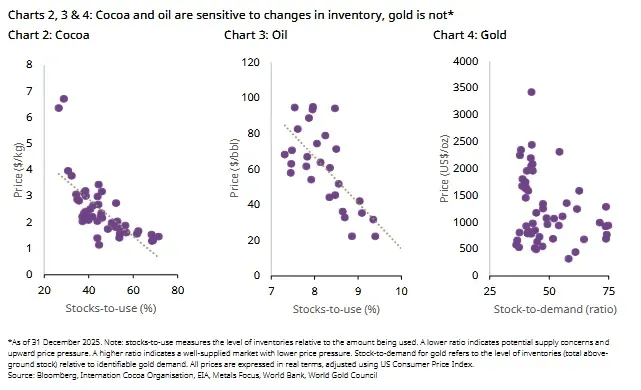
Supply behaves differently as well. Energy, copper, adn agriculturals depend heavily on inventories to bridge production and consumption. When inventories become scarce, prices can rise sharply. Gold is not consumed in the same way. Its above-ground stock is enormous relative to annual mine production, so its price is less dependent on short-term scarcity. More than any other commodity Gold’s price is demand-driven. Its supply is known. As one Bullion Bank said: ‘You can’t pump more gold out of the ground, but you can bid it out of unsuspecting hands’
The report outlines the three major advantages Gold has over other commodities.
- Stronger Returns
- Better Diversification in Crisis
- Liquidity when it is needed
1- Stronger Returns and Less Contango
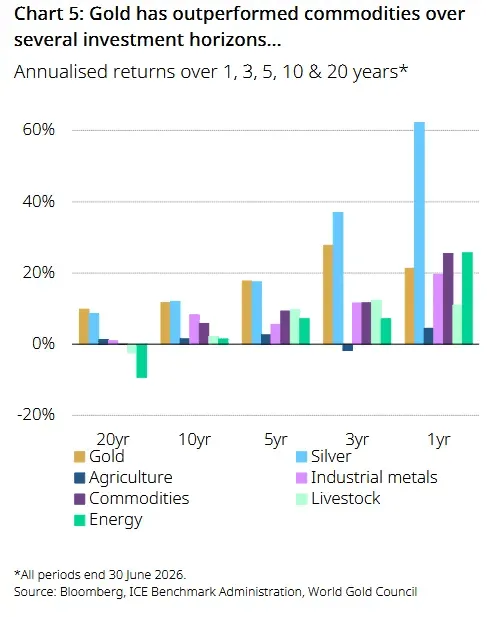
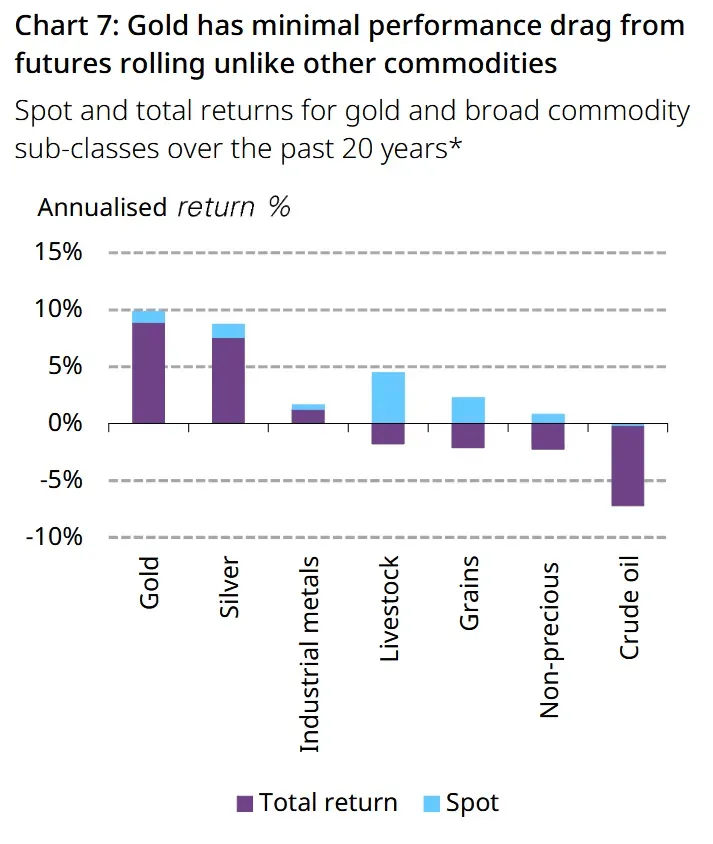
The first major investment advantage is performance. Gold has outperformed broad commodity indices and most commodity subsectors over the past three, five, ten, and twenty years (see chart below) through June 2026. Over the longest horizon, several commodity sectors generated negative returns, while gold remained positive. The report acknowledges that gold can underperform over shorter periods, but its longer-term record has been considerably stronger.
Part of that difference comes from futures-market structure. Commodity investors can face substantial roll costs when futures curves trade in contango. Gold’s large above-ground inventory, low storage costs and limited convenience yield have historically produced a much flatter futures curve. Between June 2006 and June 2026, gold returned 9.9% annually in spot terms and 8.9% through futures. Oil generated a negative 0.2% spot return and negative 7.2% futures return over the same period after rolling and collateral effects.
2- Diversification in Crisis
Gold’s second major advantage is diversification. Its correlation with other commodities and financial assets has historically been low, but the report emphasizes that the relationship changes with market conditions. During stronger economic periods, gold can rise alongside equities as consumer demand improves. During risk-off periods, investment demand can take over and gold’s correlation with equities tends to fall.
Continues here unlocked