





Snatching Defeat From The Jaws Of Victory

The $25 Exit We Missed
One of our subscribers, TL, sold his August 21st $95 call on Robinhood Markets (HOOD 0.00%↑) for $25 on July 2nd. We held the same call and eventually sold it for $1.25 on August 19th.
That $23.75 difference cost us $2,375 on one contract.
The call was the long-dated leg of a four-leg hybrid we entered for a $4.10 net debit on March 5th. By July, we’d already resolved its short call and put spread, leaving that call uncapped. If we’d sold it at $25, the completed trade would have made about $1,820, or 190% of its maximum risk. At our $1.25 exit, it lost $555, or 58% of maximum risk.
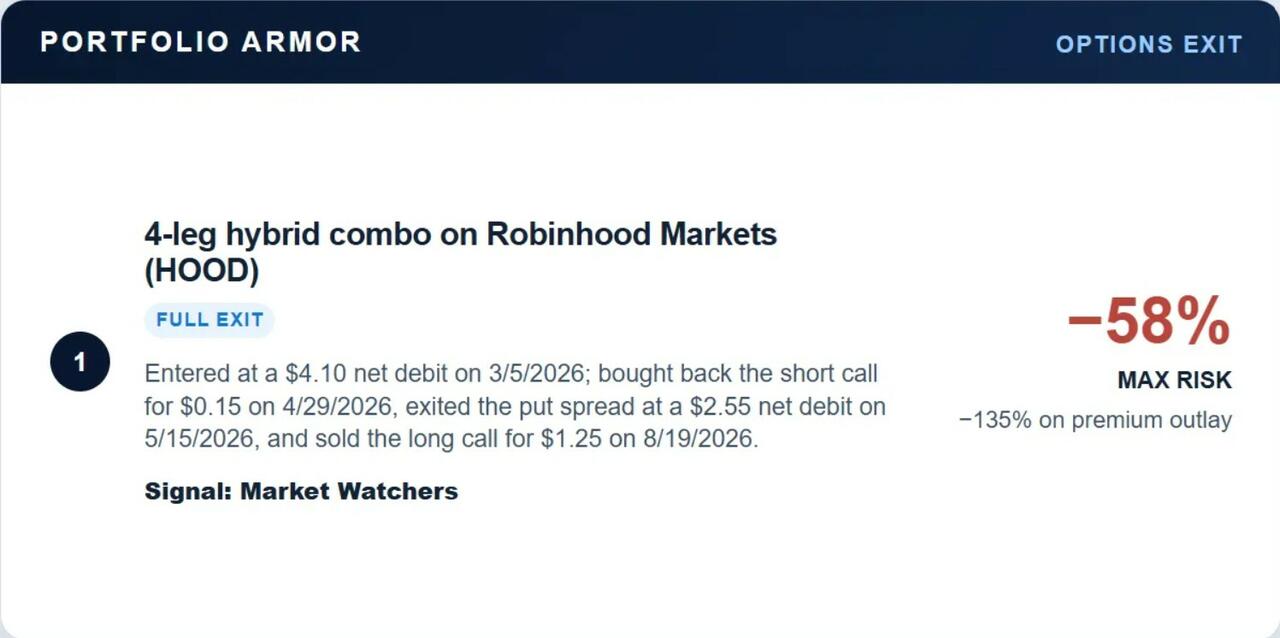
The mistake was our all-or-nothing treatment of our model target. TL accepted less than our target, locked in an impressive gain, and moved on. We kept waiting for a better exit until the market gave us a much worse one.
The Target Was Defensible
On June 23rd, with 59 days left on the call, we set a good-’til-canceled limit price of $29.50. Our runner process estimated a plausible move in the stock from the current at-the-money straddle, then priced the option at that stock target using Black–Scholes, Bjerksund–Stensland, and the Cox–Ross–Rubinstein binomial model. We used the conservative, model-consistent result.
There was a real case for holding. The call still had time, its upside was uncapped, and Robinhood had another earnings report ahead. Selling every runner at the first large gain would defeat the point of owning convexity in the first place.
But TL’s $25 fill was already about 85% of our $29.50 target. Later on July 2nd, Robinhood scheduled its earnings report for July 29th. His sale came 27 days before that catalyst. At that point, the prospect of squeezing out the last 15% of our theoretical target wasn’t worth risking a 190% return on maximum risk.
Runners Have Earned Their Place
Runner targets still belong in the process. They’ve helped us stay in winners long enough to capture returns that ordinary profit-taking would have cut short.
Recently, our runner process helped us hold a 10x Genomics (TXG 0.00%↑) call until a $31.90 exit. TXG came from our Multibaggers—our name for a small group of outside investors who’ve posted multiple documented gains of 100% or more. The completed trade returned 380% on maximum risk and 1,309% on premium outlay.
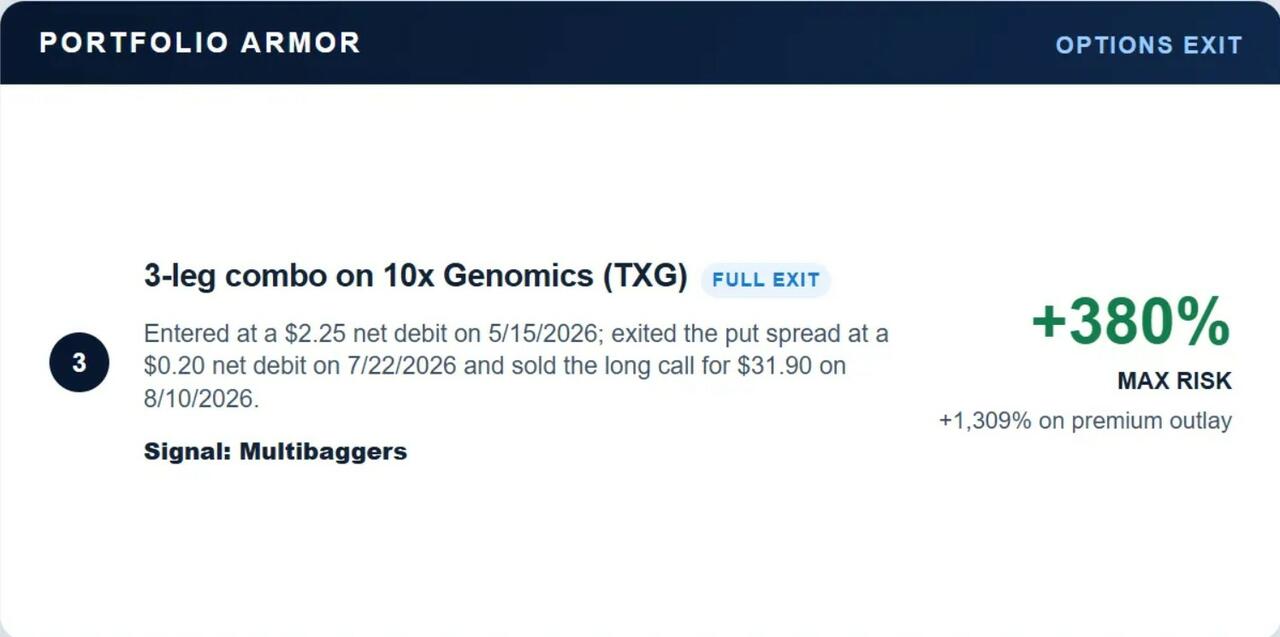
That kind of outcome is why we’re refining the process instead of replacing it.
The 0.60x-Straddle Catalyst Window
Our default runner target assumes a stock move equal to 75% of its current at-the-money straddle: up for a call, down for a put. We’ll keep that default when the option has time and no material catalyst is close.
Inside the 30 days before a scheduled—or reasonably expected—material catalyst, we’ll now reduce the assumed stock move to 60% of the straddle. That’s an explicit 20% haircut to the usual 0.75-straddle move:
Catalyst-window stock target for a call: current stock price + 0.60 × the at-the-money straddle
Catalyst-window stock target for a put: current stock price − 0.60 × the at-the-money straddle
We’ll then price the option at that stock target with the same three models, using the conservative, model-consistent value. The haircut belongs on the assumed stock move, not on the resulting option price; option values aren’t linear, so applying another 20% discount would count the same caution twice.
If that recalculated price is realistically executable, our default will be to take it. If the exit would close the full trade at a loss, it’ll trigger a review instead of an automatic sale. Holding through the catalyst will require a documented exception and fresh modeling—particularly when the trade was built around that catalyst in the first place.
We’re also adding the next material catalyst, its date or expected window, its verification status, and the 30-day review date to our Trade Entries sheet. Our nightly AI watchdog can then flag the position when it enters the catalyst window.
Our separate time-decay rule still applies. With 30 days or less and no material catalyst ahead, a failed runner order can still step down to a target based on 50% of the at-the-money straddle.
The Goal Is Better Decisions
The goal is to preserve enough patience for an uncapped option to become an outsized winner without turning a compelling, executable gain into an all-or-nothing bet on the last few dollars of a model target.
TL made that judgment better than we did in HOOD. The right response is to say so, quantify the mistake, and improve the rule.
Looking For The Next TenX Genomics
We've got two more catalyst-driven biotechs in today's trade alert.
As usual, we're offering free subscribers to the Portfolio Armor Substack a one-time unlock on today's trade alert. If you're not a subscriber yet, you can become one via the widget below.