





The LNG Energy Relay
On the last day of February 2026, the Strait of Hormuz closed. It is nineteen miles of water between Oman and Iran, and about a fifth of the world’s liquefied natural gas goes through it — almost all Qatari, almost all loaded at one complex called Ras Laffan. Between 1 March and 24 April, the number of laden LNG carriers that made the transit was zero. This is the sort of thing that turns up in annual reports under “concentration risk,” usually in a footnote, usually the following year. What followed was a live experiment in how the energy system actually works. European TTF rose about 35 percent; Asian JKM rose 51. India turned its coal plants back up. Bangladesh and Pakistan stopped buying altogether, having found the outer edge of the phrase “market-based pricing.” Egypt — which spent 2025 converting itself from an exporter into an importer, timing being everything — ended up bidding against Tokyo.
And American gas got cheaper. Nine percent. Henry Hub drifted toward $2.60 while the rest of the world paid six to eight times that, because US export terminals were already running at 94 percent utilisation and physics declines to be motivated. Production kept climbing, storage hit its highest pre-winter level since 2016, and the biggest supply shock in the history of LNG ended with the world’s largest LNG exporter enjoying a glut.

Liquefied natural gas is the most physically demanding and most capital-intensive business in energy. It involves cooling a gas to a temperature colder than the surface of Mars, holding it there across ten thousand miles of ocean, and warming it back up at the far end — all so it can do the one thing gas has always done, which is boil water and spin a turbine. A liquefaction plant costs more than an aircraft carrier. A single cargo runs $70–100 million. The entire apparatus exists because natural gas is abundant nearly everywhere and cheap only where you can pipe it — and pipes, for all their virtues, are hopeless at crossing oceans and sanctions regimes.

Liquefied natural gas is natural gas that has had everything liable to freeze, corrode or poison the equipment stripped out, then chilled to about −162 °C (−260 °F) at near-atmospheric pressure, whereupon it condenses into a clear, colourless, odourless liquid roughly half as dense as water. That is the entire definition. No chemical transformation, no reforming, no catalysis, no clever trick. LNG differs from natural gas the way ice differs from water — which is to say not at all, except in the one respect that matters. It is the same methane, in a different phase.
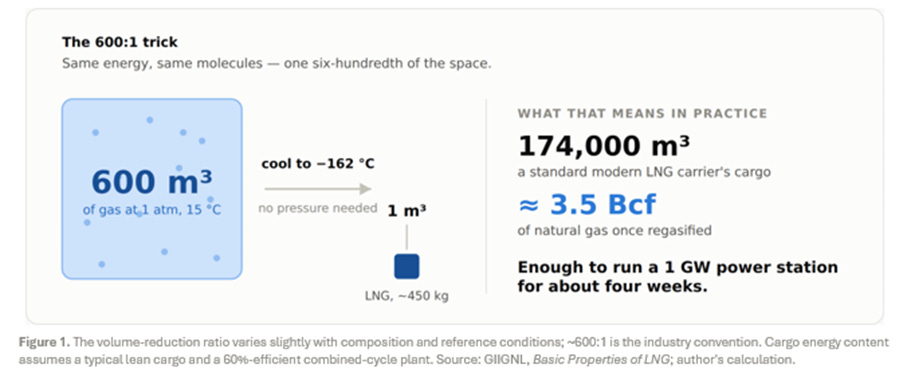
What changes is the logistics, and the logistics are everything. Gas at atmospheric pressure is mostly empty space with a little methane in it. Condense it and the same energy shrinks to about one six-hundredth of the volume — the single most important number in the industry. At 600:1, methane finally becomes worth the trouble of putting on a ship, and a fuel that used to be stranded wherever it happened to come out of the ground turns into a global commodity, priced against cargoes on the far side of the planet by people who will never see it.
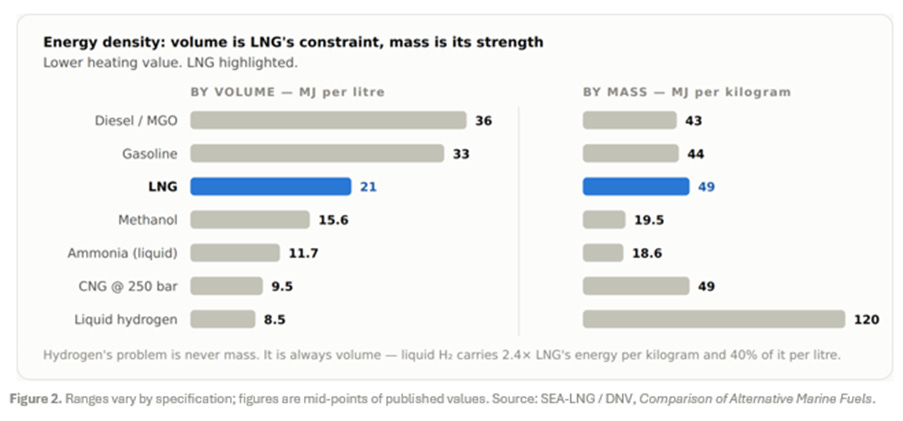
The obvious alternative is to squeeze the gas rather than freeze it, and for some jobs that is exactly what happens — compressed natural gas lives at 200 to 250 bar. But methane has a critical temperature of about −82.6 °C, and above that no amount of pressure will persuade it to become a liquid; you can only compress the gas and hope. Compressed gas is still mostly space: CNG at 250 bar manages about 200 kg per cubic metre against LNG’s 450. This is why propane and butane come in cheap steel bottles from the petrol station — their critical temperatures sit comfortably above a warm afternoon — while methane demands an insulated vessel and a cryogenic engineer, neither of which is sold at the petrol station.
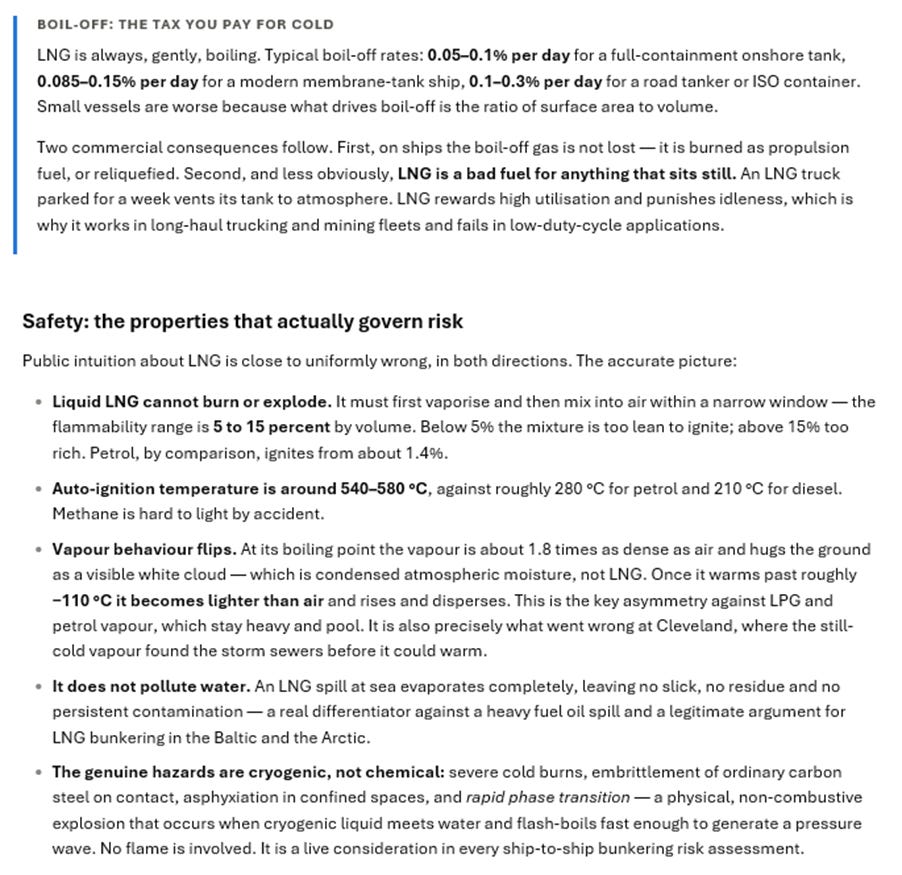
The elegant part is that once you have paid to make the liquid cold, keeping it cold is nearly free. LNG sits at its boiling point and holds itself there by auto-refrigeration: a little vapour boils off, carries its latent heat away with it, and chills whatever stays behind. Let the vapour escape — or catch it and burn it — and a tank will hold −162 °C indefinitely, asking nothing of anyone. A well-built onshore tank loses 0.05 to 0.1 percent a day. A modern membrane-tank ship loses about 0.1 percent a day, some three percent of the cargo over a month at sea, and even that goes uncomplainingly into the engines pushing the ship along. The fuel, in effect, pays part of its own passage.
Pound for pound, LNG beats every hydrocarbon fuel in commercial use — 48–50 MJ/kg against diesel’s 43. Litre for litre, it manages only 55–60 percent of diesel, and litres are what decide tank size. Every transport decision about LNG is really a negotiation with that one number. It explains why LNG is superb in a container ship (vast tank, long voyage), fine in a long-haul truck (twin cryogenic tanks, 1,000–1,600 km of range), and a bad joke in a delivery van. It is also why LNG wins in trucking: at 2.2 to 2.4 times CNG’s volumetric density, it is the only form of methane that gets a tractor across a continent instead of across a county.
The physics came first, and it came slowly. In the 1820s Michael Faraday started liquefying gases in London, proving that most would condense under enough cold and pressure. Methane, with its very low critical temperature, held out until 1886, when the Polish physicist Karol Olszewski finally pinned it down. The machine that made it possible had shown up thirteen years earlier — Carl von Linde’s 1873 compression refrigerator in Munich, great-grandfather to every LNG plant now running.
Turning that party trick into a storable commodity was, fittingly, the work of an American businessman rather than a physicist. In 1915 Godfrey Cabot patented a thermos for liquefied gases — two walls, a vacuum between — which is still, essentially, how every cryogenic tank on earth is built. Around 1917–18 the US government liquefied gas at scale in West Virginia, though it wanted the helium inside for British airships, not the gas. In 1937 Lee Twomey patented industrial-scale liquefaction, and the commercial idea at last arrived: store gas cheap in summer, boil it back in winter. It is called peak-shaving, and most small LNG plants still do exactly that.
The world’s first full-scale commercial LNG plant was built by East Ohio Gas in Cleveland in 1940–41: three spherical tanks holding a city’s winter insurance. In 1942, under wartime steel rationing, a fourth was added — cylindrical, different design, an alloy nobody yet knew was wrong for cryogenic duty. The last three words of that sentence are the entire problem.
On 20 October 1944, at half past two in the afternoon, the fourth tank let go. A million gallons of LNG escaped, vaporised, and — cold, and so heavier than air — poured downhill into the street and the storm sewers, then found a flame and came roaring back up through the drains into the neighbourhood’s basements. Between 128 and 131 people died, 225 were injured, and 79 homes were gone. Cleveland did not just dent LNG’s reputation; it removed the industry from the list of acceptable technologies for the better part of twenty years. America went underground for its gas storage and did not look back until the late 1950s — when different engineers, in a different country, solving a different problem, worked up the nerve to try again.
Britain in the 1950s ran on coal and town gas, and the notion of importing natural gas by sea from Louisiana sat somewhere between ambitious and absurd. On 25 January 1959, a converted WWII Liberty ship named Methane Pioneer — five aluminium tanks, about 5,000 cubic metres — left the Calcasieu River near Lake Charles for Canvey Island on the Thames. She arrived with her cargo intact, which was the entire point, and went on to make thirty more crossings before retiring in 1972.
That one demonstration built an industry. By 1964 Algeria’s CAMEL plant at Arzew was shipping the first truly commercial LNG to Britain and France aboard Methane Princess, the first purpose-built carrier, at 27,000 cubic metres. In 1969 Alaska’s Kenai plant became the first baseload LNG exporter in the United States, sending cargoes to Tokyo and founding the Pacific trade that would run the business for the next forty years.

https://www.sheaws.com/the-history-of-the-lng-industry/
How LNG differs from natural gas — and how it doesn’t
The short version: LNG is cleaner natural gas that has been made very cold. The long version matters commercially, because the small differences that survive — composition, heating value, engine suitability, safety behaviour — are precisely the ones that turn up in contract disputes, cargo-routing decisions and engine warranties, i.e. the places where money changes hands.
What is actually in the liquid?
Straight from the wellhead, natural gas is a mixed bag: mostly methane, plus ethane, propane, butanes, nitrogen, carbon dioxide, water vapour, hydrogen sulphide and — depending on the field — traces of mercury, helium and heavier hydrocarbons. Pipeline gas has had a light tidy-up. LNG has had a deep clean, because at −162 °C nearly every impurity turns into a solid, and every solid turns into a blockage in something expensive.
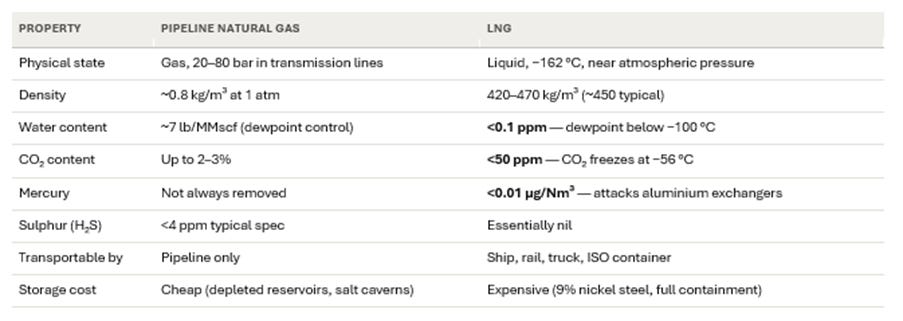
The upshot is nicely counter-intuitive: regasified LNG is usually cleaner, drier and lower in sulphur than the pipeline gas it competes against. Gas turbines with fussy fuel specs care a great deal about this — it is a real quality edge, and one the industry almost never bothers to advertise.
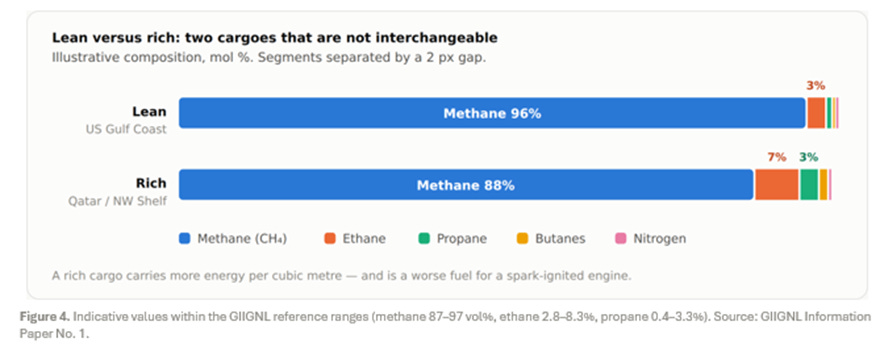
Composition is where the two genuinely part ways, and geography calls the shots. American Gulf Coast LNG starts from pipeline-spec gas whose ethane, propane and butanes have already been stripped out upstream and sold to petrochemical buyers, who prize them more than any LNG customer would. What’s left is a lean cargo — 95 percent-plus methane. Qatari, Nigerian and Australian Northwest Shelf gas turns up at the plant considerably richer, heavier hydrocarbons and all.
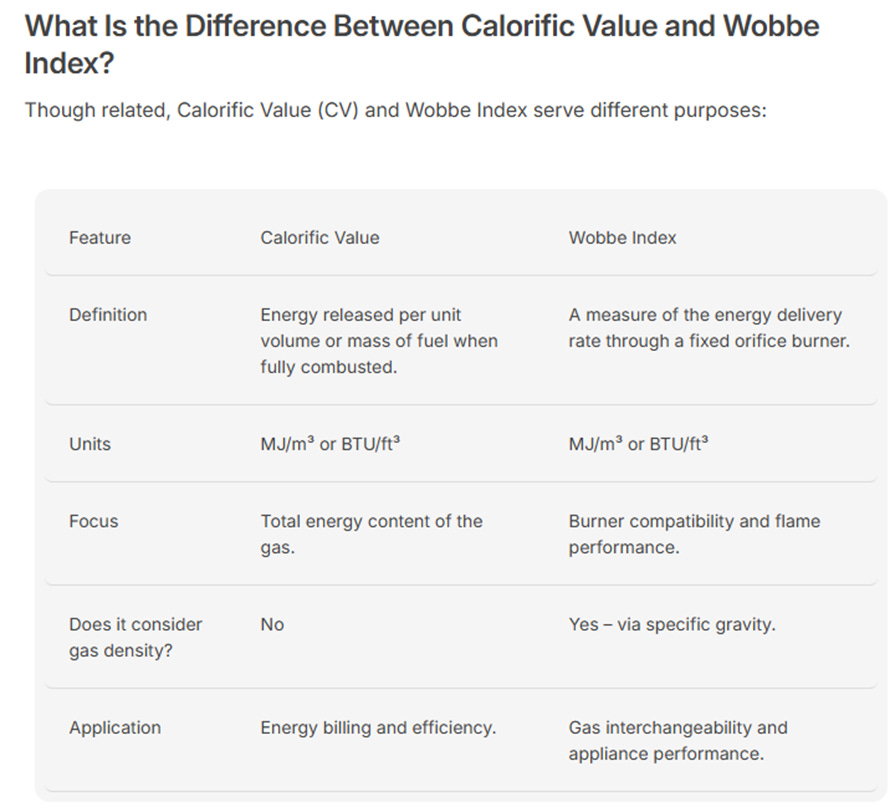
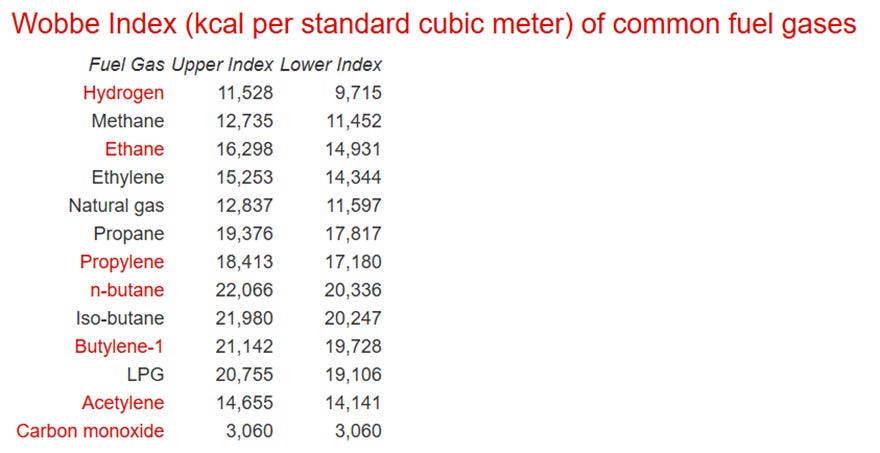
The Wobbe index is a gas’s gross calorific value divided by the square root of its relative density — and two gases sharing a Wobbe number push the same heat through the same burner at the same pressure, so appliances, turbines and industrial burners can swap between them without anyone re-drilling a single jet. That is “interchangeability,” and every gas grid on earth insists on a Wobbe band it will accept.
https://www.yzsystems.com/en/knowledge-hub/wobbe-index/
Rich LNG regasifies to about 1,100–1,150 Btu per standard cubic foot, over the ceiling of many US and North-West European systems. Lean American LNG can sink below the floor the old Japanese and Korean grids were built around. Either way, someone pays rich cargoes get watered down with nitrogen at the terminal, lean ones get topped up with LPG. It is not a footnote — it dictates which cargo is allowed into which terminal, and it keeps lawyers busy.
For gaseous fuels the knock-resistance scale is the methane number: pure methane scores 100, pure hydrogen scores 0. Think octane rating, for gas — and heavier hydrocarbons drag it down fast. German standard DIN 51624 wants MN ≥ 70; European engine makers are angling for ≥ 80, which in practice means methane north of 93.7 percent. A fair slice of the world’s traded LNG simply doesn’t make the cut.
https://www.chemeurope.com/en/encyclopedia/Wobbe_index.html
This is the quiet reason two rival gas-engine designs exist at all. A spark-ignited Otto-cycle engine premixes fuel and air and squeezes them, so it lives in fear of knock — a low methane number of forces retarded timing, derating and lost efficiency. A high-pressure direct-injection diesel-cycle engine squirts the gas at ~300 bar straight into a burning pilot flame, so there’s no premixed charge to detonate and the engine barely cares what the methane number is. The punchline: for an engine, lean American LNG is the better fuel — a neat reversal of the usual hydrocarbon rule that richer is better.
LNG isn’t so much an industry as a relay race. A methane molecule that ends up in a Japanese power station has been handed off between six separate businesses, each with its own balance sheet, its own risks and its own way of...
Read more and discover how to trade it here: https://themacrobutler.substack.com/p/the-lng-energy-relay
Visit The Macro Butler Website here: https://themacrobutler.com/
Join The Macro Butler on Telegram here : https://t.me/TheMacroButlerSubstack
Register your interest to The Macro Butler World Economic Summit 2026 here:
https://themacrobutler.substack.com/p/the-macro-butler-world-economic-s…
☀️ SUMMER SPECIAL — 15% OFF
Ready to understand your money and the markets better?
This summer, take your financial knowledge to the next level with The Macro Butler Financial Academy.
Learn the principles behind:
📈 Investing & Portfolio Building
🌍 Economics & Market Cycles
💡 Smarter Financial Decision-Making
Whether you’re starting your investment journey or looking to sharpen your financial knowledge, The Macro Butler gives you the framework to think differently about money.
🎓 Get 15% OFF when you subscribe.
⏳ Limited Time Offer — Available until September 15, 2026.
👉 Start Learning Now

https://themacrobutler.com/financial-academy/
You can contact The Macro Butler at info@themacrobutler.com

Disclaimer
The content provided in this newsletter is for general information purposes only. No information, materials, services, and other content provided in this post constitute solicitation, recommendation, endorsement or any financial, investment, or other advice.
Seek independent professional consultation in the form of legal, financial, and fiscal advice before making any investment decisions.
Always perform your own due diligence.