Bond Jitters Meet Biotech Fireworks

A Shaky Week, A Strong Finish
The bond market set the tone for most of the week. Persistent inflation, rising oil prices and concern about federal debt pushed Treasury yields higher and pressured stocks, particularly the growth-heavy Nasdaq.
Friday brought some relief. The S&P 500 rose 0.4%, the Dow gained 1%, the Nasdaq added 0.4% and the Russell 2000 climbed 0.9%. The rebound wasn’t enough to erase the week’s losses: the S&P 500 fell 1.4%, the Dow lost 0.8%, the Nasdaq dropped 2.1% and the Russell declined 1.6%.
The split beneath those index numbers was more interesting. Higher rates weighed on long-duration assets, while two very different scientific announcements showed that investors will still pay aggressively for validated biotechnology.
Two Breakthroughs Moved Biotech
Moderna (MRNA) surged 177% Wednesday after the company and Merck announced that their personalized mRNA cancer therapy, intismeran, combined with Keytruda, met its primary and key secondary endpoints in a Phase 3 melanoma trial. It was the first positive Phase 3 result for an individualized neoantigen therapy and an mRNA-based cancer treatment.
The companies haven’t yet disclosed the full effect sizes or overall-survival data, but the result was still a major platform proof point: a customized therapy built from the mutations in an individual patient’s tumor improved both recurrence-free survival and distant-metastasis-free survival versus Keytruda alone.
Twist Bioscience (TWST) rose 23% in the same session after Anthropic disclosed that Claude had designed protein binders against 14 of 15 testable targets. Twist and Adaptyv Bio independently built and tested the designs in the lab, confirming 354 binders from 1,320 designs.
A protein binder isn’t a drug, but this was a meaningful demonstration of AI moving beyond literature review and into the design-build-test loop of experimental biology. We already had an open TWST trade when the news arrived. We also closed an MRNA trade last month for a 491% return on its net debit, although that trade’s July expiration was too early to capture Wednesday’s move.
Those developments were the backdrop for Friday’s The Biotech Bid Broadens, where we explained why we were seeing a wider bid for both therapeutics and the tools that may compress discovery timelines.
How We Traded It
We attempted 11 distinct bullish option setups during the week, but only two filled at our required prices. That low fill rate was intentional. A promising thesis doesn’t make an illiquid option structure worth any price.
Several of those alerts drew on our Multibaggers list: outside analysts whose records we track and who’ve produced multiple recent 100%+ winners. We treat their ideas as starting points, then apply our own technical screens, catalyst work, option structures and entry-price discipline.
Monday: Neither order in Two Engines Of Alpha filled. We left both alone rather than lifting our limits.
Tuesday: One of the two structures in An Immune Cloak And An Alzheimer’s Beachhead filled for a $0.20 net credit. It gives us asymmetric exposure to an early commercial-stage Alzheimer’s company while defining our maximum loss. The long-dated Sana Biotechnology order didn’t fill.
Thursday: None of the three trades in Biotech’s Bid Is Back filled, even after we recalculated one structure. Their catalysts remain interesting; their option prices didn’t meet our thresholds.
Friday: One of the four structures in The Biotech Bid Broadens filled for a $0.25 net credit. It was our Top Names trade on a biopharma royalty platform. The other three orders expired unfilled.
OpEx: One Loss, One Win
Last week was an options-expiration week, so our full Exits post contains 35 partial and full exits. Here are two representative completed trades.
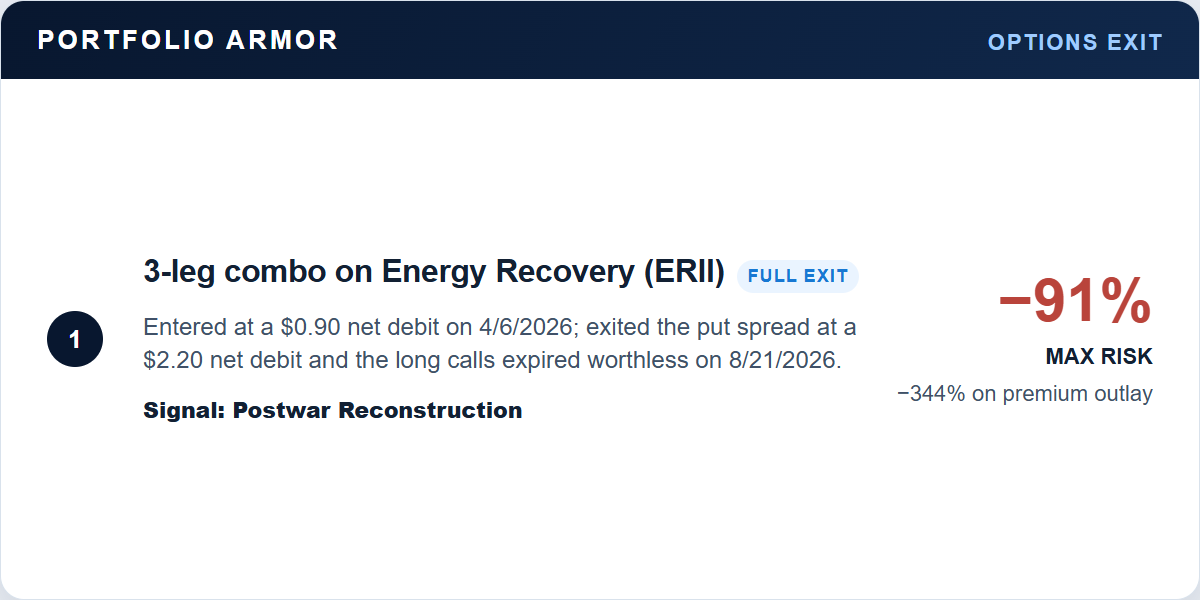
Energy Recovery (ERII) was the loss. We entered a three-leg combo in April as a postwar-reconstruction trade tied to desalination infrastructure. The expected move never arrived before the August options expired. The trade lost 91% of its maximum risk.
Teradyne (TER) was the winner. We entered its four-leg combo for a $2.35 net debit in March, exited the put spread for a $0.20 net debit in April, and sold the call spread for a $16.12 net credit last week. The completed trade returned 181% of maximum risk, or 577% on the original premium outlay.
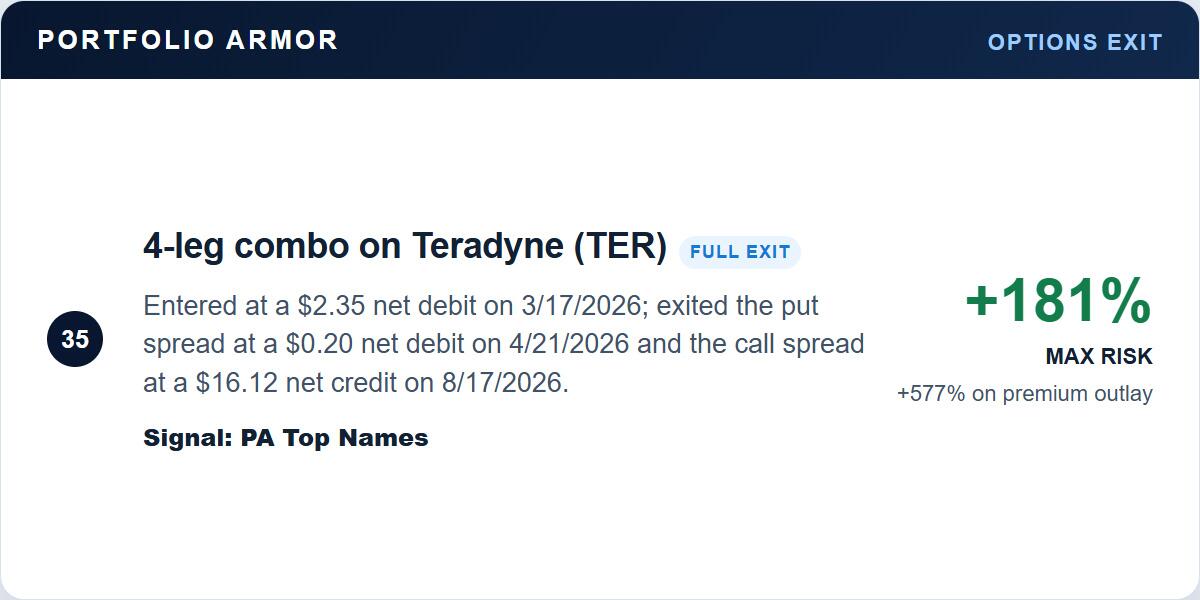
The comparison captures why we define risk at entry and preserve meaningful upside when the thesis supports it. ERII’s loss was bounded. TER’s gain was large enough to matter.
The Next Test
The bond market remains the broad risk. The company-specific test comes Wednesday, when NVIDIA reports fiscal second-quarter results. Expectations are high enough that strong numbers alone may not be sufficient.
The macro test follows at the Jackson Hole Economic Policy Symposium, which runs August 27th through August 29th. With last week’s market pressure centered on yields, inflation and government debt, any change in the expected policy path could move both bonds and growth stocks.
We’ll keep looking for setups where the thesis, technicals, catalyst calendar and option price all line up—and we’ll let the order go when they don’t.
Portfolio Armor posts the exact trades, the prices we’re willing to pay, and the prices where we plan to exit. Our own money goes into every trade we publish, and we publicly document every result. Start here to see how the process works, including how free subscribers can unlock one complete paid trade alert without paying.

And if you want to cover your ass(ets), you can use the Portfolio Armor iPhone app.