





How do you put gold to work without sacrificing security?
Gold is remarkably easy to own.
A bar can sit in a safe for decades without spoiling, defaulting, or requiring anyone else to honor a promise. You don't need a management team to operate it, and you don't need a government to guarantee it. You can simply possess it.
Putting that same gold to work is considerably more complicated.
Once physical gold leaves passive storage and enters productive use, many of the characteristics that make it attractive to own create an entirely different challenge:
How do you maintain confidence in an extraordinarily valuable asset that's small, portable, interchangeable, and constantly moving?
Gold concentrates enormous value into very little space
Most businesses accept some degree of inventory loss.
A supermarket may lose food to spoilage or theft; a clothing retailer may occasionally discover that merchandise has disappeared. These losses are undesirable, but businesses can anticipate a certain amount of "shrink" and incorporate it into their economics.
Gold is less forgiving.
A relatively small amount of metal can represent thousands of dollars.
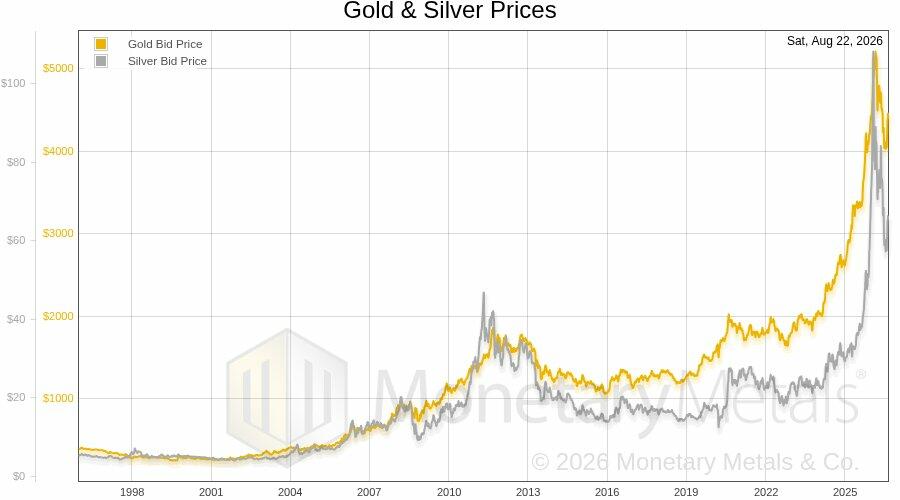
Gold can also be transported easily and divided into smaller quantities without destroying its underlying value.
That changes the economics of inventory control.
A discrepancy that might be immaterial when managing ordinary consumer products can become expensive when the inventory is gold. Small losses repeated over time can quietly accumulate into substantial ones.
Productive assets have to move
The simplest way to protect gold is also the least economically interesting: lock it away and leave it alone.
A sealed bar inside a secure vault is straightforward to account for, comparatively: confirm that the bar entered the vault, control access to it, and periodically confirm that it's still there.
Productive inventory doesn't behave that way.
Consider a business that actually uses gold. Metal may arrive as inventory, move between locations, change form, or eventually leave the business as part of a finished product. New gold replaces what leaves, and the cycle begins again.
Movement creates opportunities for errors, discrepancies, and theft that don't exist when an asset remains stationary.
More importantly, simply knowing how much gold should be present isn't the same as proving how much gold is present.
Accounting records can't verify physical reality
Every sophisticated business maintains records.
Those records might say that a particular piece of inventory exists, weighs a certain amount, contains a particular quantity of gold, and is located in a specific place.
But the record and the asset are two different things.
If someone enters incorrect information, moves an item without recording it, substitutes another item, or simply makes a mistake, the database can remain internally consistent while physical reality has changed.
This is where physical assets present a challenge that financial ledgers alone can't solve.
A system designed to safeguard productive gold must reconcile the digital record with the actual metal. And importantly, that reconciliation must occur frequently enough to identify discrepancies before they compound.
The greatest risks aren't always dramatic
When people imagine gold theft, they may picture masked thieves, smashed display cases, or elaborate vault robberies.
The more mundane risk can be harder to detect.
- Inventory can disappear gradually.
- An employee can make an error.
- Procedures can slowly diverge from written policies.
- A small discrepancy can go unnoticed because nothing dramatic occurred to trigger an investigation.
The result may only become visible during an inventory count weeks or months later.
By then, determining what happened becomes considerably harder.
Protecting high-value inventory, therefore, isn't only about preventing catastrophic events. It's also about detecting small anomalies while enough evidence still exists to explain them.
Productive gold requires verifiability
None of these challenges makes putting gold to work impossible. Instead, they establish a demanding standard for doing it responsibly.
Physical inventory needs to be reconciled against records.
Controls need independent checks.
Unusual activity needs to be identifiable.
Procedures need to be tested against what people actually do.
When something does go wrong, there should be enough evidence to reconstruct the event rather than speculate about it afterward.
Above all, no single safeguard should have to carry the entire burden.
Gold owners have spent centuries valuing physical possession because possession minimizes dependence on someone else's promise.
Putting gold to work introduces that dependence again.
The challenge is preserving as much of the certainty associated with physical ownership as possible while allowing the metal to become economically productive.
That requires more than trust.
It requires the ability to verify.
Watch or listen to our conversation with Gabriel Nasser, founder of TJS USA Inc. and the Chief Asset Assurance Officer at Monetary Metals. He breaks down the technology, procedures, and discipline that goes into protecting productive gold.