AI's Next Bottleneck Isn't Chips. It's Power.
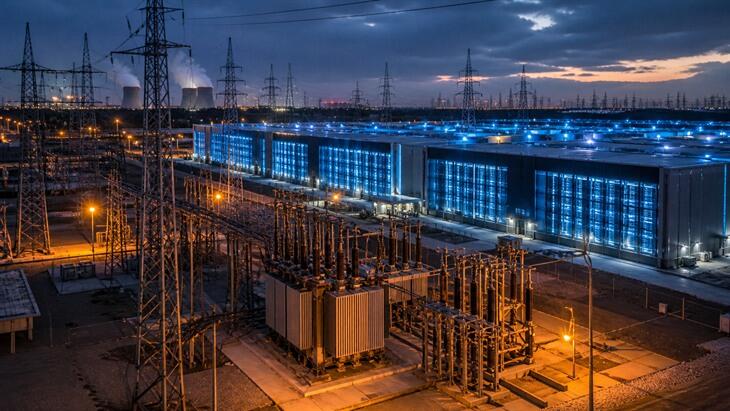
Megawatts Move Slower Than GPUs
Nvidia (NVDA) reports tomorrow. Wall Street will count GPUs. The harder number is megawatts.
AI capital spending can jump in a year. Power plants, turbines, transformers, substations, and transmission lines take years. That mismatch is moving the bottleneck—and some of the upside—down the stack from chips to electricity.
The latest IEA update puts scale on it: electricity use by AI-focused data centers surged 50% in 2025. Global data-center demand is headed from 485 terawatt-hours (TWh) in 2025 to roughly 950 TWh by 2030, while AI-specific consumption triples.
The five biggest technology spenders poured more than $400 billion into capital projects last year. The IEA expects that figure to jump another 75% this year—more than the world invests in oil and gas production.
The Hardware Behind The Hardware
The load is getting denser, too. By 2027, one advanced server rack could draw as much power at peak as 65 households. AI-server power density rose elevenfold from 2020 through 2025; the IEA expects it to quadruple again by 2027.
That strains the whole chain: grid connections, gas turbines, transformers, cables, power electronics, and storage. The IEA's 2025 report says transmission can take four to eight years in advanced economies, while waits for transformers and cables have doubled in three years. About 20% of planned data-center projects face delay if those risks aren't addressed.
The market has started sorting the beneficiaries. The IEA finds the strongest AI linkage among manufacturers of gas turbines and electrical equipment, some nuclear companies, and selected energy startups. The useful screen is time to power: who can add reliable megawatts, connect them, or stretch them further?
Hormuz Was A Stress Test
This year's Strait of Hormuz disruption showed why a 24/7 AI load is also an energy-security trade. EIA data shows Brent crude hitting $118 on April 29th and $72 on June 26th as restricted flows, ceasefire talks, and renewed strikes whipped prices around.
Data-center developers have responded to slow grid connections by pursuing on-site gas generation. The IEA sees 15 to 27 gigawatts of it powering U.S. data centers by 2030. Yet reliable on-site systems may require 30% to 70% more capacity than the load, and turbine backlogs can erase the hoped-for speed advantage.
The winning stack will mix sources: gas for speed, nuclear for firm long-duration supply, renewables and storage where they fit, and better hardware at every conversion point. Selectivity matters most where capacity is scarce and customers pay to get online sooner.
We Traded The Bottleneck Early
We laid out the nuclear side in The Nuclear Option For AI in January 2025. Oklo (OKLO) had announced non-binding letters of intent to supply up to 750 megawatts to U.S. data centers. Our December 20th, 2024 call spread cost $0.20 and exited on June 3rd, 2025 for $0.97: a 385% gain.

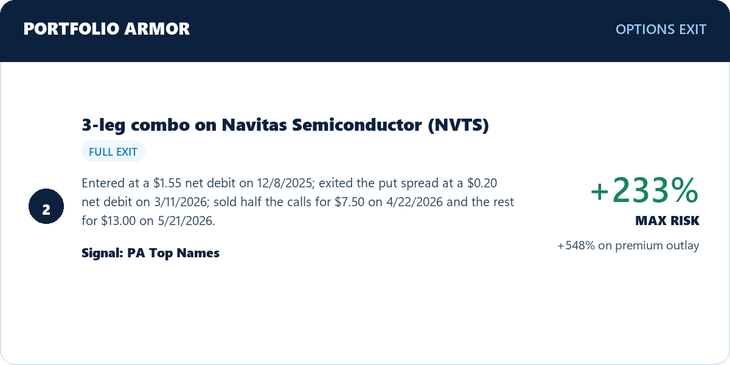
Navitas Semiconductor (NVTS) exposed another choke point: the gallium-nitride and silicon-carbide power semiconductors that raise efficiency inside AI data centers and grid equipment. We entered a three-leg combo on December 8th, 2025 and completed the exit on May 21st, 2026. It returned 233% on max risk and 548% on premium outlay.
The point is timing: overlooked physical constraints can reprice violently once the market sees them. Defined-risk options let us pursue that upside with strictly limited risk.
The Next Trade Follows The Watts
The next opportunity may sit in generation, turbines, transformers, storage, or power semiconductors. Its common feature will be shortening time to power or making each megawatt do more work.
Governments can help AI infrastructure get ahead of the curve. Investors can get there first. Whatever Nvidia prints tomorrow, the demand for power will still be there.
We're hunting the next AI-power trade now. Join us free, and you'll get a heads-up when our next trade alert goes out.