





The President Personally Tried to Make Gold a Critical Mineral.
I’ve spent the last two pieces walking through how the Trump administration is moving gold back into the geopolitical arena via Executive Order, an audit of Fort Knox, and formal sanctions against Iran.
In the context of these developments, investors are likely wondering… “is gold a critical mineral?”
The answer depends on how you look at it. And it ties back to an earlier piece of this story that isn’t really about minerals law. It’s about what the President himself apparently believes.
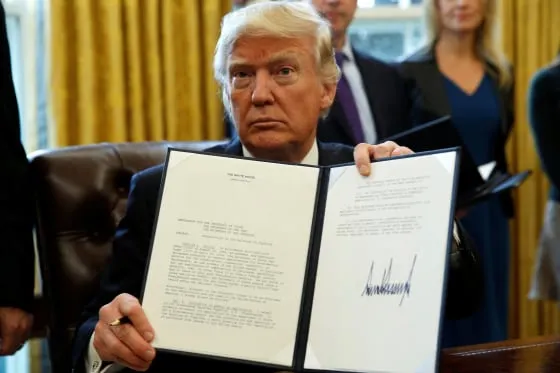
Executive Order 14241, “Immediate Measures to Increase American Mineral Production,” which President Trump signed on March 20, 2025, directed federal agencies to expedite permitting and production for a list of minerals. For the first time in decades, gold was listed as a critical mineral right alongside copper, uranium, and potash.
That’s the President, in the text of a formal executive order, treating gold as if it belongs in the same category as the minerals everyone agrees are critical. And to be clear, we’re talking about being critical in terms of national security.
Let that sink in for a moment.
For 50 years, gold was seen as a “hedge” and nothing more. Warren Buffett famously stated it does nothing but “look at you.” Wall Street didn’t even bother including it in asset allocation models. And if you mentioned “Fort Knox” or “gold as a backstop for the $USD,” people looked at you as if you were talking about Bigfoot or UFOs.
No longer.
The President of the United States, the single most powerful person on the planet, personally designated gold a critical mineral vital to national security in an Executive Order (EO) specifically aimed at accelerating U.S. energy and critical mineral independence.
This tells us that the President and his inner circle view the precious metal as a tool/weapon that is of critical importance regarding national security/decoupling from reliance on the U.S.’s adversaries. Specifically, China.
For years, analysts have called China the “smart money” because it was aggressively buying gold at a time when most developed nations were selling it. The running theme here was that China was “playing the long game,” in terms of economic ascension, acquiring gold by the hundreds of tons in order to position itself as the next economic superpower backed by the precious metal that has served as the ultimate store of wealth for 5,000 years.
President Trump told us, via EO, that he personally is aware of this situation, and is moving to change it.
So why isn’t gold officially a critical mineral?
A single line in the law that actually governs the Critical Minerals List, the Energy Act of 2020, the law the President’s own Executive Order runs alongside but doesn’t control.
You see, when the President moves to implement policy changes rapidly, he needs to invoke a specific legal authority, and on March 20, 2025, he invoked the Defense Production Act through Executive Order 14241, “Immediate Measures to Increase American Mineral Production.” The DPA gives him the power to expedite permitting and funding for mineral projects the government wants moving faster, including gold.
Therein lies the issue.
The DPA is the tool Trump used to move fast. But it is not the law that decides whether something is officially a critical mineral. That designation comes from a completely different statute, one Congress passed years before Trump took office, and one the President doesn’t get to override by executive order.
The official Critical Minerals List runs through the Energy Act of 2020. Congress told the Interior Department, acting through the USGS, to publish and update that list on a fixed schedule, using a specific three part test.
- A mineral has to be essential to economic or national security.
- Its supply chain has to be vulnerable to disruption.
- It has to serve an essential function in manufacturing.
Gold clears the first test easily, arguably more easily than half the minerals already on the list. It fails the second one, and that failure is the single line that keeps it off.
The supply chain test is really an import dependency test. It asks whether the U.S. relies on other countries, especially unfriendly ones, to get enough of something to function.
Gold doesn’t have that problem.
The United States has substantial domestic gold production and reserves of its own. Nobody can cut off America’s gold supply, because America isn’t meaningfully dependent on anyone else’s. There’s no chokepoint to protect, so the statute has nothing to flag.
Now go back to what actually happened here. Trump didn’t sign a generic mineral order and let staff fill in a list. He personally invoked the DPA and had gold named specifically, in the same breath as copper and uranium, minerals nobody disputes are critical. That’s the President putting gold in the same mental category as the minerals America genuinely cannot do without.
The Energy Act said no anyway, on a technicality that has nothing to do with whether gold matters and everything to do with whether America is exposed to a foreign supplier. It isn’t. So the law that was written in 2020 to catch industrial supply chain risk simply doesn’t have a box for what Trump is actually worried about with gold, which isn’t a factory running out of supplies. It’s a reserve asset question, a monetary question, and Congress wasn’t writing that statute with monetary questions in mind.
That gap between what the President tried to do and what the law was built to measure is the real story here. Trump reached for the fastest tool available, the DPA, to move gold into the same category as America’s other strategic minerals. The Energy Act wasn’t built to let him. And so gold is officially not a critical mineral.
Now let’s review the moves the Trump administration has made pertaining to gold since that time.
- Treasury Secretary Scott Bessent offhandedly commenting that the U.S. dollar used to be backed by gold during an interview with Fox News.
- In the same interview, the Treasury Secretary added that the U.S. has performed an audit of its gold holdings at Fort Knox, that all the gold is accounted for, and that at market value it is worth over $1 trillion, the largest gold holdings in the world.
- On Monday this week, during a press conference pertaining to sanctions on Iran, the Treasury Secretary formally classified gold as a sanctionable strategic asset class, in the same breath as crypto and aviation.
When we look at those developments through the lens of the President personally moving to designate gold as a critical mineral vital to national security, everything becomes clear.
A Treasury Secretary doesn’t casually revisit the gold-backed dollar, volunteer a trillion-dollar Fort Knox number, and then formally sanction gold alongside crypto and aviation, unless the administration already viewed gold the way the President tried to make official back in March of 2025.
Gold never got the legal label “critical mineral.” But the President personally trying to secure it tells you where his head was from the start, and China’s decade of quiet accumulation is the backdrop that made waiting on Congress unacceptable. Everything Bessent has said and done since is that same decision, working through whichever door didn’t require the Energy Act’s permission.
Step back and look at what that actually means. For fifty years, gold sat on the sidelines of the financial system, a hedge you owned in case things went wrong and nothing more. What we’re watching now is a government treating it as something else entirely, a strategic asset worth fighting for and a monetary tool worth controlling, at the same time.
That combination hasn’t shown up out of Washington since Nixon closed the gold window in 1971.
This isn’t a trade to time off a single headline. It’s a shift in what gold is allowed to be, and the investors who recognize that now, while the repricing is still underway rather than finished, are the ones who stand to benefit most as the rest of the market catches up.
If you haven’t grabbed a copy of our Survive the Inflationary Storm yet, do it now. What I described two days ago is playing out faster than even I expected.
It explains my top precious metals plays, their names, their ticker symbols, and the resources they own. These are high-octane positions that rallied 75%, 140%, 150%, 180%, 280%, and an incredible 574% in 2025. And I wouldn’t be surprised to see them repeat this performance in 2026.
Normally I’d charge $499 for this report as a standalone item, but considering what is unfolding today, we are making just 100 copies available to the public.
To grab one of the last remaining copies…
Best Regards,
Graham Summers
Chief Market Strategist
Phoenix Capital Research