





Europe's Gas Squeeze Just Got Worse
EU natural gas prices hit new cycle highs this morning, €69/MWh, after Qatar again extended its LNG force majeure. European buyers are pushed into November, Pakistan into October. Worth noting that, unlike oil tankers, gas tankers through the Strait of Hormuz remain near a standstill, as LNG carriers are scarcer and more valuable. The squeeze is not easing.
TTF is now near its highest in more than three and a half years, the strongest since the last energy crisis, and up more than 70% from the April lows. We think there is more to go. Europe is refilling storage far too slowly, into a full Russian phase-out next year that is not talked about enough. The official message remains that all is well. The data, and increasingly Germany, say otherwise.
TTF price (€/MWh)
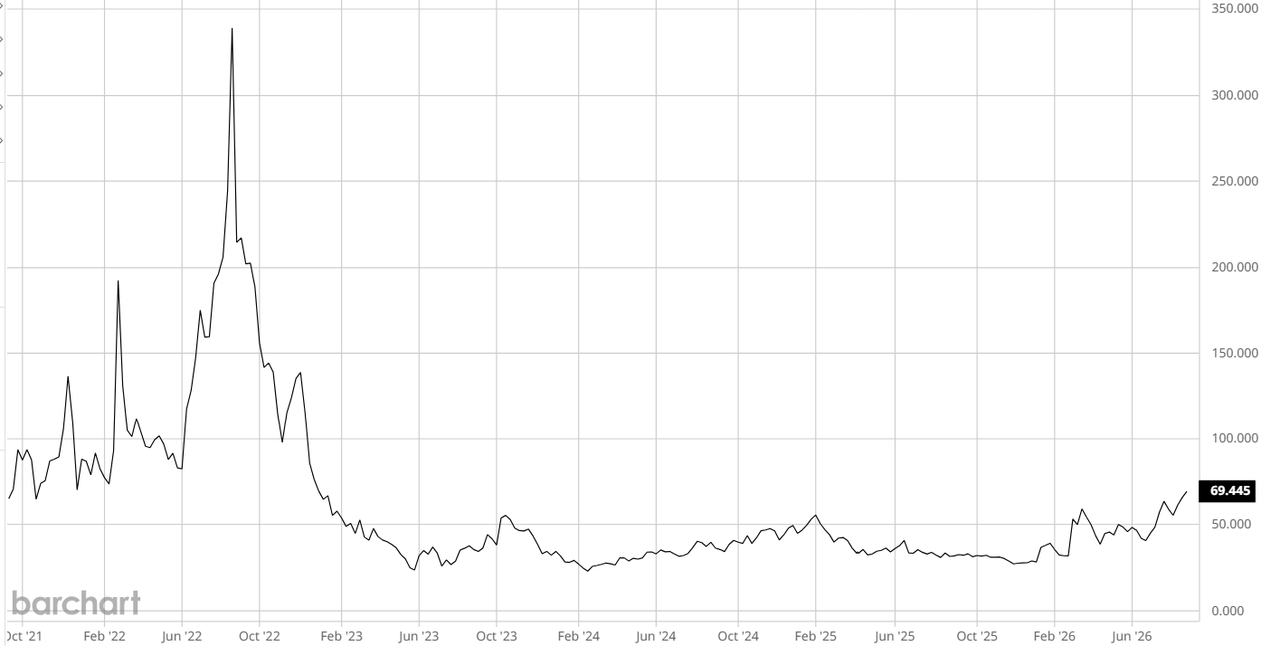
Source: Barchart (Month ahead)
Brussels remains in denial
The European Commission continues to downplay the risk. It has cut the winter storage goal from 90% to 80% and maintains there is no immediate concern over security of supply, pointing to the resilience the system has shown so far. The argument is that storage, adjusted for lower annual consumption, leaves the winter outlook comfortable. But we would want to see what happens to TTF if that extra storage capacity were permanently removed today.
We think the reasoning is naive. Last winter, which was warmer than average, still produced a net storage draw in line with pre-Ukraine-war levels. Repeat that draw from where we now expect storage to peak, and inventories reach crisis levels of around 17 bcm by April. That is before the elephant in the room: the scheduled full phase-out of Russian gas next year, into which the EU still relies heavily on Russian volumes. There appears to be a reluctance among officials to remind the market of this, yet once the phase-out takes effect Europe faces a structural shortfall regardless of the weather.
A further risk we think is entirely unpriced: that Russia cuts its remaining exports abruptly, and sooner than 2027. Any U-turn on the phase-out would be legally and politically complex, which leaves Russia with significant leverage over the EU at its most vulnerable point, with tensions over Ukraine still unresolved. We suspect more pain for the EU comes first.
Germany starting to say otherwise
Germany is now taking a different tone, and this is the more telling development. German transmission operators have warned the country's winter storage target is virtually unattainable. Sites are only around 50% full, the lowest seasonal level since records began in 2009, and the operators have called on the government to require market participants to secure sufficient volumes through the end of winter.
The Economy Ministry has said it will prepare contingency measures if security of supply deteriorates further, looking not only at German fill levels but at LNG and import availability in neighbouring countries. Officials have floated 60 to 70% fill as sufficient, a quiet retreat from the previous 70% legal target. When the largest gas consumer in Europe starts preparing for intervention while Brussels projects calm, we would pay attention to the former.
Supply picture has worsened
Beyond Qatar and Hormuz, the near-term picture has also softened. Since early August, average daily injections have run around 10% below our forecasts. Three supply developments compound the problem:
First, Norway. Ormen Lange output has fallen by 8.9 mcm/day from its normal 22.9 mcm capacity, and Gassco has pushed the return to full operations from October out to February 2027. The problem extends into next year: on currently scheduled planned outages, Norway's 2027 maintenance programme is around 20% heavier than 2026 and concentrated in the autumn refill window.
Second, shipping. Beyond the Hormuz constraint on LNG, the Panama Canal will cut daily transits from 36 to 32 from mid-September as an intensifying El Niño threatens water levels. The restrictions should at least moderately sustain international prices.
Third, price signals. Time spreads are still not incentivising refill, and Europe to Asia differentials, while improved, are arguably on a thin edge.
The next month is critical. The window from now to late September has historically accounted for more than 60% of the season's remaining refill. If the EU and Germany are going to wake up and act, this is the window to do it, and forcing refill into a tight market is bullish TTF. If they do not, they push the problem further down the road, into a phase-out year with even less room to manoeuvre. Either way, we struggle to see how this resolves at lower prices.
We cut our storage forecasts again
We have lowered our EU storage forecasts again, the fourth downgrade since the Iran conflict began. We now expect storage to peak at only around 72% before winter, the lowest pre-winter peak of any year in the chart below. Europe would enter the withdrawal season worse stocked than in any recent year.
Our EU 2026E Gas Storage Forecast vs History (% full)
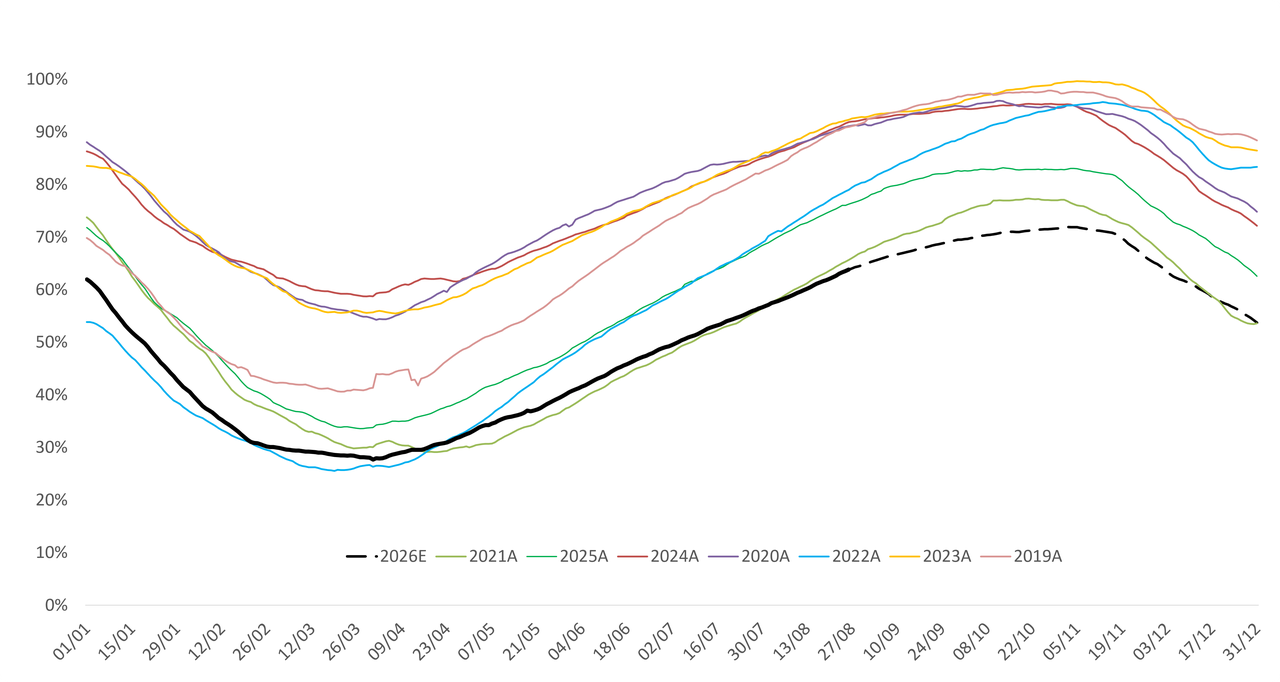
Source: GIE AGSI. 2026E estimate = Asymmetric Research
From that peak, we ran the following winter's drawdown at each of the last seven years' actual draws. Four of the seven finish below 30% by April, and even the mildest outcome was only reached, historically, at crisis-level prices. None of these paths yet counts the Russian phase-out. We set out the full scenario analysis, and how we are positioned, in our latest note on Asymmetric Research.
Bottom line
The Qatari force majeure, the Hormuz constraint on LNG, weak injections, the Norwegian outages and the looming Russian phase-out all point the same way. Official messaging continues to downplay the risk, but Germany is breaking ranks and the price is moving. We have been long TTF since the Iran crisis began. It is playing out, but there is more to go, and time is running out to refill.
[...]
This article is based on research originally published on Asymmetric Research. Our latest note, “EU Natural Gas: A Rude Awakening”, sets out the full storage scenario analysis and how we are positioned across energy. Read it at: asymmetricresearch.substack.com
***
Disclaimer: This article is for informational purposes only and does not constitute investment advice or a personal recommendation. Past performance is not indicative of future results. The value of investments can go down as well as up. Natural gas and related instruments are highly volatile. Readers should seek independent professional financial advice before making any investment decision. We are long TTF futures.