AI Broadens. Warsh Pushes Back.

The Breakout Met The Bond Market
Wednesday set the policy backdrop. The PCE price index rose 3.7% year over year in July, while the core measure rose 3.3%. Both increased 0.2% from June. Inflation had cooled from its peak, but it was still running well above the Fed's 2% target.
Thursday supplied the growth counterweight. Nvidia (NVDA) reported $96.2 billion in quarterly revenue, including $89.0 billion from data centers, and guided to roughly $108 billion for the current quarter. The S&P 500 gained 0.7% and the Nasdaq 100 jumped 1.4%. Technology rose 3.4% even as every other S&P sector and the equal-weighted index fell.
Software supplied the broader signal. Strong earnings pushed the group sharply higher, and the software-to-semiconductor ratio broke out. Our Thursday Top Names commentary showed the same concentration from the bottom up: seven of ten names were tied to the technology stack, with the top four clustered in memory, storage and AI infrastructure.
Warsh Raises The Hurdle
Friday raised the hurdle. In his Jackson Hole remarks, Fed Chair Kevin Warsh said policymakers need confidence that underlying inflation is moving toward 2% "clearly and at sufficient speed." Otherwise, he said, the Fed has work to do. The two-year Treasury yield jumped to about 4.35% from 4.22% just before the speech.
Stocks bent without breaking. The S&P 500 slipped 0.2% Friday and the Nasdaq fell 0.5%, yet they still finished last week up 0.5% and 0.8%, respectively. The Russell 2000 lost 1.5% for the week. The opportunity widened within growth while the rate hurdle rose: companies now need current cash flow or unmistakable operating momentum to carry long-duration valuations through higher yields.
How We Traded It
Monday's three-biotech alert paired long-dated catalysts with firm entry prices. One structure filled; two expired unfilled.
Tuesday combined a profitable cross-border growth platform with a cell-therapy retry. We repriced both structures as their intraday fair values changed. The growth trade filled; the biotech retry didn't.
Wednesday brought two Top Names energy setups, one tied to gasoline and the other to liquefied natural gas. Neither market met our limit.
Thursday paired connected-TV advertising with a revised prime-editing trade. The advertising structure filled; the biotech order remained unfilled after a same-day reprice.
Friday's software-and-biotech alert put the week's market thesis into practice. The commercial-stage biotech filled. The AI-software structure didn't.
Four of 11 proposed structures filled. The other seven expired at the end of their trading days. Every new position entered inside its published limit.
Four Full Exits, Then The Ratchet
Friday's Exits post included four completed trades and nine partial exits. Most partials were short calls bought back for $0.20 or less, removing the cap from the corresponding long calls. Those runners now enter the weekly review process we described in Sharpening The Saw.
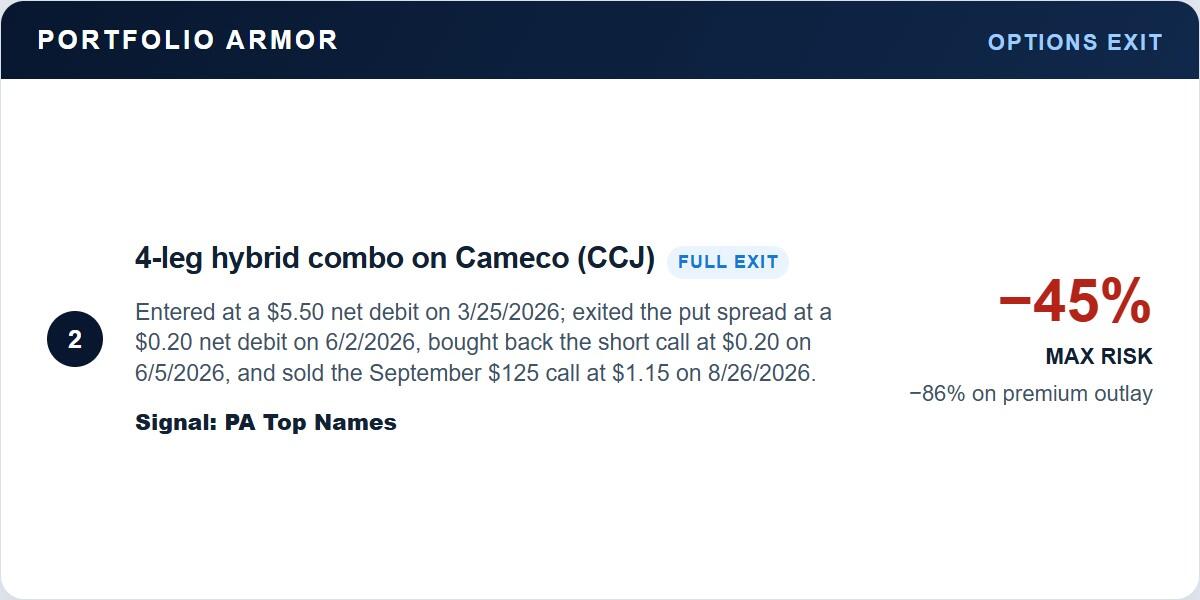
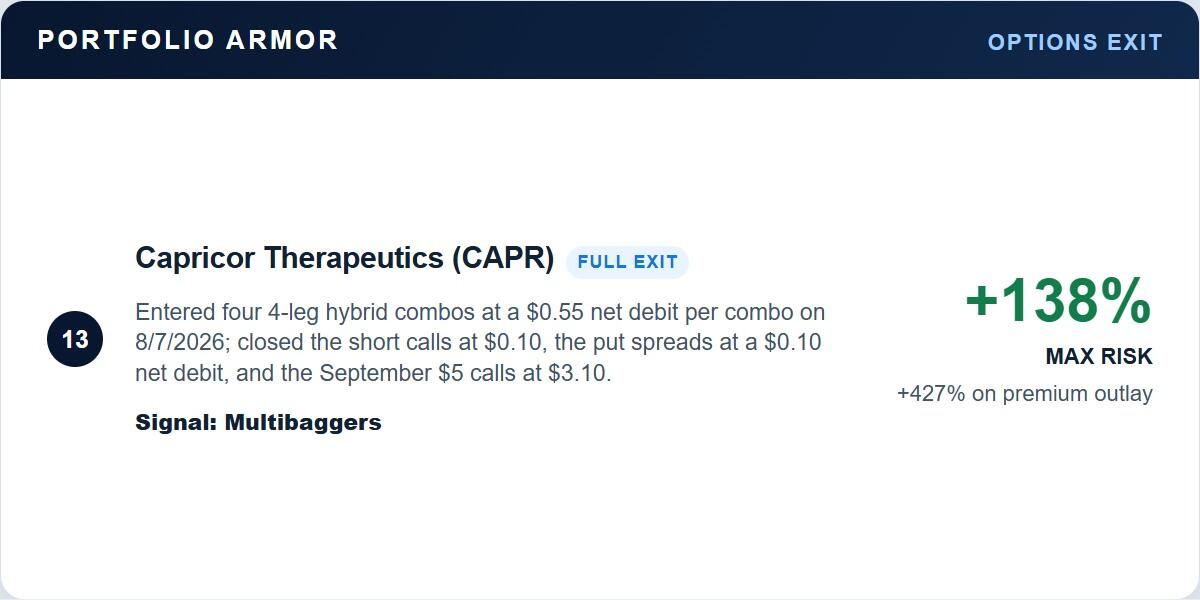
The completed trades showed the intended asymmetry. Our Cameco (CCJ) hybrid lost 45% of its defined maximum risk. Our Capricor Therapeutics (CAPR) hybrid gained 138% on maximum risk.
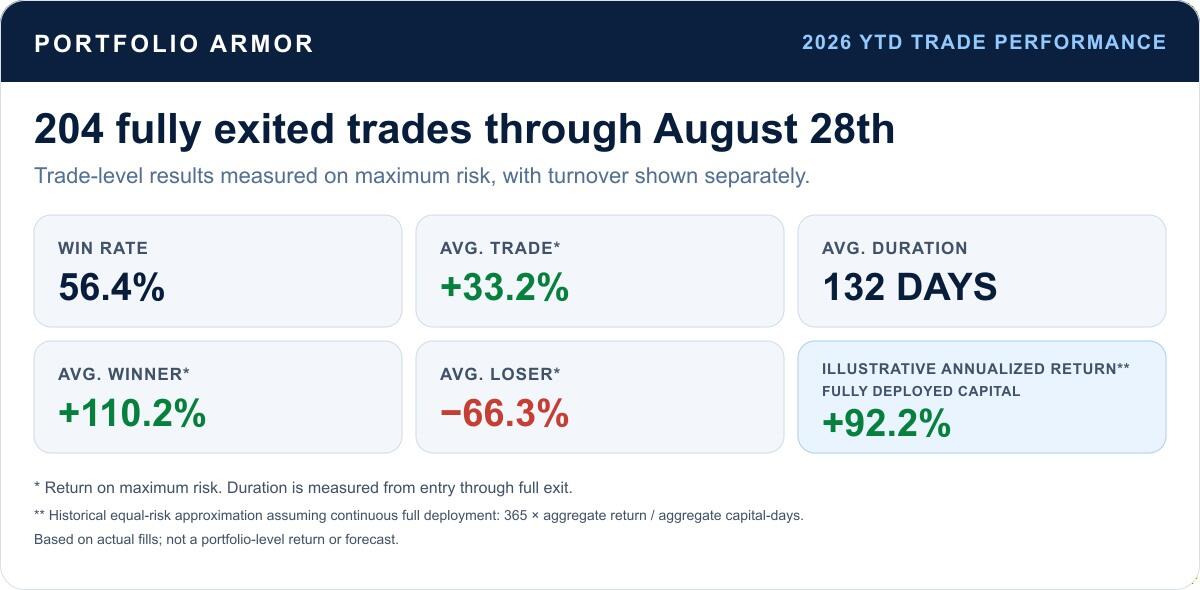
Across 204 fully exited trades in 2026 through August 28th, our win rate was 56.4%. The average winner gained 110.2% on maximum risk, the average loser fell 66.3%, and the average trade returned 33.2%.
Payrolls Get The Last Word
Warsh committed the Fed to a standard, not a preannounced decision. Markets will test that standard quickly. JOLTS arrives Tuesday, and the August jobs report follows Friday at 8:30 a.m. ET.
For us, the next setup needs to clear three gates: operating evidence, technical strength and an options price that preserves the asymmetry. When one does, we'll write it up as a trade alert. We send those out premarket, so you can enter the trade at the same time we do.
If you'd like a heads up and a free unlock when we send out our next trade alert, feel free to subscribe to our trading Substack/occasional email list below.