





THE HUNGRY DECADE
Civilisation is a magnificent thing — the apps, the ETFs, the geopolitics, the artisanal oat milk. It is also, at all times, roughly nine missed meals from turning into a very motivated mob. Every state, however sophisticated, is really just a promise that dinner will show up tomorrow. Renege on that promise and watch how quickly your beautiful institutions lose an argument with a hungry crowd. So when J.P. Morgan titled its August 2026 report Food security is national security, that wasn’t a clever metaphor. It was the oldest fact in politics, wearing a Bloomberg terminal.
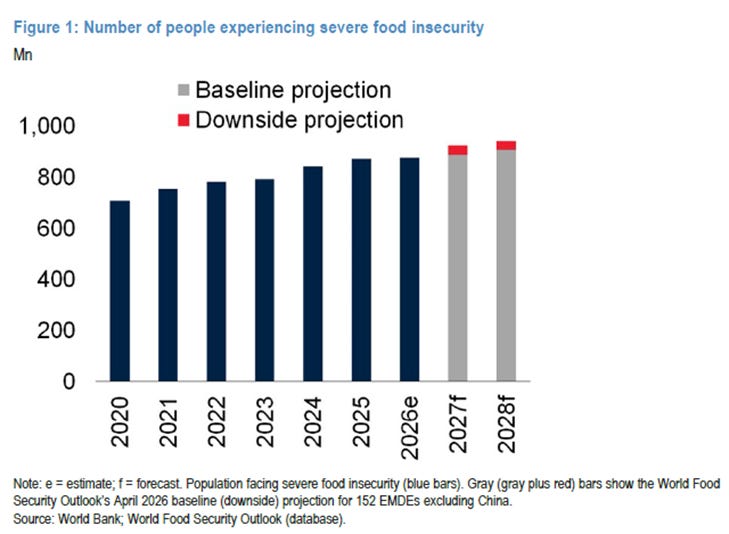
And the facts don’t fit on a fridge magnet. The FAO counts roughly 2.1 billion people — one in four of us — living with moderate or severe food insecurity in 2025, and 645 million going properly hungry. The hunger rate has technically improved (7.8%, down from 8.6% in 2022), which is the statistical equivalent of your ship taking on slightly less water. Underneath, the plumbing is getting worse: outside China, the ranks of the severely food-insecure swelled by about 165 million between 2020 and 2025, with the World Bank pencilling in another 35–70 million by 2028.
Now the part that should interest anyone with a portfolio and not just a conscience. This is no longer a faraway problem for faraway places. A Washington Post–Ipsos poll this year found 66% of Americans now think groceries are unaffordable — up from 45% in February — and that includes most households pulling in over $100,000. Food insecurity has quietly stopped being something that happens to other people and started being the number that ambushes you at the till. It’s not a headline anymore. It’s your receipt.

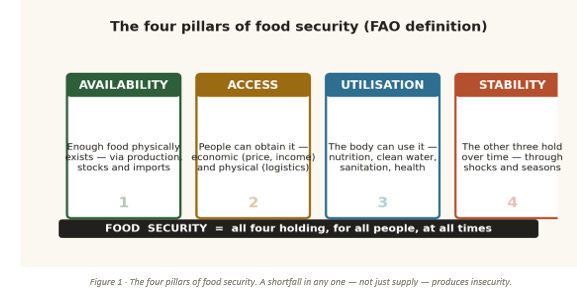
“Security” conjures a cosy image: a bulging silo, a shelf you could photograph for a stock catalogue. But food security isn’t a quantity — it’s a checklist, and a fussy one. Since the 1996 World Food Summit it has rested on four pillars that must all stand at once, for everyone, all the time. Kick out just one and your household is officially insecure — cold comfort that there’s a mountain of grain sitting pretty in a warehouse three time zones away, where it can’t butter your toast.
Meet the four pillars. Availability is the one everyone pictures: does the food actually exist — grown at home, left over in storage, or shipped in? Access is sneakier, and in rich countries it’s usually the real culprit: can you get the food, or does the wall in your way have a price tag (too dear) or a location problem (a washed-out road, a shut port, a neighbourhood with three vape shops and no greengrocer)? Utilisation asks whether your body can turn lunch into actual nutrition — which needs clean water, sanitation and health, a tidy reminder that food security and water security are the same headache, not two. And stability is the referee governing all three over time: eating well in an average year is no consolation if one drought, war or price spike tips you over the edge.
This foursome cracks an awkward paradox. The world grows more than enough calories for everyone — on availability alone, we’re in surplus, practically drowning in the stuff. People still go hungry because of access (can’t afford it) and stability (something knocked the table over). That’s why food crises are usually price crises, not harvest crises, and why the very same failure can clobber a Cairo apartment block and a small town in Kansas through entirely different pillars. Keep this distinction in your back pocket — it unlocks everything ahead, including where the money is to be made.
Food does not simply materialise on a shelf, no matter what your local supermarket’s lighting implies. It runs a long, accident-prone relay from seed catalogue to fork, and at every hand-off both value and a startling amount of the actual food quietly leak onto the floor. Two reasons to care about this chain: it shows how a stumble in one spot trips everyone downstream — and it shows an investor precisely which batons are worth owning.
It starts with inputs — seed, fertilizer, fuel, water, machinery and credit. This is the least glamorous link, the one nobody photographs, and (spoiler) the one currently sweating hardest. From there the baton passes to production on farms, fisheries and feedlots; to processing — milling, refining, packing and, crucially, keeping things cold; to distribution, that vast circus of freight, ports and shipping that a landlocked drought or a single blocked strait can bring to a dead stop; to retail; and at last, to consumption, at your table or your favourite restaurant. Your humble loaf of bread may rack up more air miles than you do.
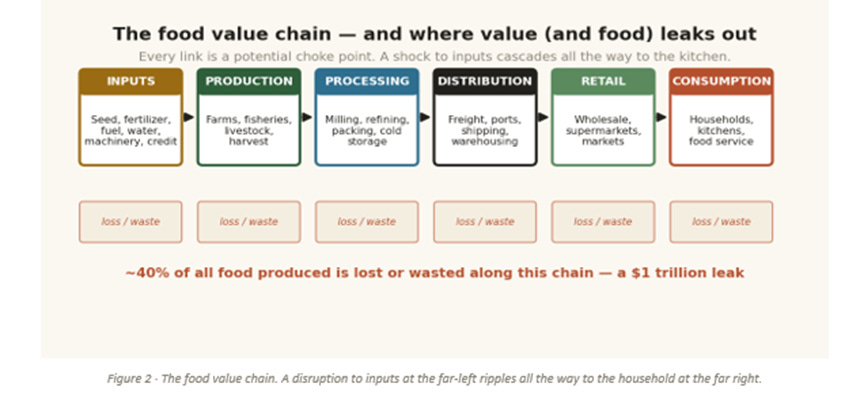
Every link is a potential choke point, and the chain snaps at its weakest one. A fertilizer shortage doesn’t politely stay put — it becomes a thinner harvest a season later, a pricier bag of flour the season after that, and eventually a loaf that makes you wince at the till. This is why today’s headaches are tomorrow’s price tags: farm shocks take six to twelve months to fully land, so 2026’s fertilizer and fuel dramas are really just an invoice, postmarked 2027.

The reality boils down to five structural drivers of food insecurity — five forces that,...
Read more and discover how to trade it here: https://themacrobutler.substack.com/p/the-hungry-decade
Visit The Macro Butler Website here: https://themacrobutler.com/
Join The Macro Butler on Telegram here : https://t.me/TheMacroButlerSubstack
Register your interest to The Macro Butler World Economic Summit 2026 here:
https://themacrobutler.substack.com/p/the-macro-butler-world-economic-s…
☀️ SUMMER SPECIAL — 15% OFF
Ready to understand your money and the markets better?
This summer, take your financial knowledge to the next level with The Macro Butler Financial Academy.
Learn the principles behind:
📈 Investing & Portfolio Building
🌍 Economics & Market Cycles
💡 Smarter Financial Decision-Making
Whether you’re starting your investment journey or looking to sharpen your financial knowledge, The Macro Butler gives you the framework to think differently about money.
🎓 Get 15% OFF when you subscribe.
⏳ Limited Time Offer — Available until September 15, 2026.
👉 Start Learning Now

https://themacrobutler.com/financial-academy/
You can contact The Macro Butler at info@themacrobutler.com
Disclaimer
The content provided in this newsletter is for general information purposes only. No information, materials, services, and other content provided in this post constitute solicitation, recommendation, endorsement or any financial, investment, or other advice.
Seek independent professional consultation in the form of legal, financial, and fiscal advice before making any investment decisions.
Always perform your own due diligence.