





Cheap Uranium Is Over
Kazakhstan: the acid-plant delay tightens 2027 supply
The most direct supply development is the delay to the commissioning of Kazatomprom's (KAP) new sulphuric acid plant, now pushed to between Q3 2027 and Q1 2028 from an initial Q1 2027 schedule. We think this means Kazakh production in 2027 runs 5 to 12% below subsoil entitlement, with production essentially flat year on year at around 73 Mlbs if the delay extends to Q1 2028. This is supportive for our thesis. We await KAP’s announcement of its 2027 production plans.
Kazakhstan: the strategic reserve is the potential game changer
More importantly, we believe the market has barely digested the strategic uranium reserve set out in the country's Nuclear Industry Development Strategy to 2050. The strategy was published in April, so this is not new news, but its implications for available supply are significant.
Kazakh Nuclear Industry Development Strategy to 2050, key targets

Source: Asymmetric Research, Information Legal System of the Republic of Kazakhstan (Ministry of Justice)
The strategy earmarks very large strategic reserves, 19 to 28% of current Kazakh uranium reserves set aside for 2040-50, versus domestic nuclear targets of 6 to 8.4 GW. This suggests the intent to hold uranium sufficient for the entire 80-year life of each planned reactor. It raises a serious question: if the lowest-cost producer in the world starts sequestering uranium on this scale, the Western utilities' customary up to three-year inventory coverage standard may soon look obsolete.
Kazakh uranium reserve targets and possible implication on available production for market

Source: Asymmetric Research, Information Legal System of the Republic of Kazakhstan (Ministry of Justice)
No start date for sequestration is disclosed, but the strategy notes Kazakh production will decline from 2035 as mines close, which implies the build-up must begin well before then. On our numbers, sequestering enough to meet the 2040 target implies removing around 19 Mlbs a year from available production, c20% of subsoil. Uranium that goes into a national reserve is uranium that does not reach the market.
Kazatomprom's costs have exploded
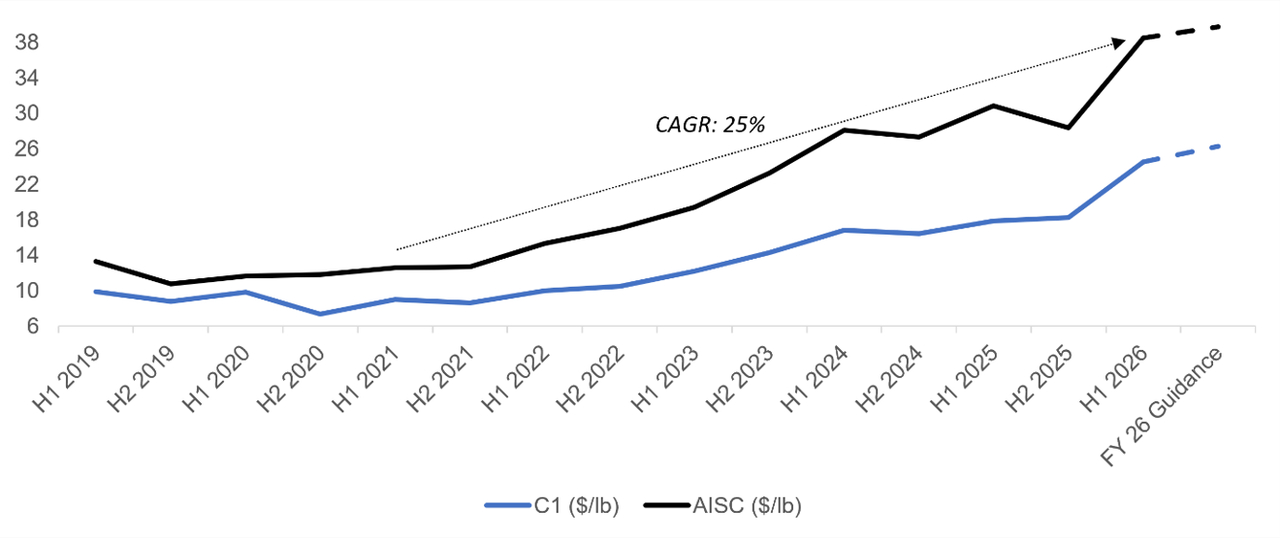
A recurring theme in our work is that the cost of producing uranium has risen structurally, and KAP’s latest guidance reinforces it. The company raised its AISC guidance towards $40/lb, partly blaming unfavourable FX. But the FX explanation only goes so far: AISC is up threefold since 2019, with cash costs up by a similar factor, and since 2021 both have compounded at around 25% a year – unrelated to FX.
KAP AISC over time ($/lb)
Source: Asymmetric Research, company reports
This matters because it tells us something about the floor price for uranium. In the last cycle, spot bottomed at $18/lb after Fukushima and term bottomed at $29/lb in 2018, against a KAP AISC of around $12/lb in 2019. In other words, spot bottomed at a 50% premium to KAP's AISC. Apply the same relationship to today's cost base and it points to a nominal floor nearer $60/lb. As KAP's CEO put it at the H1 release, the era of cheap uranium is fading. We agree.
Where this leaves us
The developments since we last wrote all point the same way: 1) the sulphuric acid plant delay tightens Kazakh supply into 2027; 2) the Kazakh strategic reserve, once it begins, takes a structural chunk of the world’s lowest-cost production out of the market for years; 3) KAP's production costs have exploded over the past years, and the era of cheap uranium indeed looks to be over.
And then there is the elephant in the room. We continue to see a utility restocking cycle as probable within the next three years, few talk about it and the market is not pricing it, at all.
Equities now discount…
[…]
This article is based on research originally published on Asymmetric Research. Continue reading, including full equity valuations and positioning across the sector at: asymmetricresearch.substack.com
***
Disclaimer: This note is for informational purposes only and does not constitute investment advice or a personal recommendation. Past performance is not indicative of future results. The value of investments can go down as well as up. Uranium and related equities are highly volatile. Readers should seek independent professional financial advice before making any investment decision