





Gold’s latest bull market has further to run as sovereign buying, changing portfolio behavior and concern over public finances continue to support the metal. Its relationship with real interest rates has changed since 2022, weakening models built around the assumption that higher real yields must produce lower gold prices.
In the Financial Times Bhanu Baweja, chief strategist at UBS Investment Bank, said the current advance began in 2018 and has returned approximately 19% annualized. Declining real rates and Covid-era quantitative easing started the rally, but the freezing of Russia’s foreign reserves later produced a more fundamental change.
Three Bull Markets
Gold has experienced three major bull markets since Bretton Woods collapsed in 1971. The first ran from 1971 to 1980 and produced annualized gains of 46% over eight and a half years. Baweja linked the revaluation to the breakdown of the postwar monetary system, deeply negative real rates, geopolitical uncertainty and widening fiscal deficits.
The second ran from 1999 to 2011 and generated annualized gains of almost 18% as gold became financialized, Chinese commodity demand expanded and US monetary policy remained exceptionally loose.
Russia’s Reserve Freeze Makes Them “Want the Gold”
Baweja identified February 2022 as the point when gold’s established relationship with real rates broke down.
“For the first two decades of this century, a 1 percentage point move in US real rates typically coincided with a roughly 14 per cent move in gold in the opposite direction. That relationship ended in February 2022, when western governments froze Russia’s foreign exchange reserves. Reserve and asset managers globally were left confronting a simple question: if $630bn held in Treasuries, Bunds, gilts and other bonds could become inaccessible overnight, what constituted money? Their answer was gold. Emerging market central banks and sovereign funds have since increased gold allocations from 5 to 7 per cent of reserves in 2022 to 11 per cent today, still short of the 26 per cent held by developed-market peers.”
The change became clear as US five-year real yields rose more than four percentage points between March 2022 and October 2023. The historical relationship implied gold should fall approximately 55%. It gained 7% instead. Over the following two years, real yields declined less than one percentage point while gold rose 110%.
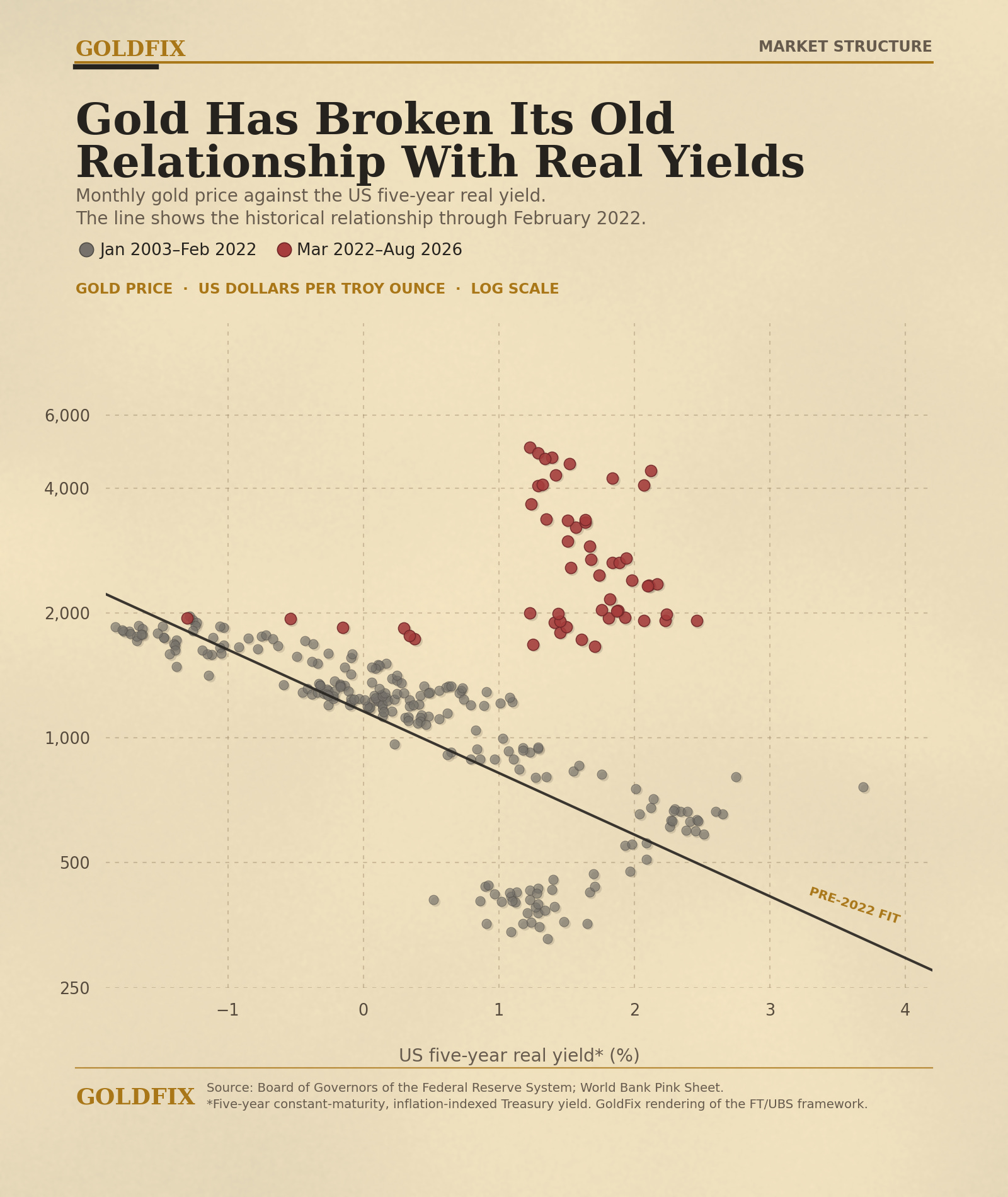
Baweja said gold is now more responsive to falling real yields and less sensitive when they rise. This asymmetry has left many fair-value models describing gold as extremely overvalued since approximately $2,500 an ounce.
Bonds No Longer Provide the Same Hedge
Positive correlation between bonds and equities has provided cyclical support. During the inflationary environment of the past five years, bonds have frequently failed to offset equity losses, while gold has generally offered stronger diversification.
Free Posts To Your Mailbox