





Continues here


Macro Trader: "The Treasury Picked a Fight Gold Can Win"
Macro Analysis: The Treasury Picked a Fight Gold Can Win
Authored by a GoldFix Founder and Executive Director at a leading investment firm.
The Goldfix VBS generated a buy signal on 10-year Treasury yields (yields up) at the end of July. As if to confirm, charts circulated in the gold community towards August month end highlighting the chance of an imminent breakout in yields over the next few months. Was the fiat credit system creaking?
The signal was directionally correct with the yield closing in July at 4.7347% and in August at 4.7500%. However, volatility expansion was lacking. The distribution of the trade’s potential outcomes had altered[1]. It is worth taking a closer look at why.
We entered August against the backdrop of the new Fed Chairman’s June and July pressers. In these he indicated a preference for a normalisation of the risk or term premia[2] along the Treasury curve: Premia that have been suppressed by the multiple QE programs of the last 20 years, which, some would argue, have caused distortionary effects[3]. From around the middle of June until the middle of August, term premia at the various maturities increased.
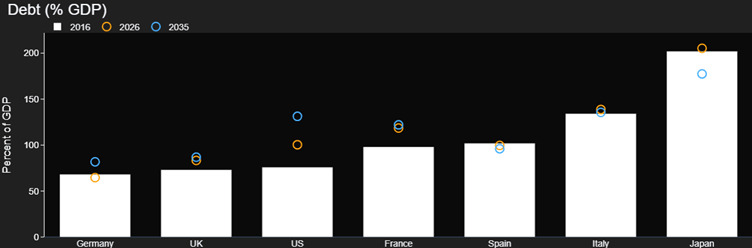
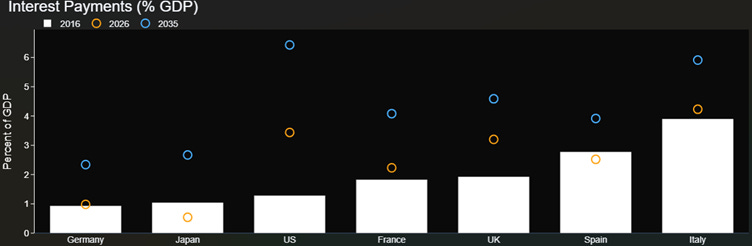
In contrast, the Treasury Secretary was already invested in supporting the Japanese Yen through jawboning/rate checking and actual intervention, and, as some noted, was sensitive to the level of US 30y yields in that context[4]. Any further reduction in Japanese holdings of US Treasuries would be problematic. This picture is compounded by a growing narrative around the sustainability of the US fiscal position. An analysis by Bloomberg Intelligence comparing projections of Debt/GDP and Interest Expense/GDP amongst major developed economies is shown below:
Source: Bloomberg
Source: Bloomberg
One can always take issue with analysis; the key is that the Bloomberg analysis will have been seen by many market participants. The adage that the US is the cleanest dirty shirt in the laundry is under threat. Supporting this from a market context, for example, since the middle of June to date, currencies of low Debt/GDP countries such as Norway and Sweden have been rewarded versus the US Dollar.
On 19th August, the Treasury Secretary surprised the market with a decision to at least double the size of the Treasury buyback operations from $2bn to $4bn. Whilst a surprise, this was perfectly in keeping with the Treasury’s stated primary goal of its public debt policy: which is to finance the government at the lowest possible cost over time while maintaining a stable, liquid market for government securities. The problem is that there was no liquidity problem in government securities. Not only was there not a problem, from the end of July onwards, liquidity (or dispersion between illiquid and liquid issues) was on an improving trend from an unproblematic level. The market, therefore, assumed that the Secretary was aiming to finance the government at the lowest possible cost through manipulating the bond market. Again, this is perfectly in keeping with the Treasury’s debt management policy. Yields and term premia softened modestly in response. The 30y remained soft the following day with the 10y reversing course.
The operation is slated to run from 9th September until the QRA in November, just after the mid-terms. If deployed to its maximum capacity, approximately 17% of new long-end issuance (even though auctions are not a problem) would be taken out by the extinction of illiquid off-the-run bonds. Seeing this is as a yield management operation with little justification, Gold rallied $200. The logic behind the move in Gold was a concern over fiscal dominance. Specifically, that monetary inflation through removal of duration from the long end would likely be delivered in one of two ways[5]:
Commercial bank balance sheet expansion to accommodate bill issuance
If Commercial bank demand were satiated, Reserve Management Purchases by the Federal Reserve
One can only assume that the Treasury Secretary was unenthused with the bond market’s response.
On the 24th of August, he let it be known to CNBC that the $950bn Treasury General Account with the Fed could be deployed. The Gold market thought a collective “I told you so”, and bond yields softened.
On the 28th of August, The Chairman of the Federal Reserve delivered his first Jackson Hole address. It was hawkish. He majored on price stability. Trading algos picked up on the use of the word “hike” three times in the initial address. Short rates rose, long rates fell and the gold rally (and the “debasement trade”) was punctured. However, at the time of writing, yields are around their levels on the 19th of August. The crux of the matter is that bonds are not responding to inflationary concerns[6] as much as to real growth. It is real rates that are adjusting; not inflation break-evens. Whilst personal consumption expenditures are running high and capex related to AI buildout even higher, the pressure on bond yields will continue to be in the upwards direction (notwithstanding the further consideration of the competition to Treasury issuance presented from long-dated issuance related to AI). The question then is, why did the Treasury Secretary pick this fight now?
It is worth considering that the world’s biggest bond salesman is facing a tough sell at the long end [for 3 reasons].
The most price insensitive of buyers, namely official institutions are no longer a “slam dunk”.
Of the foreign sector, Russia and China have been selling Treasuries since 2018 and 2022 respectively, and even friendly Japan, the largest holder, has been reducing her holdings.
Domestically, the FED is balance sheet neutral through its reinvestment operation (albeit acquiring duration) and only back in balance sheet expansion through Reserve Management Purchases. These purchases are primarily in Bills and are solely to meet the liquidity needs of the Commercial Banking system.
The next level of price sensitivity:
The big Japanese Life Insurers need a steeper US yield curve to be enticed to buy the long-end on an FX-hedged basis. For, example, the FX hedged US 30-year yields over 150bp less than the equivalent JGB.
Also, within the “real money” universe, long-only asset managers have correctly been persistently underweight Treasuries with little reason to change their stance. A change in stance would require a bear market in equities and/or a recession which seems a long way away.
Free Posts To Your Mailbox
Contributor posts published on Zero Hedge do not necessarily represent the views and opinions of Zero Hedge, and are not selected, edited or screened by Zero Hedge editors.
Loading...