





The Sovereign Chain Gang
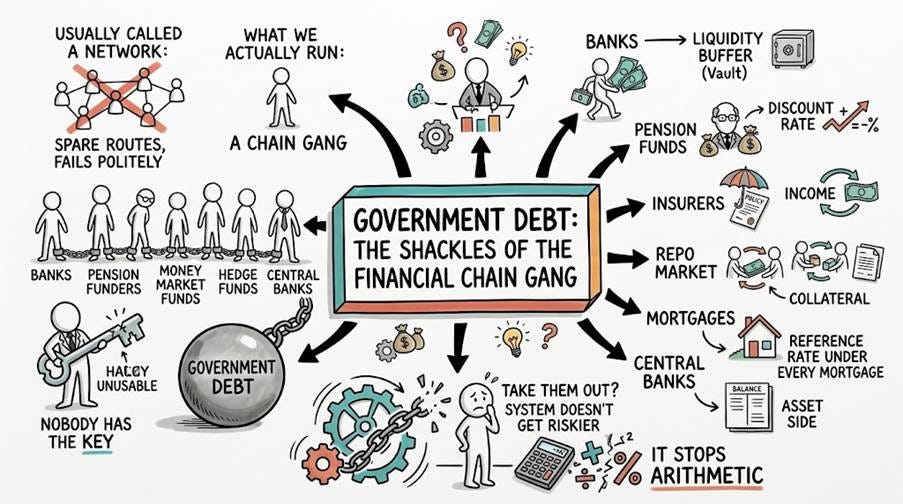
The financial system is usually called a network. Flattering. A network has spare routes and fails politely. What we actually run is a chain gang: banks, pension funds, insurers, money market funds, hedge funds and central banks, shackled at the ankle to the same object, shuffling in step because nobody has the key. The object is government debt.
This is not poetic licence, it is bookkeeping. Sovereign bonds are the bank’s liquidity buffer, the pension fund’s discount rate, the insurer’s income, the repo market’s collateral, the reference rate under every mortgage on earth, and the asset side of every central bank. Take them out and the system doesn’t get riskier. It stops arithmetic.
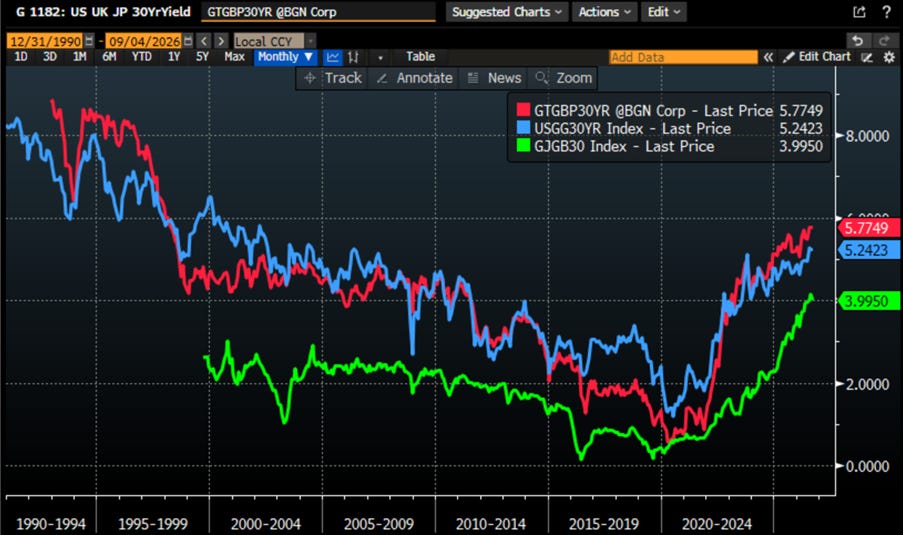
For forty years none of this was visible, in the way plumbing isn’t visible until it’s on the ceiling. Debt was small, inflation was falling, and there was always a Chinese surplus or a Japanese pension fund willing to buy anything with a coupon attached. Four decades of rising prices will do that. An asset that only goes up stops being perceived as collateral and starts being perceived as gravity. Gravity has been repriced. The thirty-year gilt yields 5.78%, the highest this century. The thirty-year Treasury yields 5.21%, last seen when Lehman Brothers was merely having a difficult week. The thirty-year JGB yields 4.15%, the highest since on Bloomberg record — a time in which everyone owned a fax machine and considered it modern. These are not exotic instruments. They are the risk-free rate, and they have been falling, untidily, for four years.
US 30-Year Yield (blue line); UK 30-Year Yield (red line); Japan 30-Year Yield (green line).

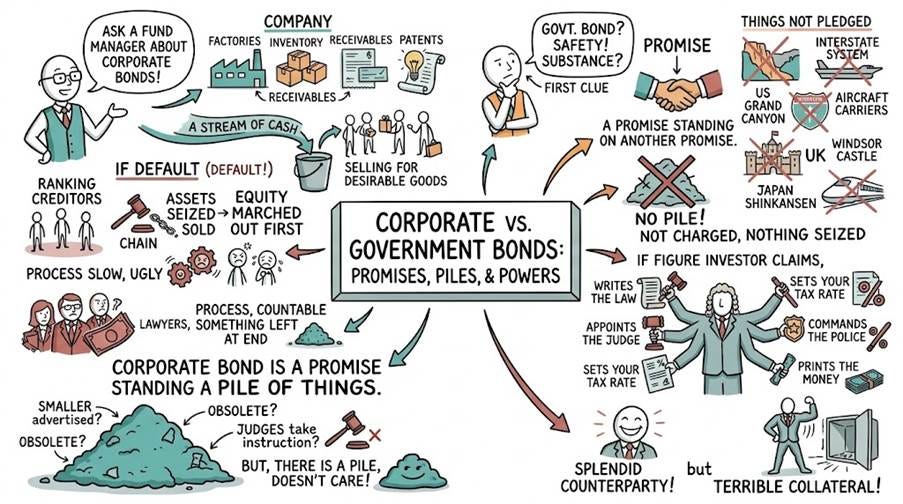
Ask a fund manager what a corporate bond is and you get a precise answer. Behind it sits a company: factories, inventory, receivables, patents, and a stream of cash from selling something to somebody who actually wanted it. If it stops paying, several centuries of law take over. Creditors have rank, assets get seized and sold, equity holders are marched out first. The process is slow, ugly and enriches nobody but the lawyers — but it is a process, and something countable is left at the end.
A corporate bond is a promise standing on a pile of things. The pile may be smaller than advertised, or obsolete, or in a country where judges take instruction. But there is a pile, and it doesn’t care what anyone thinks of it.
Now ask the same fund manager what a government bond is. You will get an answer about safety rather than about substance, which is the first clue.
A sovereign bond is a promise standing on another promise. There is no pile. The US Treasury does not pledge the Grand Canyon, the interstate system or the aircraft carriers. His Majesty’s Treasury does not pledge Windsor Castle. Japan’s MoF is not putting up the Shinkansen. Nothing is charged, nothing can be seized, and if you try to enforce your claim you discover that your counterparty writes the law, appoints the judge, sets your tax rate, commands the police and prints the money he owes you. Splendid counterparty. Terrible collateral.
What actually sits behind the bond is two forecasts wearing a suit: that the state can extract enough from an economy that doesn’t exist yet, from voters who haven’t been asked; and that the currency will still buy something when it repays you. One is political, one is monetary. Neither is an asset.
And here is the trick nobody prices. A sovereign borrowing in its own currency never defaults the way Tesla or Thames Water might. It simply pays you back in full, in money worth less — a default administered by inflation, spread across the entire population, voted on by nobody and appealable to no court. The corporate borrower goes bankrupt. The sovereign borrower goes quiet.
So, a sovereign bond is not a safer version of a corporate bond. It is a fundamentally different instrument with a different failure mode. The corporate instrument fails visibly, in a courtroom, with a recovery rate. The sovereign instrument fails invisibly, in the purchasing power of the coupon, over ten or twenty years, with no recovery rate at all — merely a slow subtraction that shows up in the price of housing, food, energy and school fees and is blamed on greedy landlords, greedy grocers, greedy oil companies and greedy schools.
Holding a corporate bond, you take credit risk you can analyse. Holding a sovereign bond, you take political risk that nobody prices, described in regulatory documents as no risk at all. Which brings your Butler to the great sleight of hand of modern finance.

Under the international capital rules, a bank holding its own government’s bonds in its own currency may assign them a risk weight of zero. Not low. Zero. Unlimited quantity, no capital, no concentration limit, no obligation to diversify. Lend a hundred million to a profitable manufacturer with hard assets and forty years of trading history: hold capital. Lend the same hundred million to a government running a 5.8%-of-GDP deficit in the ninth year of an expansion: hold ....
Read more and discover how to trade it here: https://themacrobutler.substack.com/p/the-hungry-decade
Visit The Macro Butler Website here: https://themacrobutler.com/
Join The Macro Butler on Telegram here : https://t.me/TheMacroButlerSubstack
Register your interest to The Macro Butler World Economic Summit 2026 here:
https://themacrobutler.substack.com/p/the-macro-butler-world-economic-s…
☀️ SUMMER SPECIAL — 15% OFF
Ready to understand your money and the markets better?
This summer, take your financial knowledge to the next level with The Macro Butler Financial Academy.
Learn the principles behind:
📈 Investing & Portfolio Building
🌍 Economics & Market Cycles
💡 Smarter Financial Decision-Making
Whether you’re starting your investment journey or looking to sharpen your financial knowledge, The Macro Butler gives you the framework to think differently about money.
🎓 Get 15% OFF when you subscribe.
⏳ Limited Time Offer — Available until September 15, 2026.
👉 Start Learning Now

https://themacrobutler.com/financial-academy/
You can contact The Macro Butler at info@themacrobutler.com

Disclaimer
The content provided in this newsletter is for general information purposes only. No information, materials, services, and other content provided in this post constitute solicitation, recommendation, endorsement or any financial, investment, or other advice.
Seek independent professional consultation in the form of legal, financial, and fiscal advice before making any investment decisions.
Always perform your own due diligence.