





Dark Oil Transit Rises as Goldman Rolls Its Diesel Hedge
Hidden Persian Gulf Flows Are Keeping More Oil Moving Than Markets Can See, Leaving Diesel as the Cleaner Geopolitical Trade
Authored by GoldFix
Brent crude has climbed toward $95 a barrel as markets increasingly price a prolonged Middle East standoff, but Goldman Sachs says the oil market is also becoming better at adapting to the conflict, limiting how far crude prices may ultimately need to rise.
The bank’s latest Oil Tracker argues that a growing volume of Persian Gulf oil is moving outside normal vessel-tracking systems. At least six tanker strikes were confirmed over the previous ten days, but the expansion of dark transits means visible shipping data increasingly understate how much oil is actually getting through.
The Dark Transit
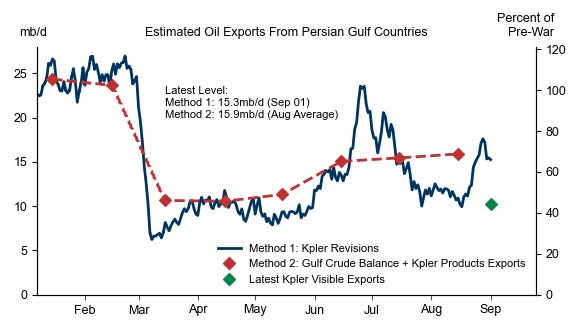
Visible Persian Gulf exports recently stood around 10 million barrels per day on a seven-day moving average. Goldman’s estimate after incorporating dark crossings is closer to 15–16mb/d, or roughly two-thirds of pre-war levels.
“Accounting for dark crossings, we estimate recent total Persian Gulf oil exports at roughly 15-16mb/d or 2/3 of pre-war levels, while recent visible exports stand at only 10mb/d (7DMA). We estimate a net hit to Persian Gulf flows of 7.9mb/d now. The 5mb/d upward revision to the Gulf flows over the last two weeks likely results from a ramp up in oil tankers crossing the Strait near the coast of Oman with their AIS off.”
That distinction changes the interpretation of the disruption. The barrels have not necessarily disappeared. Increasingly, the ability to see them has.
Hormuz traffic has improved, while Red Sea exports fell by roughly 4.5mb/d in August versus July as Saudi Arabia redirected flows away from Yanbu and back toward eastern ports in response to the Houthi threat.
Visible Inventories May Also Be Wrong
Dark shipping also complicates the inventory picture.
If more oil is moving than vessel trackers can observe, oil-on-water and global inventory estimates are likely being understated as well. Goldman says expected revisions place global visible stocks roughly 39 million barrels above the raw same-day reading, although inventories are still drawing.
The more important signal for crude pricing, however, is that OECD commercial inventories have not tightened nearly as dramatically as the headline disruption would imply.
“Adjusting for expected upward revisions, we estimate global visible stocks at 39mb above the same-day raw reading, implying a 2.1mb/d pace of inventory draws over the last 30 days. OECD commercial stocks -- the core predictive indicator for Brent timespreads -- remain in line with their historical averages, with our OECD commercial stocks counter down only 19mb since March 1st.”
Large OECD strategic reserve draws averaging more than 1mb/d over the past six months, together with barrels held on water, have helped prevent a larger draw in commercial stocks.
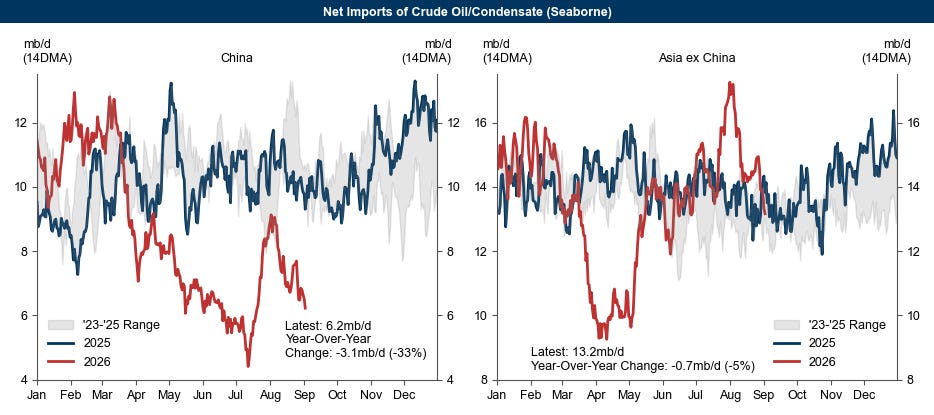
China has simultaneously acted as a demand-side pressure valve.
China Backs Away on Price Rise
Chinese crude demand remains highly sensitive to price.
After a short-lived pickup in early August, imports fell back to roughly 3mb/d below seasonal norms over the latest two weeks. That response leaves more barrels available elsewhere when geopolitical disruption pushes prices sharply higher.
This is central to Goldman’s crude view.
The conflict creates scarcity. Higher prices encourage behavioral and logistical adaptation. That adaptation then limits the amount of scarcity that must ultimately be reflected in Brent.
Brent at $95 Contains About $15 of Risk Premium
Goldman’s fundamental estimate for spot Brent remains around $80 per barrel, compared with a market price near $95.
“We estimate the fair value of Brent spot prices at around $80/bbl based on our OECD commercial stocks counter, current OECD demand estimates, estimates of the long-term Brent anchor, and the historical relationship between stocks and spot prices.”
That leaves approximately $15/bbl of geopolitical and security premium embedded in spot crude.