





Why a high-yield investment can still lose you money
A 10% yield sounds better than a 5% yield. That much is obvious.
What’s less obvious is whether the investment paying 10% is actually making you more money.
Someone searching for income may naturally gravitate toward the number attached to the distribution. Yet yield measures only one part of an investment’s economics.
What happens to your principal—and what risks you accept to earn that income—can matter far more.
Can an investment deliver the cash flow it promised and still leave you poorer?
Your income can hide what’s happening to your principal
Imagine investing $100,000 in an asset yielding 10% annually. After a year, you’ve received $10,000 in income.
It’s tempting to call that a 10% return.
Now suppose the investment itself is worth only $85,000 at the end of the year. Your $10,000 of income has been more than offset by a $15,000 decline in principal.
The investment produced plenty of cash flow, but it didn’t produce a positive total return. This isn't hypothetical.
Real-world investment data can show the same gap between distributions and overall performance. The following table from Aberdeen Investments compares several funds’ total returns based on net asset value (NAV) with their annualized and cumulative distribution rates.
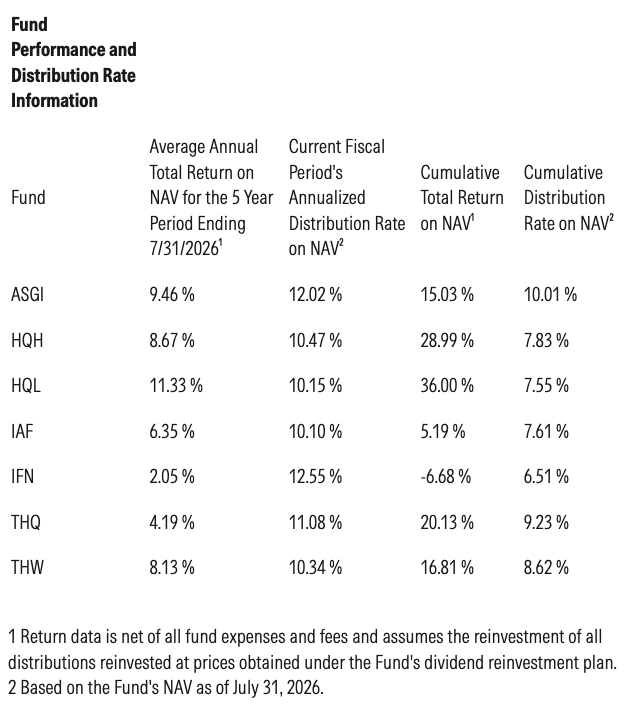
This is particularly easy to overlook when distributions arrive regularly while changes in the underlying asset’s value remain less visible. Income feels tangible because it lands in an account.
Deteriorating principal can stay hidden until an asset is sold, refinanced, revalued, or reaches maturity.
Where is that yield actually coming from?
A high yield isn’t inherently good or bad; it’s information.
The number makes more sense in the context of what produces it.
Sometimes a higher yield reflects an unusually productive opportunity. Other times, the market is demanding greater compensation because investors are:
- assuming greater credit risk
- accepting less liquidity
- using more leverage
- facing greater uncertainty about getting their principal back
That’s why comparing investments by yield alone can be misleading.
A 10% return on an investment you can’t exit for several years isn’t directly comparable to 10% on an investment you can sell tomorrow. Neither is a yield backed by a heavily leveraged asset equivalent to one generated with little or no debt.
The percentage may be identical, but the bargain behind it isn’t.
Sometimes the “income” is your own money coming back
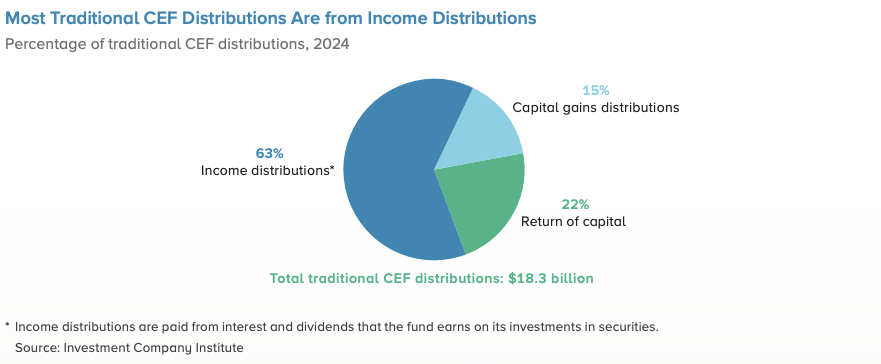
There’s another complication: not every dollar distributed by an investment necessarily represents profit.
Some investments can make distributions that include a return of investors’ own capital. Receiving $10,000 sounds attractive, but if some of that money is effectively being handed back from your original investment, treating the entire distribution as investment income can create a misleading impression of performance.
This doesn’t automatically make the investment unattractive. Returning capital can be a perfectly legitimate part of an investment structure.
It does mean investors should understand the source of a distribution rather than assuming every dollar represents newly created wealth.
The highest yield may come with the highest hurdle
Yield becomes more useful when you stop treating it as a score and start treating it as compensation.
When one investment offers substantially more income than another, the difference may reflect what investors are being compensated for.
Perhaps your money will be inaccessible for years.
Perhaps repayment depends on a borrower with meaningful default risk.
Perhaps leverage magnifies the potential outcome in both directions.
Perhaps the underlying asset itself is unusually volatile.
Suddenly, the highest-yielding investment seems to carry economic characteristics that the headline yield doesn’t reveal.
Those additional percentage points may reflect additional risks required to earn them.
Cash flow is only valuable when the economics work
None of this diminishes the importance of cash flow.
For investors trying to make their wealth support their lifestyle, recurring income can reduce dependence on selling assets to meet expenses. That can be enormously valuable.
The mistake is allowing the desire for income to turn yield into the objective itself.
A better evaluation starts with what remains after considering the entire investment:
- income received
- changes in principal
- fees
- liquidity constraints
- leverage
- the possibility of loss
A high yield can be part of an excellent investment, but it can also be the most attractive number attached to a bad one.
The cash hitting your account tells you how much an investment paid you.
It doesn’t necessarily tell you how much money you made.
That leaves another consideration beyond how much income an investment produces: what that income ultimately allows you to do. In our conversation with Bronson Hill, we explore how cash-flowing wealth can change the relationship between your money, your work, and your time.