





A Few Thousand Dollars of Drones Just Repriced the World’s Oil
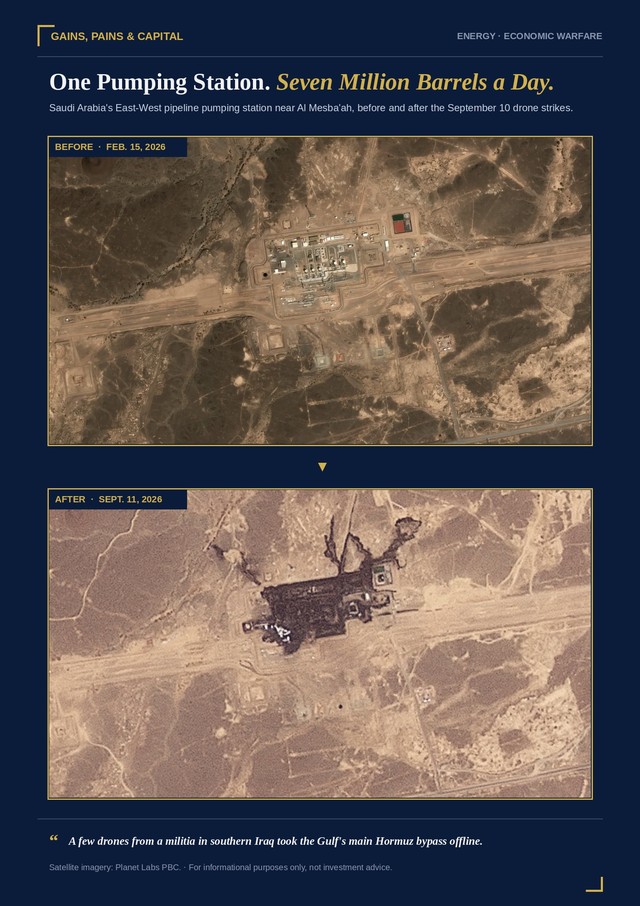
On September 10 and 11, drones launched from Maysan province in southern Iraq hit pumping stations on Saudi Arabia’s East-West crude oil pipeline near Riyadh and Medina. Saudi Arabia shut the pipeline on Friday. Riyadh called it a precaution. Satellite imagery of the station near Al Mesba’ah tells a different story.
Brent spiked to $110, settled at $105, and closed the week up more than 8%. First settle above $100 since May.
Here is what most investors missed.
The East-West pipeline was the single most important piece of energy infrastructure on earth for the past six months. Iran effectively closed the Strait of Hormuz in March. Before the war, roughly a fifth of the world’s oil moved through it. Saudi Arabia’s answer was to push about 5 million barrels a day through the East-West line, a 745-mile pipe from Abqaiq to the port of Yanbu on the Red Sea, with capacity for 7 million. Aramco’s CEO said last month it had done more to offset the Hormuz shutdown than every emergency reserve release combined.
Put simply, that pipeline was the reason oil was at $95 and not $150.
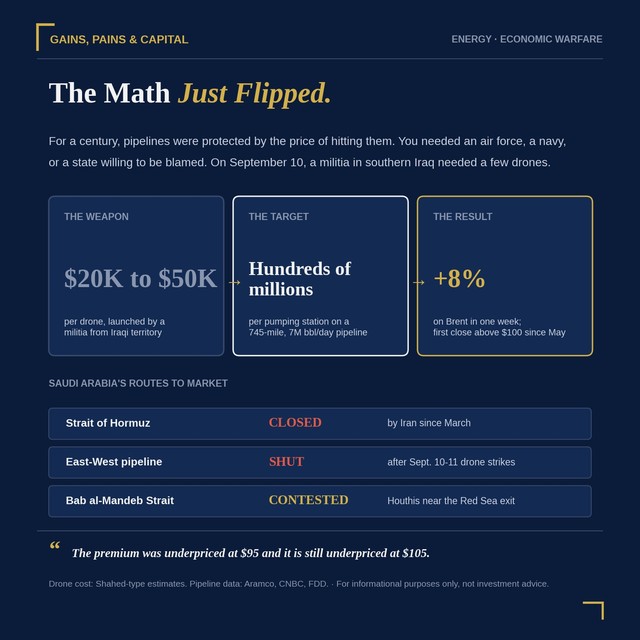
It took a handful of drones to shut it down. Not a missile strike. Not an air campaign. Drones, launched by a militia, from a country that is not at war with Saudi Arabia, costing somewhere between a few thousand and a few tens of thousands of dollars apiece.
THAT is the story, and it is bigger than one pipeline.
For a century, energy infrastructure was protected by the cost of attacking it. You needed an air force, or a navy, or a state willing to be blamed. The math has flipped. A pumping station costs hundreds of millions of dollars. The drone that disables it costs less than a used pickup truck. Anyone with a grievance and a few engineers can now impose a supply shock on the global economy, and the September 10 attack proved it in front of every adversary the West has.
The market has not caught up to this.
Oil at $105 is pricing a pipeline that comes back quickly and a September 30 deadline that holds. Iraq’s prime minister has given the Iran-backed militias in his country until the end of the month to disarm. At least four have refused. Saudi Arabia is holding off on retaliation at Baghdad’s request. Meanwhile, the Houthis have captured positions near the Bab al-Mandeb Strait, the southern exit from the Red Sea that every tanker leaving Yanbu has to pass. Both of Saudi Arabia’s routes to market are now under threat, one closed and one contested.
To be clear, none of this means oil goes to $150 next week. It means the risk premium in oil is no longer a temporary feature of one conflict. It is a permanent feature of a world where infrastructure is expensive and the tools to hit it are cheap. That premium was underpriced at $95 and it is still underpriced at $105.
Now for the part that matters to your portfolio.
There is one large economy that comes out ahead on net. The United States is the largest oil and gas producer on earth and a net exporter of petroleum. Among the world’s three largest economies it is the only one that produces more energy than it consumes. It does not need Hormuz, the East-West pipeline, or Bab al-Mandeb to keep running, and it imports very little from the Gulf.
Oil is a global market, so every barrel that cannot leave Saudi Arabia raises the price of every barrel that comes out of Texas, North Dakota, and the Permian. For American producers, chokepoint attacks on the other side of the world are a windfall. For American consumers they are an inflation problem, which is why the Fed is meeting this week, but that is a story for another day.
The same logic applies further down the hard asset chain. Every input that has to cross an ocean or a border someone else controls now carries this premium. Uranium out of Kazakhstan moves through Russia or across the Caspian. Rare earths out of China move only when Beijing allows it. The assets that do not carry that risk, because they are produced and refined inside a country with no hostile militia on its soil and no adversary on its border, are worth more than they were two weeks ago, and the market has not repriced them yet.
A few thousand dollars of drones just told you where the next decade of energy risk lives. Own the supply that does not have to cross a chokepoint to reach you.
Which brings me to how we are actually making money on this.
A few thousand dollars of drones just added 8% to the price of oil in a week. That is not going away. The Fed can hike all it wants. It cannot reopen a pipeline, clear a strait, or make a militia in southern Iraq stand down. Energy inflation is back, and this time it is coming from a place monetary policy cannot reach.
The last time this setup hit, in 2025, certain hard assets were the best-performing corner of the market. The five plays in our Special Investment Report, Survive the Inflationary Storm, rose 140%, 150%, 180%, 280%, and 574% that year. Not one of them needed Hormuz to stay open to do it.
The conditions that drove those moves are back on the tape: oil above $100, inflation running hot, a Fed behind the curve, and a bond market that has stopped believing Washington can hold yields down. Precious metals do their best work in exactly this environment, and the miners give you leverage to the move.
Normally this report sells for $499 as a standalone item. Given what happened on September 10, we are making 100 copies available to the public.
The drones were cheap. Missing this will not be.
CLICK HERE to grab one of the remaining copies of Survive the Inflationary Storm
Graham Summers, MBA
Chief Market Strategist
Phoenix Capital Research