





AI Can't Buy A Transformer.
A Historic Rotation
Tuesday produced an extraordinary split between two of the market’s main technology groups. The iShares Expanded Tech-Software Sector ETF (IGV) rose 5.04%, while the iShares Semiconductor ETF (SOXX) fell 5.7%. Bespoke Investment Group said software’s relative performance was the strongest in roughly 25 years of history.
Yesterday, the software ETF $IGV gained 5.04%, while the semis ETF $SOXX fell 5.7%.
— Bespoke (@bespokeinvest) September 15, 2026
It was the best day for software vs. the semis ever (going back ~25 years).
The divergence points toward a broader AI trade. Investors are beginning to distinguish between the companies that manufacture accelerators and the companies that connect, monitor, secure and power the systems around them.
We made the case in July that the physical AI buildout was accelerating. Results from ASML Holding (ASML), Aehr Test Systems (AEHR), Micron Technology (MU) and Penguin Solutions (PENG) showed capital moving from capacity plans to equipment orders, chip production and deployed systems.
Tuesday brought fresh evidence from three more layers. Micron introduced a 512-gigabyte DDR5 server module that AMD and Intel are validating. Micron says it can reduce operating power by more than 60% compared with four 128-gigabyte modules.
Advanced Micro Devices (AMD) recently reported 50% year-over-year revenue growth and a 107% increase in data-center revenue. Credo Technology Group (CRDO) launched 1.6-terabit optical transceivers with real-time telemetry designed to detect fiber problems before they interrupt AI workloads.
The demand is spreading through the stack.
From Chips To The Systems Around Them
Accelerators create additional requirements as clusters grow. Networks need faster links. Operators need software that can observe increasingly autonomous systems. Companies need tighter identity controls, stronger cybersecurity and reliable recovery when AI-generated code or an agent causes trouble.
That helps explain Tuesday’s software strength. Our Market Watchers feed surfaced Rubrik (RBRK), Dynatrace (DT) and SailPoint (SAIL) as examples of companies addressing security, observability and access control around AI systems.
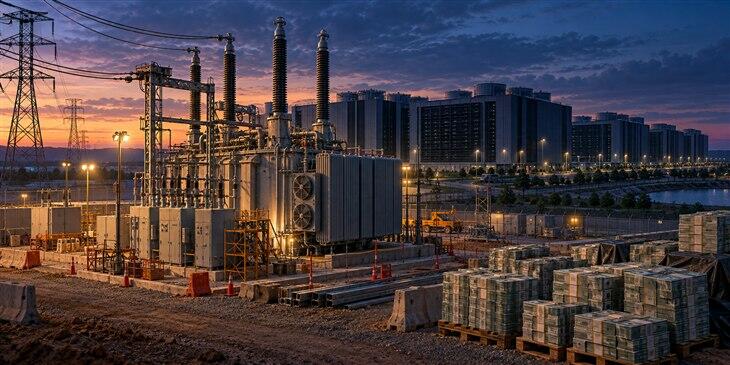
The physical constraint may prove more durable. Every new cluster needs electricity that can be generated, transformed, switched, backed up and delivered on schedule.
The Slowest-Moving Layer
P Equity Research relayed UBS estimates for current lead times across the AI power chain:
- Power semiconductors: 6–12 months
- Backup power and switchgear: 10–18 months
- Transformers: 36–42 months
- Gas turbines: 2–7 years
UBS: Supply Chain Lead Time
— P Equity Research 📰 (@pequityresearch) September 15, 2026
Power Semiconductors: 6-12 months
Backup Power Systems: 10-18 months
Switch Gear: 10-18 months
Power Transformers: 36-42 months
Gas Turbines: 2-7 years
$GEV $TXN $NXPI $ADI $WOLF $ON $STM
Those timelines turn power equipment into a gating item. An AI company can raise capital quickly. New manufacturing capacity for transformers and turbines arrives on an industrial schedule.
Power also determines when a completed cluster begins generating revenue. A delayed transformer can leave far more expensive GPUs idle, increasing the value of equipment that gets a project energized sooner.
Where The Orders Are Landing
That demand is already appearing in the results of companies outside the familiar semiconductor group.
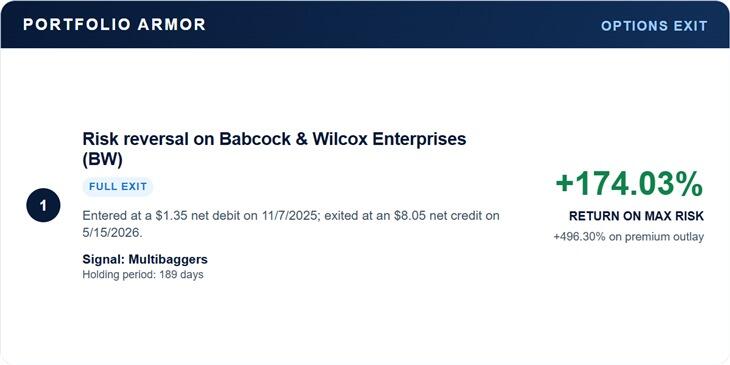
Babcock & Wilcox Enterprises (BW) is supplying power-generation systems for AI data centers. In March, it received full notice to proceed on a $2.4 billion project intended to deliver 1.2 gigawatts to Applied Digital AI-factory campuses. B&W’s second-quarter revenue rose 130%, while its backlog increased 533% to $2.6 billion. The company also secured another gigawatt of steam turbines for a potential data-center project.
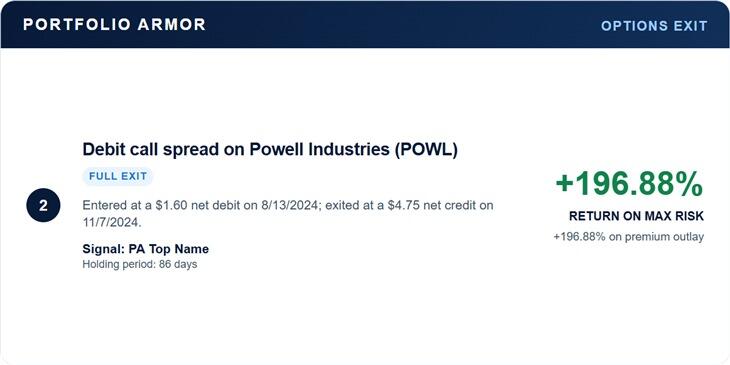
Powell Industries (POWL) makes systems that manage, control and distribute electrical power, including the switchgear used in data centers. Its fiscal third-quarter new orders rose 158% to $934 million, and its backlog rose 69% to $2.4 billion. Those orders included a data-center award valued at more than $400 million.
Semiconductors remain central to the buildout. The expanding opportunity now reaches the companies that make AI clusters operable.
Less Obvious Ways To Trade The Buildout
Companies such as Babcock & Wilcox and Powell Industries may not be household names, but sometimes the best opportunities are in the less obvious parts of the AI buildout.
For example, we have successfully traded Babcock & Wilcox Enterprises (BW):
We’ve also successfully traded Powell Industries (POWL) more than once:
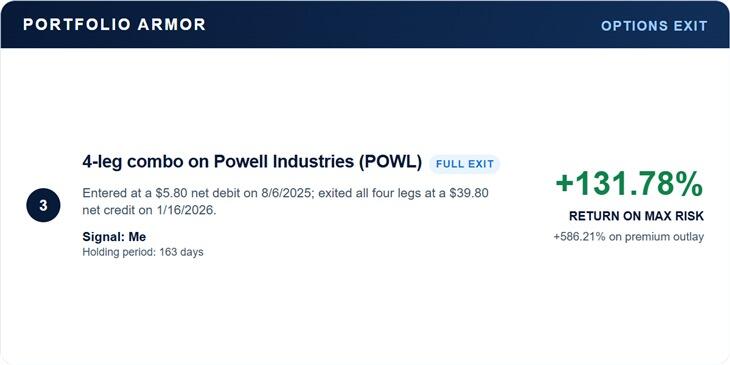
When the underlying thesis remains intact and a company passes our screens again, we’re willing to return to it.
We’ll keep looking for less obvious ways to trade the AI buildout. If you’d like a heads-up when we publish our next trade alert, become a free subscriber below.
New to our trade alerts? Start here: