





WARSH & PEACE
What’s behind the numbers?
After the Federal Reserve had fractured into factions, that the dual mandate had become a contradiction, that three hawks were in open revolt and an employment wing was massing for the autumn, the Committee raised rates by a quarter-point to 3.75–4.00 per cent — the first hike since 2023 — and did it unanimously. Twelve votes, twelve yeses, not a single dissent. Marvellous. It turns out the cure for a divided committee is simply to give the hawks exactly what they want.
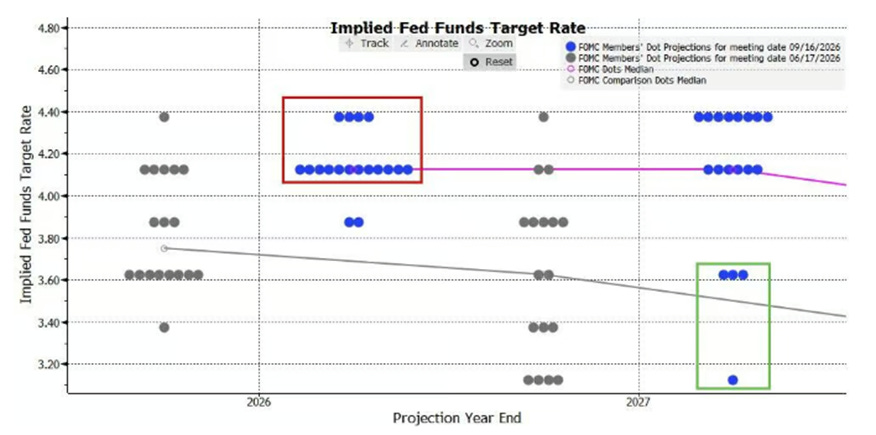
Note the mechanics of this sudden harmony. In July, Hammack, Logan and Kashkari dissented for a hike and were outvoted nine to three. In September, the very same hike passed without a murmur. Nothing was resolved. Nobody was persuaded. Nine people simply looked at the gasoline pump, looked at the long end, looked at the 95 per cent already priced into the futures market, and arrived at the deeply independent conclusion that resistance was pointless. The market did not price the Fed. The Fed priced the market. Rejecting a 95 per cent probability would have been, in the delicate phrase of the commentariat, the greatest surprise in the institution’s history — which tells you everything about who is actually leading whom.
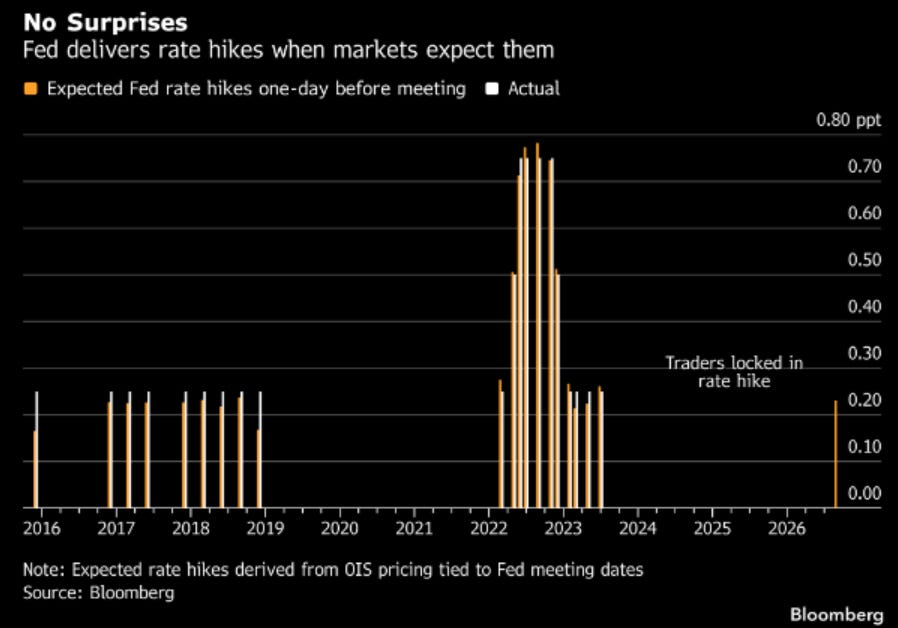
The statement itself is a small masterpiece of the genre. Domestic spending is “resilient.” Capital investment has been downgraded from “strong” to “robust,” a distinction anyone is invited to explain to a small business owner. And the new sentence — “Today’s policy action will support a timelier return to the Committee’s 2 percent goal“ — is the sort of thing one writes when the goal has been missed for five consecutive years, and somebody has suggested adding an adverb.
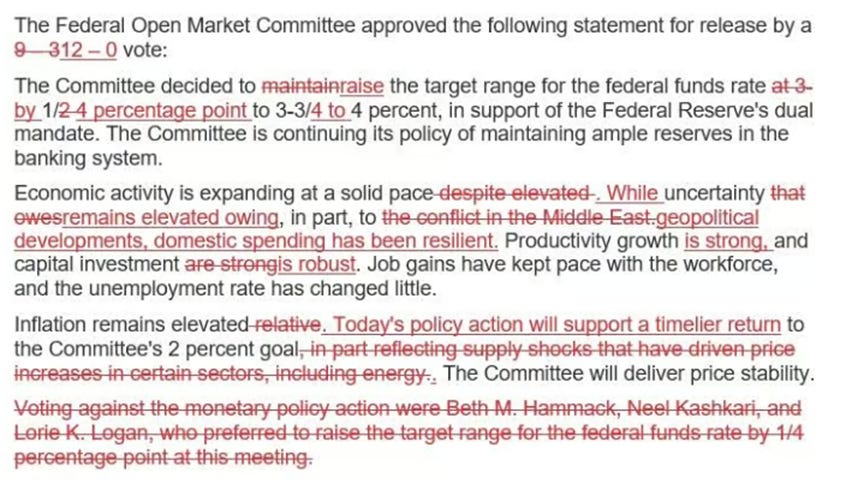
The Fed members increased their GDP outlooks, lowered their unemployment forecasts, but hiked their inflation outlooks.
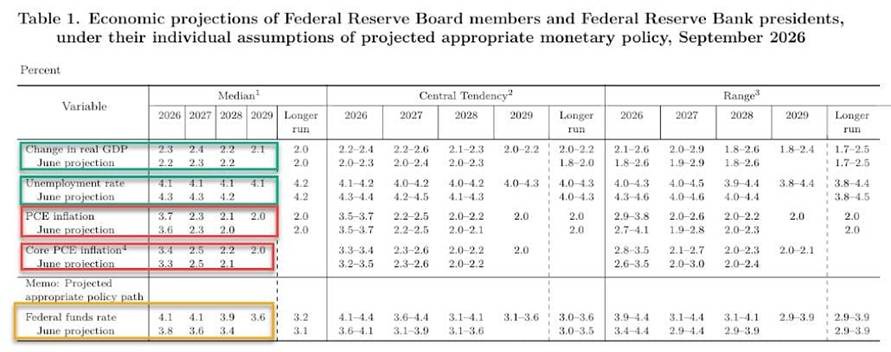
Then the dot plot: twelve of eighteen officials see one more hike this year. Eighteen. Of nineteen. The Chairman of the Federal Reserve continues to decline to submit a dot, which is either a principled rejection of false precision or the world’s most sophisticated way of avoiding being quoted. So, the median dot suggest one more rate hike in 2026.
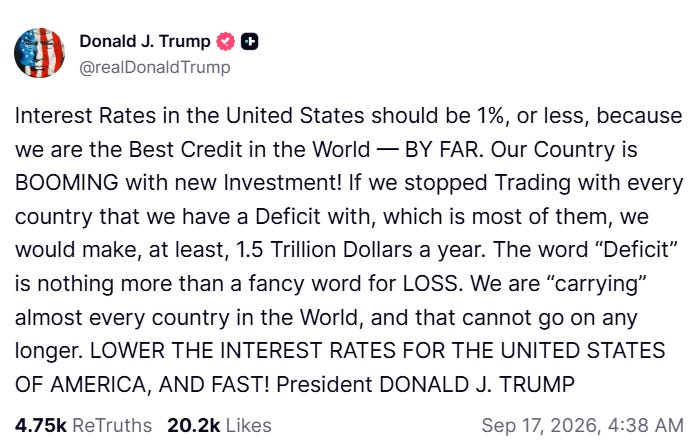
One hour after his own Fed Chairman raised rates, The Manipulator In Chief demands one per cent — “or less,” which is a charmingly open-ended way to request negative interest rates on forty trillion dollars of debt. The reasoning is airtight: America is the Best Credit in the World, BY FAR, a claim the thirty-year bond appears not to have read at 5.25 per cent. We are also BOOMING with new Investment, which is presumably why July payrolls fell by 23,000.
Then the economics. Stop trading with every country we run a deficit with — most of them — and pocket 1.5 trillion a year, since “Deficit” is merely a fancy word for LOSS. By that logic everyone suffers a catastrophic trade deficit with his grocery store, having received in return nothing but food. The remedy is obvious: stop buying food, declare the savings as income, and celebrate with a glass of something.
One small housekeeping matter. The country running the deficit that actually creates the inflation — 1.8 trillion this year, 931 billion in interest — is not a trading partner. It is the author of the post. Rates at one per cent would not fix that. It would simply make the bonfire cheaper to light.
So, the hawks have their hike, the doves have their silence, the President has a Chairman raising rates into a shrinking jobs market, and everyone is united. For now. Because nothing in yesterday’s decision reopened the Strait of Hormuz, un-levied a tariff, or filled a strategic reserve. It simply made the small business, the mortgage holder and the leveraged borrower pay a little more for the privilege of living in a country that cannot balance its books. Unanimity at the top of the cycle is not consensus. It is the sound of nine people deciding they would rather not be the last one arguing.
Watch what happens at the next meeting, when the payroll number arrives and somebody remembers there is a second mandate.
The Committee did not find agreement. The cycle assigned it.
Thoughts.
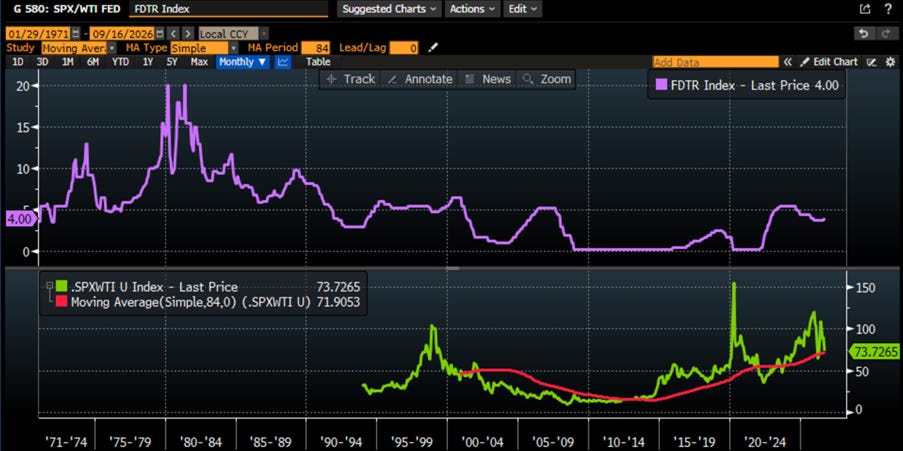
Fifty-five years of monetary policy in one line, and it tells a simple story: up to twenty per cent under Volcker, down to zero for a decade, and now back to four — which the commentariat insists on calling “restrictive,” a word last used seriously when the number began with a two. The S&P measured in barrels of oil is rather less flattering. Ninety-odd barrels bought the index at the 2020 top. Today it takes seventy-four, and the 7-year moving average has been grinding higher since 2011 — which is a polite way of saying equities have spent fifteen years getting expensive relative to the one thing the economy cannot function without. Note where the S&P 500 to Oil ratio peaked: 1999 and 2020, both moments when money was free and energy was cheap. Note where it collapsed: 1974, 1980, 2008 — every occasion the barrel reminded the spreadsheet who was in charge.
Rates at four per cent will not settle that argument. The barrel will.
FED Fund Rate (purple line); S&P 500 Index to Oil ratio (green line); 7-Year Moving Average of S&P 500 Index to Oil ratio (red line).
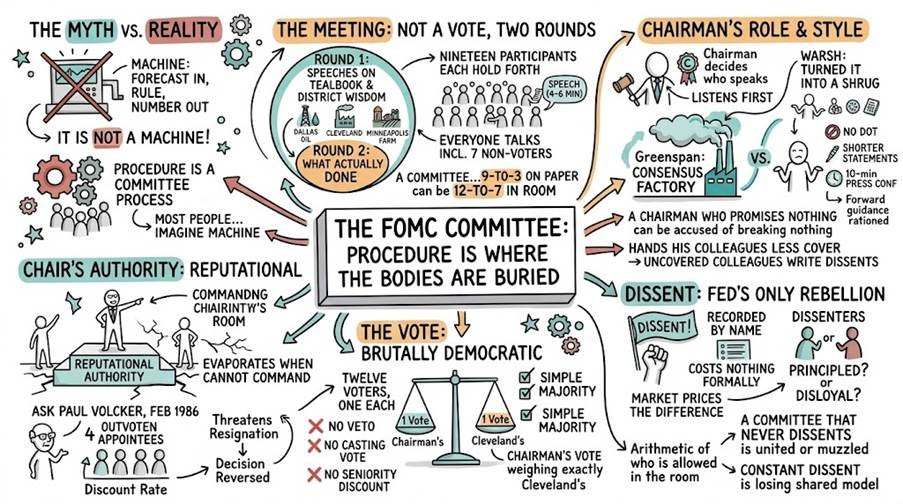
Most people — including a distressing number of professionals paid to know better — imagine the FOMC as a machine: forecast in, rule applied, number out. It is not a machine. It is a committee, and committees have procedure, and procedure is where the bodies are buried.
A meeting is not a vote; it is two rounds of speeches. Nineteen participants each hold forth for four to six minutes on the Tealbook and the anecdotal wisdom of their district — the Dallas oil executives, the Cleveland manufacturers, the Minneapolis farmers — then do it again on what should actually be done. Everyone talks, including the seven who cannot vote, which is why a Committee that reads nine-to-three on paper can be twelve-to-seven in the room. There is no running order: the Chairman decides who speaks, and by convention he listens to everyone before revealing anything, then frames the proposal the rest must argue with.
Greenspan turned this into a consensus factory; Warsh has turned it into a shrug — shorter statements, a ten-minute press conference, no personal dot, and forward guidance rationed like wartime sugar.
Elegant, a Chairman who promises nothing can be accused of breaking nothing. But a Chairman who says less also hands his colleagues less cover, and uncovered colleagues write dissents.
Then comes the vote, which is brutally democratic — twelve voters, one each, simple majority, the Chairman’s ballot weighing precisely what Cleveland’s does. No veto, no casting vote, no seniority discount. Ask Paul Volcker, who in February 1986 was outvoted on the discount rate by four Reagan appointees and had to threaten resignation to get the decision reversed. The Chair’s authority is reputational, not procedural: it is the authority of a man expected to command the room, and it evaporates the instant he cannot.
Which leaves dissent, the Fed’s only sanctioned rebellion — recorded by name, costing nothing formally and a great deal socially, since dissenters are read as principled or disloyal and the market prices the difference. A committee that never dissents is either united or muzzled. A committee that dissents constantly is confessing it has lost its shared model of the world. Which brings us, inevitably, to the arithmetic of who is allowed in the room.
Nineteen participants, twelve votes: not an oversight but the compromise of 1935, which kept monetary power safely in Washington while dressing it in regional costume. Eight of those votes never move — the seven Governors, appointed by a President and confirmed by a Senate and resident within taxi distance of both, plus the President of the New York Fed, who is Vice Chairman and votes every time because New York is the one who actually pushes the buttons. The remaining four rotate annually among the other eleven Reserve Bank presidents, drawn one from each of four fixed groups, like a raffle nobody enters and everybody wins eventually.
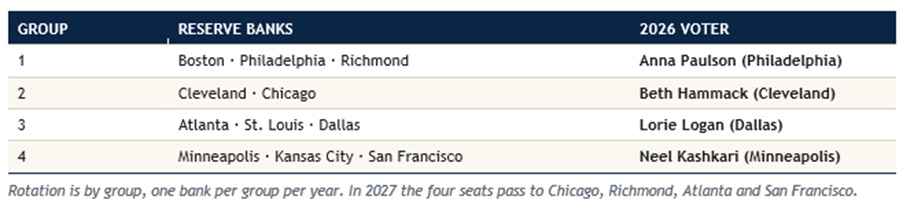
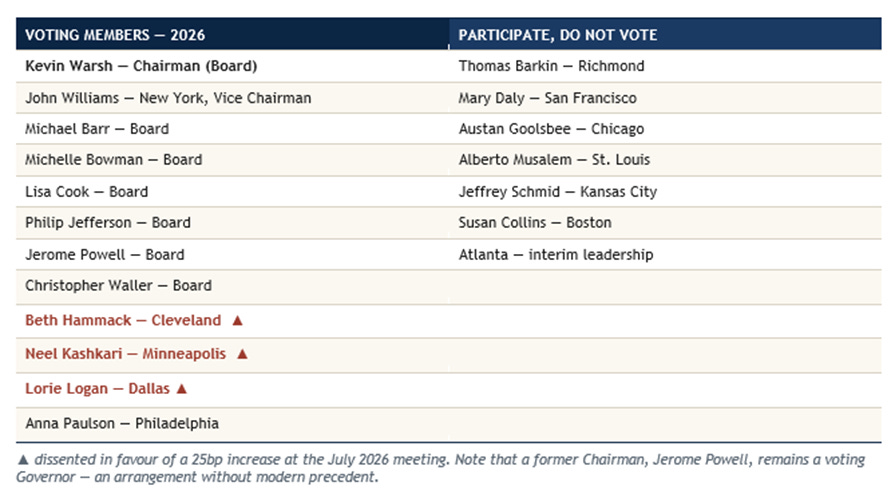
Look carefully at the 2026 draw, because the calendar is doing the work of a policy committee. All three of July’s hawkish dissenters — Hammack, Logan, Kashkari — happen to be sitting in rotating seats this year, and come January, Cleveland and Dallas hand their ballots back like guests returning the good silver. Waiting in the wings for 2027: Austan Goolsbee of Chicago, historically the softest touch in the system. No election, no debate, no new data — just a rota drawn up in 1935 quietly re-weighting American monetary policy.

That last detail deserves a sentence of its own. Kevin Warsh chairs a Committee on which his predecessor sits and votes. Whatever the public courtesies, this is not a normal boardroom. It is a boardroom with a founder in the corner.
Here is the full 2026 Committee, voters and non-voters:
Over four hundred and fifty dissenting votes in three-quarters of a century, and not one of them scattered at random. Dissent clusters — and it clusters with unhelpful reliability at exactly the moments the regime is changing, and the old model has quietly stopped returning calls.
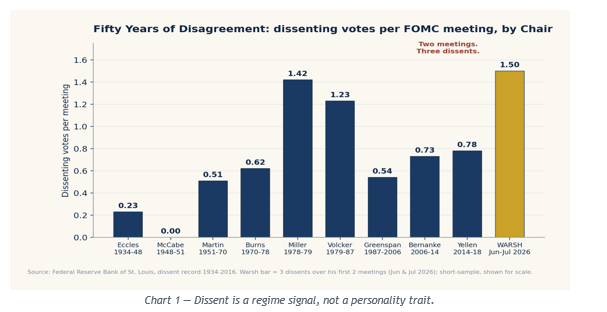
Read that chart as economic history rather than personnel history. William McChesney Martin ran the Committee for nineteen years at roughly half a dissent per meeting — the Bretton Woods era, when the model worked. Arthur Burns inherited the breakdown and drifted to 0.62. Then the two great crisis chairmanships: G. William Miller, at 1.42 dissents per meeting across seventeen ruinous months, and Paul Volcker at 1.23 while he broke the back of inflation and a good deal of the American manufacturing base with it. Then the long peace. Greenspan at 0.54, the Great Moderation, disinflation delivered by China and cheap energy, and a Chairman who treated a dissent as a personal failure of management. Bernanke at 0.73, with the 2011 rebellion of three presidents. Yellen at 0.78, mostly ceremonial.

Miller and Volcker top that chart for one reason: they governed through a supply shock. When inflation arrives by tanker, trench and drought rather than by excess demand, the standard model offers no clean answer — and where there is no clean answer there are only opinions, which is the technical definition of a divided committee. The direction of that dissent, meanwhile, follows a geometry as dependable as gravity:
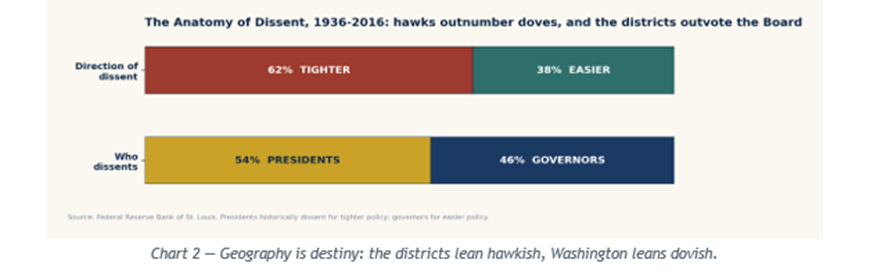
Sixty-two per cent of all historical dissents argued for tighter money; only thirty-eight per cent argued for ease — and the split runs neatly along institutional lines. Reserve Bank presidents, appointed by their own regional boards with no confirmation hearing and no political debts outstanding, dissent for tightening. Governors, who owe their chairs to a President and a Senate, dissent for easing. This is not a slur on anyone’s integrity, merely arithmetic: a man who owes his seat to the White House discounts the future rather differently from a woman who owes hers to the commercial banks of Ohio. July 2026 was the textbook illustration — three presidents, three hawkish dissents, zero governors.

The Federal Reserve Act orders the Committee to deliver maximum employment and stable prices — an instruction that was, for thirty blessed years, no instruction at all. Growth slowed, inflation fell, a rate cut served both masters at once, and the dual mandate functioned less as a dilemma than as a spare tyre nobody...
Read more and discover how to trade it here:https://themacrobutler.substack.com/p/warsh-and-peace
Visit The Macro Butler Website here: https://themacrobutler.com/
Join The Macro Butler on Telegram here : https://t.me/TheMacroButlerSubstack
If you want to be ready for what is coming visit The Macro Butler Website :
Join The Macro Butler on Telegram here : https://t.me/TheMacroButlerSubstack
Learn the principles behind:
📈 Investing & Portfolio Building
🌍 Economics & Market Cycles
💡 Smarter Financial Decision-Making
Whether you’re starting your investment journey or looking to sharpen your financial knowledge, The Macro Butler gives you the framework to think differently about money.
👉 Start Learning Now
https://themacrobutler.com/financial-academy/
You can contact The Macro Butler at info@themacrobutler.com
Disclaimer
The content provided in this newsletter is for general information purposes only. No information, materials, services, and other content provided in this post constitute solicitation, recommendation, endorsement or any financial, investment, or other advice.
Seek independent professional consultation in the form of legal, financial, and fiscal advice before making any investment decisions.
Always perform your own due diligence.