





How long can an unsustainable financial system survive?
Calling a financial system “unsustainable” sounds like a prediction. Usually, it isn’t.
A government can’t accumulate debt forever.
An asset can’t become more expensive forever.
A central bank can’t expand its balance sheet without consequences.
Each statement may seem logically sound, yet none tells you what happens next year or next decade.
Financial systems have an inconvenient ability to survive conditions that appear unsustainable on paper. The reason is simple:
They rarely remain unchanged long enough for the original constraint to finish the job.
High debt doesn’t come with a fixed breaking point
Imagine a government whose debt burden has become increasingly difficult to finance. There appears to be an obvious endpoint: investors eventually demand interest rates the government can’t afford.
Except governments have more than two choices between “business as usual” and default.
Debt can be refinanced.
Inflation can reduce its real value.
Taxes can rise.
Spending can fall.
Regulations can influence demand for government bonds.
Central banks can provide liquidity when markets seize up.
None of those actions makes the underlying problem disappear. They can, however, change how the problem manifests.
And postpone the moment when it becomes acute.
Research published by the IMF identifies several ways governments have historically reduced large debt burdens, including:
- economic growth
- fiscal adjustment
- inflation
- restructuring
- financial repression
After World War II, policies that held real interest rates below market levels played an important role in reducing government debt across advanced economies[1].
The important lesson? Constraint itself can change.
Policy intervention can extend a financial system’s lifespan
The same adaptability appears during financial crises.
When markets began breaking down in 2008, policymakers didn’t simply choose between allowing the existing system to function and watching it collapse. The Federal Reserve created new liquidity facilities, expanded lending beyond traditional commercial banks, and invoked emergency authorities that hadn’t been used in decades[2].
Something similar happened in 2020.
As investors rushed toward cash and highly liquid assets, funding markets came under acute pressure. The Federal Reserve responded with emergency facilities designed to stabilize short-term funding and support the flow of credit[3].
Those episodes reveal something important about supposedly unsustainable systems: stress can trigger the very response that allows them to survive longer.
The system that emerges may be more indebted, more dependent on policymakers, or more distorted than the one that entered the crisis. Yet survival and health are two different things.
An unsustainable system can shift its costs onto its participants
This is where predictions of collapse often go wrong.
They identify a real cost and assume that the institution creating it must eventually bear it directly. In practice, financial systems can redistribute costs.
Inflation can transfer purchasing power away from holders of money and fixed-rate debt.
Negative real interest rates can benefit borrowers at the expense of savers.
Higher taxes can shift fiscal pressure toward households and businesses.
Capital requirements and other regulations can alter where financial institutions hold their money.
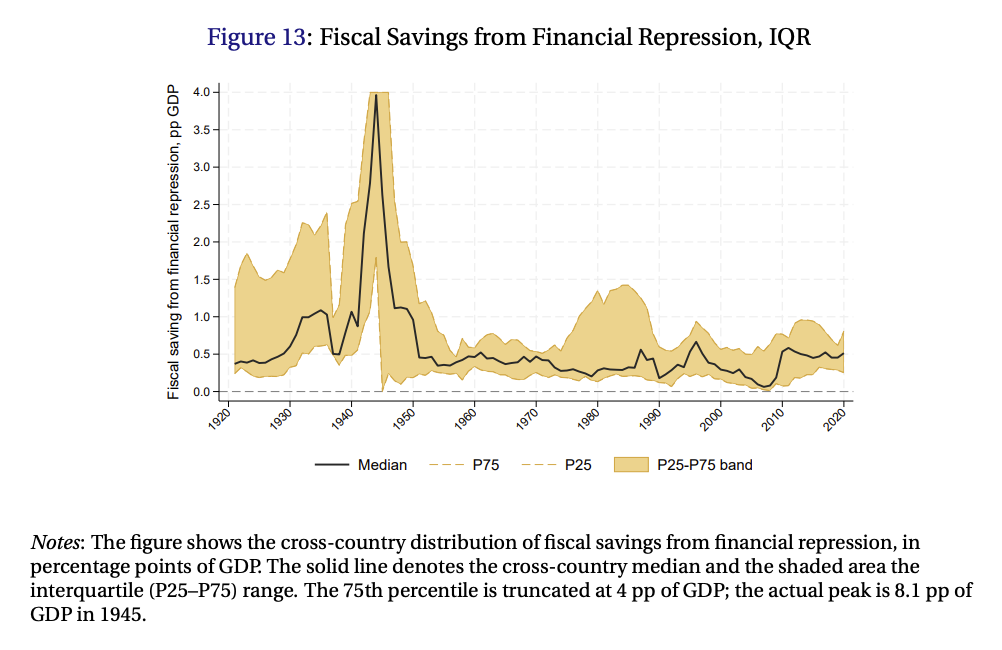
A recent IMF working paper examining 17 advanced economies since 1920 found that:
- financial repression peaked after World War II
- declined during the era of capital liberalization
- increased again after the Global Financial Crisis
The authors found that it contributed to postwar debt reduction and has generated fiscal savings again since 2008[4].
The system survives because the pressure doesn’t necessarily vanish. It moves.
“Eventually” can be an expensive investment horizon
That could create a problem for investors: a thesis can be fundamentally correct yet practically useless if its timeline is wrong.
An investor who correctly identifies an unsustainable trend still has to survive everything that happens before the eventual resolution. That could mean five years of unexpected asset appreciation, a decade of inflation, repeated policy interventions, or an entirely new set of rules.
The most dangerous assumption may therefore be that an unsustainable system must resolve itself quickly.
History offers a less satisfying possibility: the system can bend, adapt, and transfer its costs for much longer than expected.
And by the time it finally breaks—or evolves into something else—the original prediction may bear little resemblance to the path that actually got us there.
That uncertainty could leave investors with a challenge that goes beyond identifying what’s broken: deciding how much confidence to place in any one version of what happens next. Brent Johnson joins the Gold Exchange Podcast to explore what it means to invest with conviction while still preparing for the possibility that you’re wrong.
Sources:
- https://www.imf.org/en/publications/wp/issues/2016/12/31/the-liquidation-of-government-debt-42610
- https://www.federalreserve.gov/newsevents/speech/madigan20090821a.htm
- https://www.federalreserve.gov/monetarypolicy/2020-06-mpr-part1.htm
- https://www.imf.org/en/publications/wp/issues/2026/07/31/the-coming-great-repression-new-measures-and-a-century-of-evidence-578320