





The War Reached Riyadh on Saturday. Washington Said It’s Staying Out.
On Friday I told you Iran’s proxies had taken position at both of Saudi Arabia’s exits. On Saturday they went after the capital.
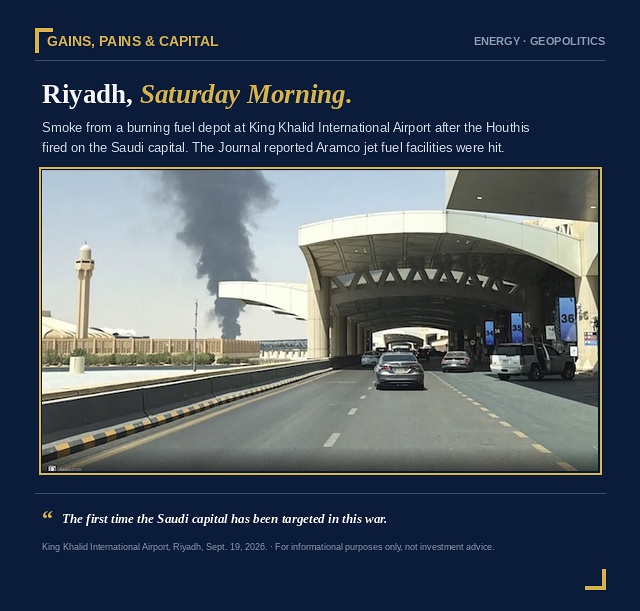
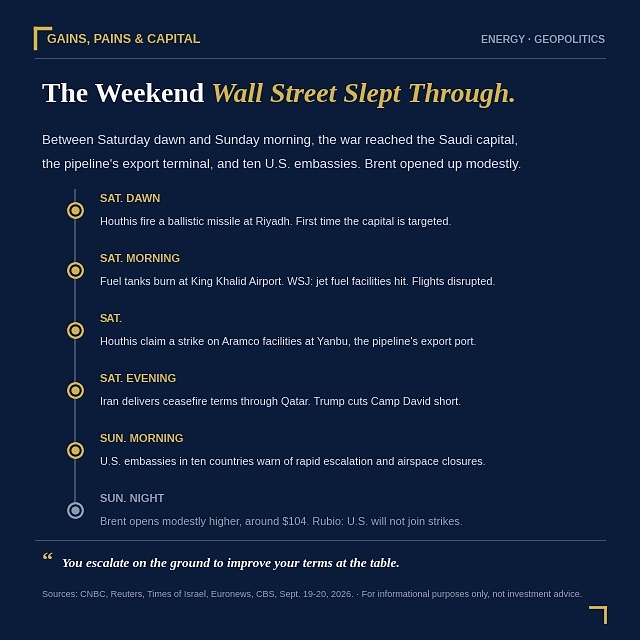
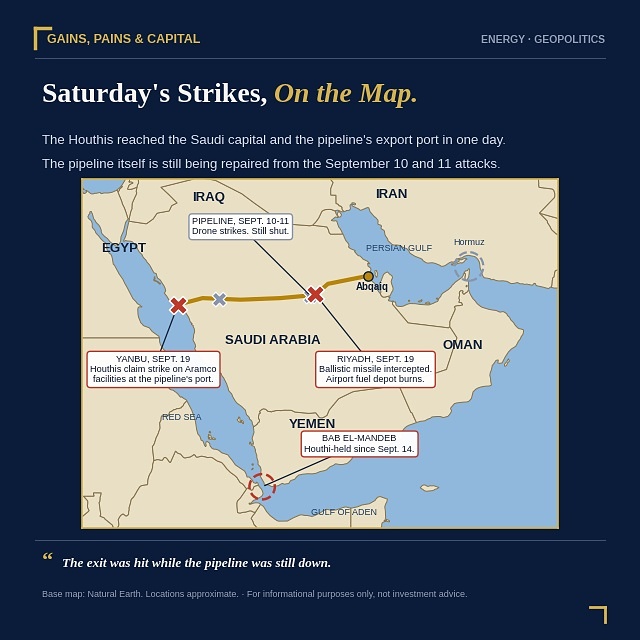
At dawn the Houthis fired a ballistic missile at Riyadh. Saudi air defenses say they intercepted it. Hours later a plume of black smoke rose over King Khalid International Airport, and video showed flames coming from fuel storage tanks marked with the Aramco logo. The Wall Street Journal, citing three officials, reported that jet fuel facilities at the airport were hit. Flights were severely disrupted. It was the first time Riyadh has been targeted in this war.
The same day, the Houthis said they attacked Aramco facilities at Yanbu. Read that again. Yanbu is the port at the western end of the East-West pipeline, the place where Saudi crude was supposed to load onto tankers once the pipeline came back from the September 10 drone strikes. The Houthis have now gone after the pipeline’s exit while the pipeline itself is still being repaired.
By Sunday morning, U.S. embassies in Saudi Arabia, Israel, Iraq, Kuwait, Bahrain, Qatar, the UAE, Oman, Jordan, and Lebanon had issued security alerts telling Americans the conflict could “escalate rapidly” and to prepare for airspace closures and flight cancellations. Trump cut his weekend at Camp David short and returned to Washington. Iran, meanwhile, delivered its terms for ending the war through Qatar and said it is waiting on an answer.
Now the part that matters for anyone trying to read where this goes.
Asked whether the United States would put pressure on the Houthis or stay out of the fight, Secretary of State Rubio deferred to the Saudi-led coalition and said the U.S. would not join offensive strikes. The Saudi crown prince asked for American military action against the Houthis two weeks ago. The answer, as of this weekend, is no.
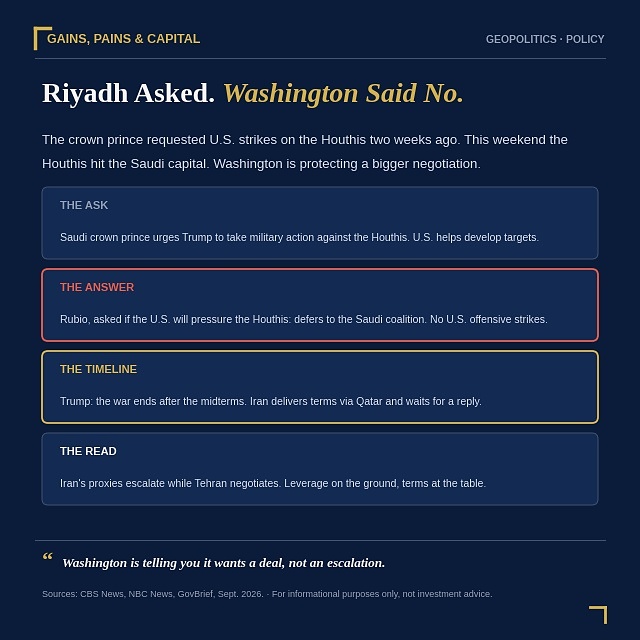
Put simply, Washington is telling you it wants a deal, not an escalation. The administration has said the war ends after the midterms. It is holding off on the Houthis to keep the Iran channel open. Iran has read that correctly and is using the time. Its proxies fired on the Saudi capital and the Saudi export terminal in the same weekend Tehran handed Washington a peace proposal. That is not a contradiction. That is leverage. You escalate on the ground to improve your terms at the table.
To be clear, the oil market has not panicked. Brent closed Friday at $103.87, down for the third straight session, and opened only modestly higher Sunday night. Traders are betting the pipeline outage will matter less than feared and that a deal is coming. I told you Friday that the options market was pricing peace, with airline call buying the tell. The weekend did not change that read. If anything, Iran delivering terms confirms it.
But here is what the market is underpricing. Even if a deal is signed next month, the last ten days have taught every adversary the West has that a militia with drones and missiles can reach an oil capital, a fuel depot, an export terminal, and an international airport, and that the United States will not respond directly if it has a bigger negotiation to protect. That lesson is now permanent. Insurers learned it. Refiners learned it. And the world’s largest oil importer, China, is watching a fifth of the global supply held hostage by a group Washington has decided not to fight.
That is why the premium on energy produced inside safe borders does not go back to where it was in February, whatever gets signed in Doha. A ceasefire lowers the futures price. It does not un-teach the lesson.
Here is what I am watching this week. If Trump answers Iran’s terms and a framework emerges, expect oil to drop hard and fast, the airlines to rip, and the producers to give back a chunk of this year’s gains. That is the dip I have told my paid subscribers we are waiting for. If instead the Houthis hit Riyadh again and Washington stays on the sidelines, the physical market goes back to pricing an emergency, and the $22 gap between paper and physical crude that I described last week opens right back up.
Which brings me to the part that matters for your money.
Kashkari said it on Friday and the weekend proved him right: inflation is spreading beyond the oil shock. A ballistic missile at Riyadh and a fire at the Saudi capital’s fuel depot are not the kind of thing a quarter-point rate hike fixes. The Fed can raise rates every meeting from here to spring. It cannot clear the Houthis off Perim Island, reopen a pipeline, or make a tanker insurable in Hormuz.
Put simply, this is an inflationary storm the central bank cannot hike its way out of, because the source of it is a militia with missiles, not a consumer with a credit card.
That is exactly the environment our Special Investment Report, Survive the Inflationary Storm, was written for. It details five precious metals mining plays built for supply-driven inflation, a Fed behind the curve, and a bond market that no longer believes Washington can hold yields down. In 2025, under the same conditions, those positions rose 140%, 150%, 180%, 280%, and 574%.
Not one of them cared whether the pipeline came back. Not one of them needed Washington to answer the crown prince’s call.
Normally this report sells for $499 as a standalone item. Given what happened in Riyadh this weekend, we are making 100 copies available to the public.
The war reached the Saudi capital on Saturday. The inflation it is feeding reaches the CPI next month. You can be positioned before it does.
CLICK HERE to grab one of the remaining copies of Survive the Inflationary Storm
Graham Summers, MBA
Chief Market Strategist
Phoenix Capital Research