





Xi Came to Washington With Leverage. Washington Is Already Buying It Back
I am in Washington this week. Yesterday afternoon Marine One flew over on its way to Joint Base Andrews, with the President on board to meet Xi Jinping’s plane in person. Trump almost never does that. He waits at the White House. And when Trump flew to Beijing in May, Xi did not come to the airport; a vice premier did. Yesterday the President of the United States stood on the tarmac for the man who holds something he needs.
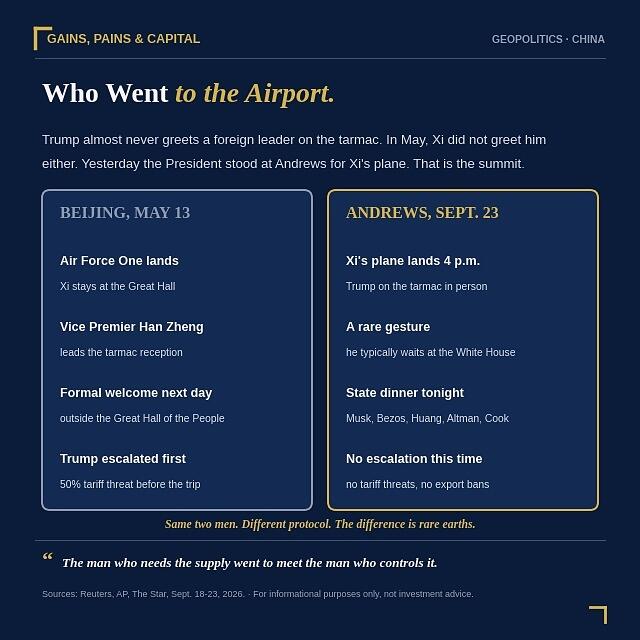
Today Trump hosts Xi at the White House, the first state visit by a Chinese leader in more than a decade, followed by a state dinner tonight. By the time you read this, the two men will have spent several hours in a room together, and the wires will be parsing every word of the readout.
I want to tell you what to watch, and why the result does not change a single trade.
Start with what did not happen in the run-up. Before every previous meeting with Xi, Trump escalated. In 2019 he threatened tariffs on $300 billion of Chinese goods before Osaka. Before Busan last October he threatened a “massive increase” in tariffs and said there was no reason to meet at all. Before the Beijing summit in May he floated a 50% tariff over reports that China was sending air defense systems to Iran. This time, nothing. No tariff threats, no export bans, no leaked demands. And the President went to the airport. Reuters ran an analysis Monday on why the tone has changed, and the answer from every China expert they spoke to was the same: rare earths.
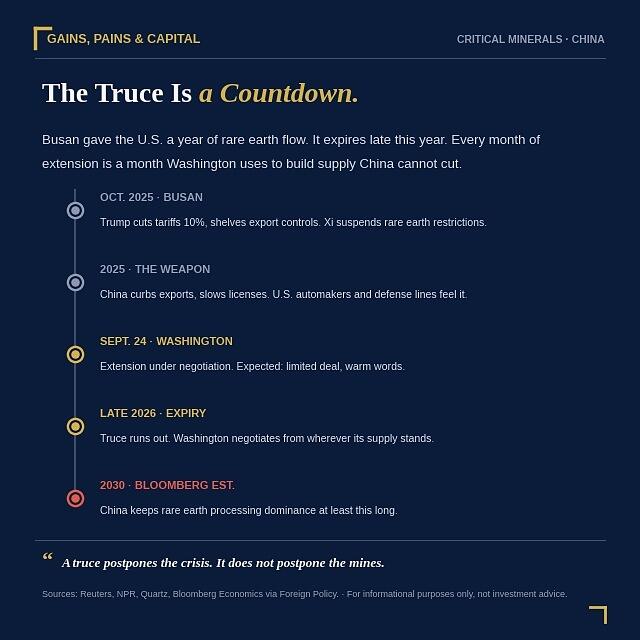
Last year Beijing curbed rare earth exports in retaliation for Trump’s tariffs. It slowed licenses to a crawl and let American automakers and defense contractors find out what happens when a single input stops arriving. It did not have to cut supply to zero. It only had to show it could. The result, in the words of Peter Harrell, a White House economic official under Biden, is that the administration now “feels vulnerable to Chinese coercion” and is seeking “stability and secure access to critical minerals” above everything else.
Put simply, China turned a supply chain into a weapon, and it worked so well that the President of the United States walked into today’s meeting with less leverage than the man across the table. That is the single most important fact about this summit, and almost nobody will say it that plainly.
Here is what is on the table. The rare earth truce from the Busan meeting last October, in which Trump cut tariffs by 10% and shelved export controls on thousands of Chinese companies in exchange for Xi suspending the restrictions and resuming soybean purchases, expires late this year. The U.S. Trade Representative said this week the two sides are still negotiating an extension. Beijing has said it is committed to “safe and stable” supply chains while reserving the right to screen anything dual-use, which is Beijing’s way of saying the weapon stays loaded. The consensus from Bloomberg, Foreign Policy, and the China analysts is that both sides want an extension, neither wants a comprehensive deal, and China keeps its dominance of rare earth processing until at least 2030.
So the most likely outcome tonight is a limited extension with warm words. Relief without a resolution.
Now, why that does not change the trade.
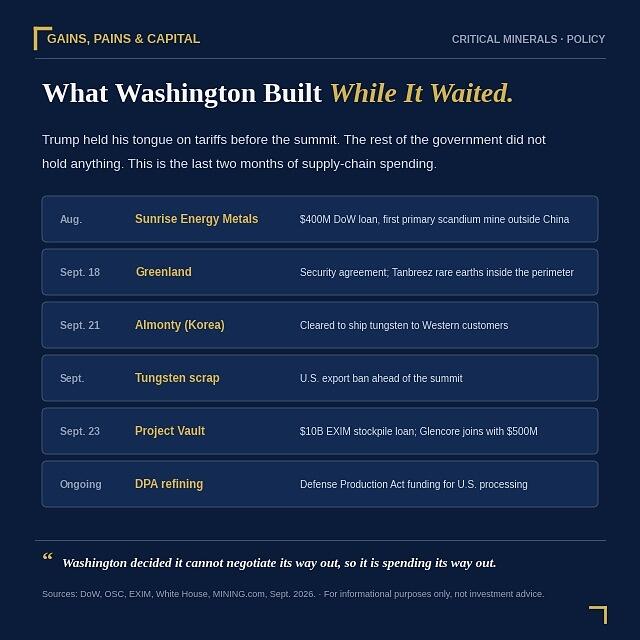
A truce extension buys Washington time, and time is the whole point. Every month of extension is a month the administration uses to build the map I described on Tuesday: the Greenland security deal, the $10 billion Project Vault stockpile that Glencore joined yesterday, the $400 million scandium mine in Australia, the tungsten line from Korea, the refining capacity being funded under the Defense Production Act. Even in the week before the summit, while Trump was holding his tongue on tariffs, Washington quietly banned exports of tungsten scrap. The administration has decided it cannot negotiate its way out of the chokehold, so it is spending its way out, and a truce gives it the calm to do that.
That is the reading that matters for your money.
If the truce is extended, the odds of a rare earth shock in the next twelve months go down. That takes the panic bid out of the names that more than doubled on Monday because they own a deposit in Greenland that ships in 2029. Nobody needs to pay up for 2029 supply if 2027 supply is flowing from China. Those stocks were pricing a crisis, and a truce postpones the crisis.
At the same time, an extension raises the certainty that the funded projects get built. Government loans do not get cancelled because a summit went well. Stockpile purchases do not stop because Xi smiled at dinner. The companies with a Department of War commitment, a price floor, or a permit and customers get twelve more months of calm to pour concrete, and every one of those months moves them closer to the day the truce runs out and the U.S. is no longer negotiating from weakness.
The gap between those two groups is the trade. It was the trade on Tuesday, and today’s summit is the proof.
One more thing to watch. If Xi leaves with an extension and Trump leaves with nothing else, the market will call it a draw. Look at who set the terms. The man who controls the supply named them, and the man who needs the supply went to the airport to meet him. That is what leverage looks like, and it is exactly why Washington has decided to spend whatever it takes to make sure the next summit looks different.
The rare earths will still be in China when Xi’s plane leaves. The mines to replace them are being funded anyway.
Which brings me to the part that matters for your money.
Washington is about to spend the next twelve months buying its way out of China’s chokehold. A $10 billion stockpile. Security deals over entire territories. Twenty-five year loans to mines that no private bank would finance. Every one of those dollars is inflationary, and every one is deliberate, because the alternative is walking into the next summit the way Trump walked into this one.
Put simply, the government has decided that independence is worth paying for. Investors who understand that get to be on the receiving end of the spending.
That is exactly what our Special Investment Report, Survive the Inflationary Storm, is built for. It lays out the specific positions we believe are best placed for a world where Washington runs hot to secure supply: the precious metals anchor that moved 4% yesterday while oil fell, the U.S. energy exporter replacing the gas Hormuz took off the market, the critical mineral producer the Department of War just funded, and two speculative names with the kind of upside that made 2025 the year it was for this sector.
The report is free. All it takes is your email address, and it will not be free for long.
Xi came to Washington holding the only card that matters. The report shows you how to own the companies built to take it away from him.
CLICK HERE to reserve your copy of Survive the Inflationary Storm.
Best
Graham Summers, MBA
Chief Market Strategist
Phoenixcapitalresearch.com