





The Voucher War: Could A Tiny U.S. Biotech Win Two FDA Prizes—Before Europe Gets There First?
Washington wants some wins in biotech but the weight of bureaucracy slows the approval process giving Europe and even China an edge. There is a real danger that the next American biotechnology asset may be slipping away under the cover of night on a boat destined for London.
This has been the recurring paradox of U.S. drug development. We have American Universities generate the science with American investors absorbing the financing risk. Then consider that American families are bearing the brunt of these diseases while American companies pay for the clinical trials. All too often, a foreign regulator becomes the first to provide a viable route of treatment to patients while the U.S. system processes another round of paperwork, or sets another review meeting, which ultimately leads to another quarter of delay.
OS Therapies (NYSE: OSTX) has become a particularly interesting test case. The company is developing OST-HER2, an investigational live, attenuated, gene-edited Listeria monocytogenes immunotherapy for patients with fully resected pulmonary metastatic osteosarcoma. Osteosarcoma is a rare, aggressive bone cancer that strikes disproportionately in children, adolescents, and young adults. When it has spread to the lungs and returns after surgery, patients and families enter a clinical landscape with few options and a treatment paradigm that has changed little in decades.
OSTX is not a pharmaceutical giant. It is a small U.S. biotechnology company with a market capitalization below $100 million. Yet it may be building one of the more unorthodox approval pathways by target two different vouchers.
The first is the FDA’s Commissioner’s National Priority Voucher, or CNPV, a new nontransferable program intended to move strategically important products through FDA review at extraordinary speed.
The second, is the older Rare Pediatric Disease Priority Review Voucher (RPPRV) which becomes a transferable asset that may be sold to big pharma’s looking to get an edge toward a faster approval for one of their pipeline drugs. In order for OSTX to get this voucher their therapy OST-HER2 will need that coveted FDA approval.
Either or both are important because one could accelerate the product while the other could capitalize the company. For investors the larger play is that OST-HER2 is not just a one-off cancer drug, but the first indication in what could translate into a larger cancer immunotherapy platform built around a reprogrammed bacterium. In the world of big pharma time is money and that is why vouchers matter.
Two Vouchers, Two Weapons
The Commissioner’s National Priority Voucher is a review-speed tool. The Rare Pediatric Disease Priority Review Voucher is potentially a monetizable asset. One is designed to get a strategically important product through the FDA more rapidly, while the other is designed to reward companies that obtain approval for qualifying rare pediatric-disease therapies.
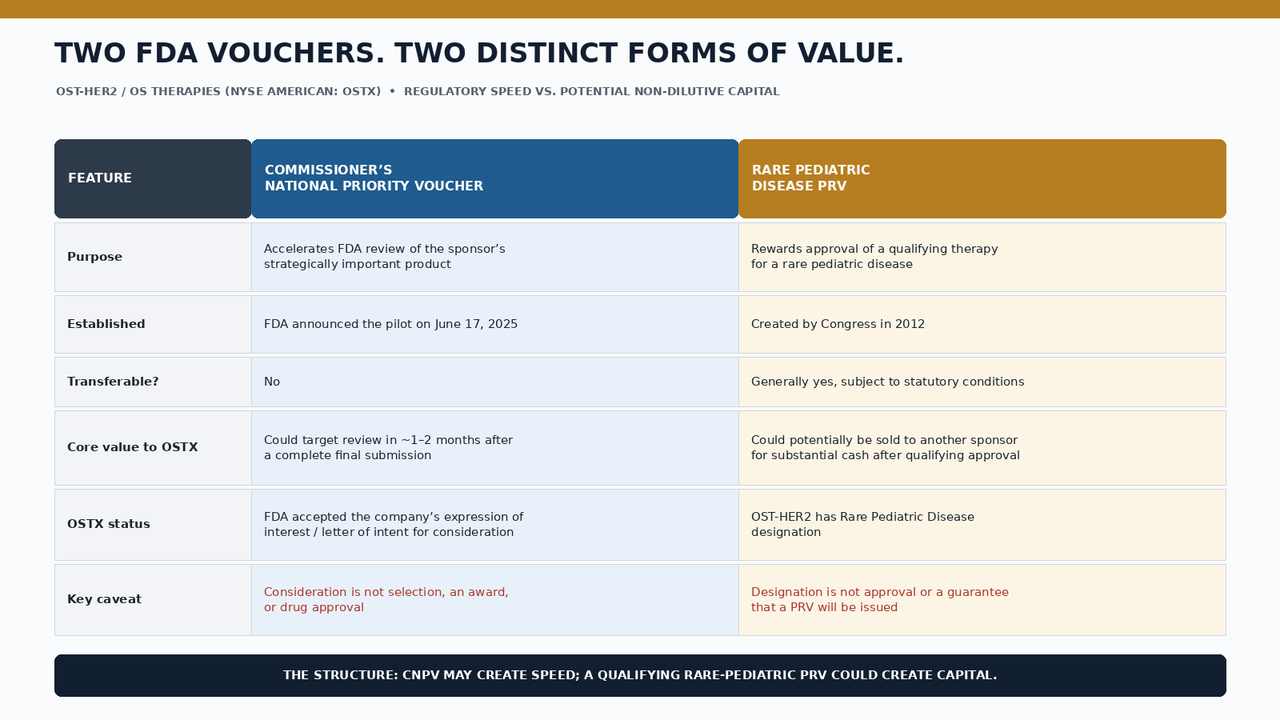
FDA launched the CNPV pilot in June 2025 for therapies aligned with U.S. national priorities such as serious unmet medical needs commonly encountered in rare pediatric cancers. This program also applies to transformative treatments, public-health threats, domestic manufacturing and supply-chain resilience, and improved affordability or access.
Given the FDA’s historical track record their review goal is impressive. They announced that the CNPV voucher could mean a review in approximately one to two months following the final application submission. The program does have elements of a rolling review in that they can’t just plop a huge binders worth of Data on the FDA’s desk and expect an answer in 30 days. The program requires substantial pre-submission preparation, including critical chemistry, manufacturing and controls information, draft labeling, and a high level of readiness from the drug developer. The approval process ends with a 1-day meeting that resembles a “tumor board style” meeting composed of a multidisciplinary team of physicians and scientists intended to cut through the sequential handoffs that typically slow complex applications.
Traditional priority review generally carries a six-month FDA goal. The CNPV concept is something more aggressive that gets stakeholders involved early to identify the problems early, and then compress the formal review clock after the application is complete.
While speed is important, so is money. The Rare Pediatric Disease Priority Review Voucher (PRV) program was created by Congress in 2012 to encourage drugs and biologics targeting rare pediatric diseases. Subject to designation, approval, and other statutory requirements, a qualifying drug company can receive a transferable PRV. That voucher can be used to secure priority review of another product or sold to another company that wants to accelerate a valuable future application. FDA says the program is currently authorized through September 30, 2029.
OSTX earned its Rare Pediatric Disease Designation (RDD) in November 2021 and has been working toward an approval since then. While the designation doesn’t guarantee an approval it’s a positive indication that if the drug is safe and can demonstrate efficacy there is a solid chance of approval if they meet their endpoints. From an investor perspective, the possibility of securing both tools represents a very positive setup in front of the readout because a rare-pediatric-disease PRV could become a major source of non-dilutive capital after a qualifying approval. Speed then cash, what's not to like about the setup.
A Bacterium Reprogrammed For War
When people hear about cancer treatments, they have a tendency to want to put it into one of three buckets. Is it chemo, is it immunotherapy, or is it radiation? OST-HER2 is not another chemotherapy regimen nor is it a conventional HER2 antibody.
It is a weakened strain of highly pathogenic bacteria that can be treated with antibiotics. The therapy involves giving the patient a gene-edited Listeria monocytogenes bacteria engineered to express HER2, a tumor-associated antigen. In plain language, OS Therapies is trying to turn a bacterium into an immune-system alarm. Once introduced the bacteria quickly drives an immune response that wants to target HER-2 which is highly expressed in Osteosarcoma. Within hours the patient is given antibiotics to neutralize the bacteria but in the background lurks a supercharge immune system focused on destroying the cancer.
After visible lung metastases are surgically removed, microscopic cancer cells may remain. In osteosarcoma, those residual cells can become the seeds of the next recurrence. OST-HER2 is intended to stimulate HER2-specific anti-tumor immune activity, helping the immune system recognize and attack HER2-expressing cancer cells before they re-establish visible disease. They are looking to get that last cell.
That is a very different therapeutic thesis than simply administering more cytotoxic chemotherapy after surgery.
A Sign of Hope in A Brutal Disease
OSTX reported that its Phase 2b study in fully resected pulmonary metastatic osteosarcoma achieved 33% event-free survival at 12 months compared with 20% in a peer-reviewed historical-control dataset. Earlier interim reporting also suggested improved one-year and two-year overall survival against historical comparator populations.
The company subsequently reported 75% overall survival at 2.5 years versus 47% in pooled historical controls, with a reported p = 0.003. A later interim three-year analysis reported 71.2% overall survival for OST-HER2-treated patients compared with 45.8% in the historical comparator group.
These results are not proof for an approval, nor do they eliminate the need for a confirmatory study. They do not guarantee an accelerated-approval pathway, a CNPV award, a rare-pediatric-disease PRV, or a commercial launch. They are, however, a serious survival signal in a disease where serious survival signals are scarce.
The Replimune Warning—And Precedent
Replimune (NASDAQ: REPL) provides a useful case study for what can happen when a small U.S. immunotherapy company brings a novel, biologically complex oncology product to FDA.
The comparison is not exact, and it should not be overstated. Replimune’s RP1—now branded Tudriqev—is a genetically modified oncolytic viral immunotherapy based on herpes simplex virus. OST-HER2 is a live, gene-edited Listeria product expressing HER2. Different organisms. Different cancers. Different clinical data packages.
But the strategic parallel is that both companies are looking to convert a biological platform that activates anti-tumor immunity into a commercial oncology franchise. Replimune’s regulatory path was messy. Its BLA for RP1 in combination with Bristol Myers Squibb’s Opdivo was accepted under priority review in January 2025. It then received complete response letters across successive FDA review cycles. The company resubmitted, returned to FDA’s Cellular, Tissue, and Gene Therapies Advisory Committee, and ultimately received a favorable 10–3 advisory-committee vote in July 2026.
On August 6, 2026, FDA granted accelerated approval to Tudriqev with nivolumab for adults with unresectable advanced cutaneous melanoma following progression on anti-PD-1-based treatment. The product’s continued approval remains contingent on confirmatory evidence.
After approval the market cap surged to $1.22 billion at its peak. The real takeaway is that OSTX is in a much better regulatory position and a tenth of its potential market cap when looking at Replimune as a comparable. The approval pathway for OSTX isn’t going to be a cakewalk because they still have to check the boxes and still have to agree on trial design and ensure the CMC meets regulatory requirements. Regardless of any setbacks OSTX might face if they keep their eye on the ball and satisfy the FDA requirements an approval is in the cards.
Europe’s Move, America’s Test
The geopolitical wrinkle in the OSTX story is that the company’s regulatory momentum may emerge outside the United States first. OSTX has announced alignment with the U.K.’s Medicines and Healthcare products Regulatory Agency on an adaptive Phase 3 design. The company also accepted an MHRA invitation to participate in Project Orbis, a collaboration intended to coordinate reviews among participating international oncology regulators.
The company has said its discussions with the MHRA and EMA support a conditional-marketing-authorization strategy and that Australia’s Therapeutic Goods Administration has also participated in global regulatory engagement.
That could be constructive. A U.K. or European conditional authorization path could potentially get OST-HER2 to patients earlier, build post-marketing and real-world evidence, and give the company an operational beachhead.
But it should also raise a question Washington cannot ignore. Why should an American-developed immunotherapy for a rare pediatric cancer be positioned to advance through European pathways before U.S. patients have access through an equivalent domestic route?
This is where the CNPV program becomes more than an FDA acronym. The CNPV was built around the premise that certain therapies deserve review timelines reflecting their national importance. FDA has already demonstrated that it can move quickly. It awarded its first nine CNPVs in October 2025, continued awards through 2026, and has highlighted oncology decisions completed in 44 and 55 days under the pilot. This is a new FDA that can move fast.
The political context makes the question sharper. The Trump administration has repeatedly made “America winning” a central theme. He wants to win in manufacturing, supply chains, strategic technologies, and global competition. There is no reason why biotech would be an exception to his agenda. It is one of the sectors where the rhetoric either becomes policy or is exposed as rhetoric.
A U.S. drug-development system that lets domestic breakthroughs migrate abroad for first validation is not winning. It is outsourcing the most valuable part of the innovation cycle: the moment a scientifically risky asset becomes a regulated product with clinical, commercial, and strategic value.
The Lobbyist, The Families, And America First
OSTX Chairman and CEO Paul Romness has experience in government affairs and public policy. Paul was Vice President of Government Affairs and Public Policy for Boehringer Ingelheim where he led the Government Affairs and Public Policy teams in its continued prioritization of the company’s public policy interests. In essence he was their lobbyist during the Affordable Care Act (ACA) passage. Before his role at Boehringer Ingelheim he had 12 years at Johnson & Johnson (NYSE: JNJ) and was also a staffer to Virginia Senator John Warren. He has amassed a number of political connections.
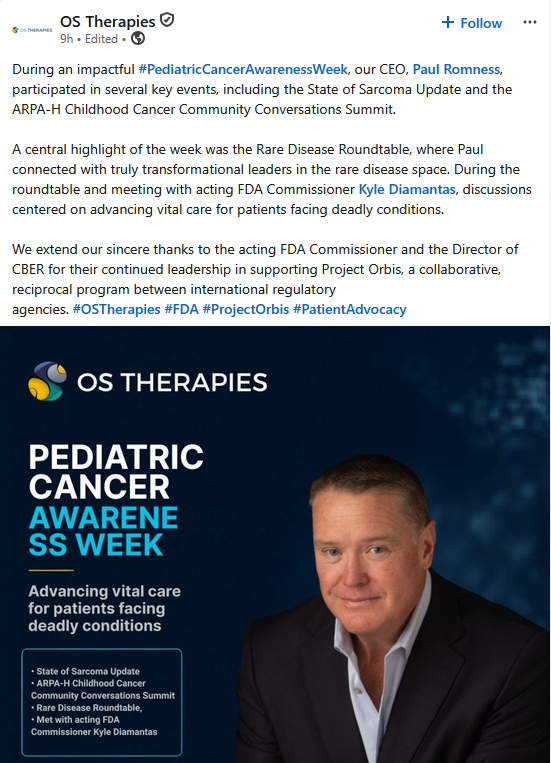
Last week Paul’s lobbying skills were on display as he had a roundtable discussion with FDA Commission Kyle Diamantas. Getting that amount of facetime for a small biotech with the FDA commissioner on the topic of Rare Disease is very rare bordering on unprecedented. The science is solid but having this much political capital really places OS Therapies on the FDA Commissioners hot list when he's looking to hand out a CNPV.
Lobbying can also come in the form of advocacy groups. In that context pediatric-cancer families have mobilized around OST-HER2 because Osteosarcoma is a graphic disease represented by amputations, repeated surgeries, recurrence, and ultimately lung metastasis. Many families all too often experience the loss of a loved one so it's not hard to express the urgency to act as soon as the evidence becomes available. When the time comes these advocacy groups will be petitioning regulators to use every lawful tool available to ensure a meaningful treatment can make it to market as soon as possible.
The political forces behind OST-HER2 approval are no longer just quiet administrative tailwinds, they are converging into a high-stakes test of whether American biotech policy can move as fast as its scientific breakthroughs. By aligning high-level regulatory access at the FDA with the grassroots urgency of grieving pediatric oncology families, OS Therapies has elevated OST-HER2 from a niche Phase 2 asset into a bellwether for U.S. competitive strategy.
If Washington moves decisively through instruments like the Commissioner’s National Priority Voucher, it signals that the American regulatory framework can protect domestic innovation before foreign jurisdictions steal the spotlight. If it stalls, OST-HER2 may become another entry in a long line of American discoveries validated abroad first which proves the point that while U.S. capital and universities build the future, politics continues to play a role of whether America gets to be first.