





AI Is Running Out Of Memory

Customers Are Paying To Get In Line
The AI buildout needs memory and storage as well as processors. Memory makers are struggling to add capacity fast enough to meet demand, and their customers are putting billions of dollars behind requests for future supply.
Micron Technology (MU) has signed 26 multiyear take-or-pay agreements, with customer financial commitments totaling $32 billion, mostly cash deposits. In its latest earnings remarks, management forecast tighter memory and storage supply-demand conditions in calendar 2027 and 2028 than in 2026.
Its September 30 results show what that demand is doing to the business: fiscal fourth-quarter revenue of $54.23 billion, followed by guidance for $61.5 billion at the midpoint in fiscal Q1 2027.
New Fabs Take Years
Micron expects initial wafer output from its first Idaho fab in mid-2027 and initial output from its new Singapore NAND facility in the second half of 2028. It says new fabrication facilities take several more quarters to reach meaningful production. These are management's announced capacity timelines.
That delay is central to the investment case. Committed demand can grow quickly, while the cleanrooms needed to satisfy it arrive years later. We see that gap keeping pricing power with memory and storage suppliers.
The suppliers serve different parts of the system. DRAM holds data in working memory, including the high-bandwidth memory used alongside AI accelerators. NAND flash stores data in solid-state drives. More AI workloads create opportunities across both.
When To Get Back In
Our July article explained how we combine an assessment of the earnings cycle with quantitative entry criteria:
The first question is how much earnings growth remains ahead. Memory shares can peak before earnings do. We monitor pricing, margins, estimate revisions, customer demand and capacity additions to judge whether the cycle is approaching its peak.
Micron's new contracts and supply forecast strengthen the case for continued growth. Falling memory prices, cuts to forward earnings estimates or a sharp reduction in customers' infrastructure spending would push us to reassess it.
Our Quantitative Reentry Screen
We created our AI Profitable Recovery Screen on ChartMill to identify profitable AI-related companies beginning to recover after a correction. Here are the criteria we laid out in July:
| Measure | Requirement |
|---|---|
| Listing and options | U.S.-listed stock with listed options |
| Setup Rating | At least 5 out of 10 |
| Relative Strength (CRS) | At least 50 |
| Moving averages | Price above the 5-day average; rising 200-day average |
| 14-day RSI | Between 30 and 50, and rising |
| Health Rating | At least 5 out of 10 |
| Next fiscal year's revenue estimate | Unchanged or higher over the previous month |
Setup measures consolidation and the quality of an entry point. Relative Strength compares the stock's performance with the broader market. RSI measures recent price momentum. Together, these filters look for stabilization in a company whose revenue outlook remains intact.
A recovery-screen signal puts a stock back on our research list. For a fresh bullish entry, we also require the price to be above its 50-day exponential moving average. Then we review the current fundamentals, our existing exposure and the available options structures before deciding whether to place a trade.
We've Traded This Space Successfully Before
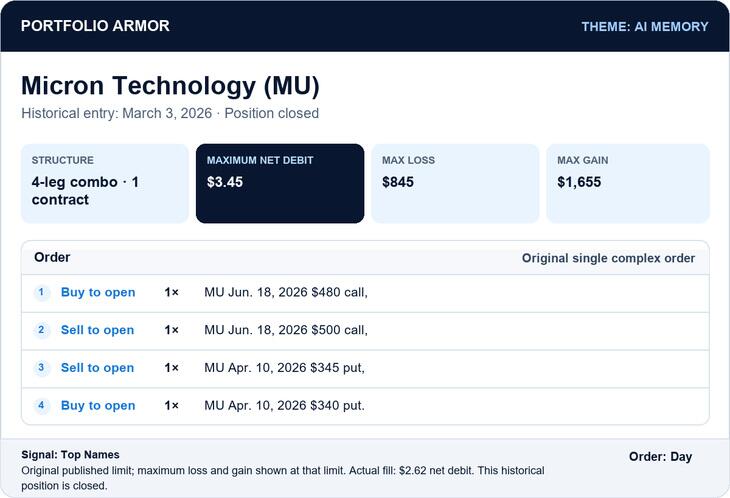
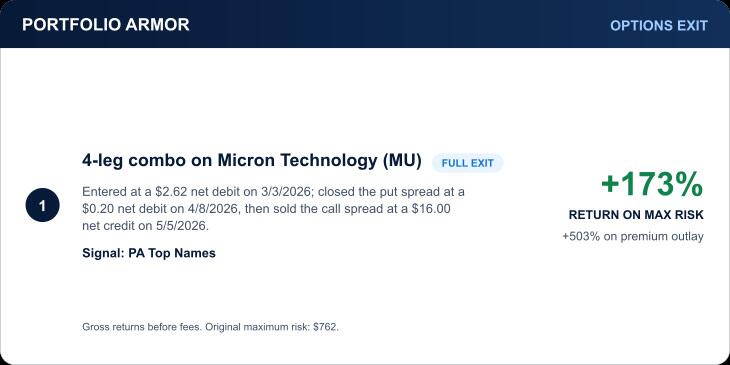
Micron Technology supplies DRAM and NAND for the AI buildout. It appeared in Portfolio Armor's Top Names before our March 3 trade. We entered at a $2.62 net debit, below the $3.45 maximum we'd published.
We closed the put spread in April and sold the call spread in May:
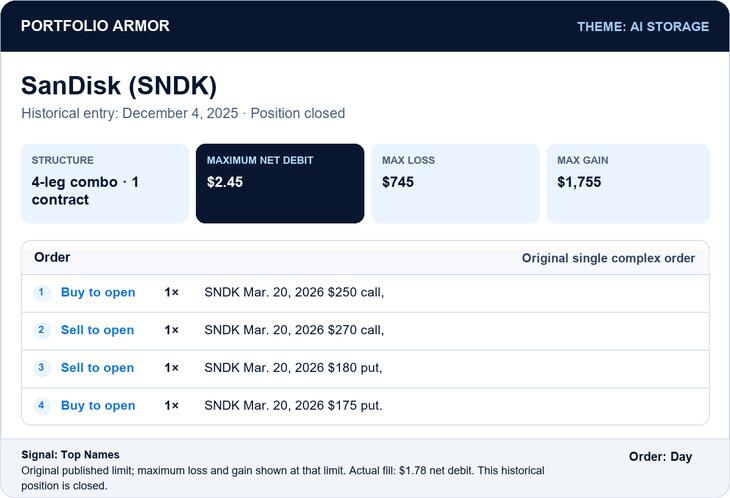
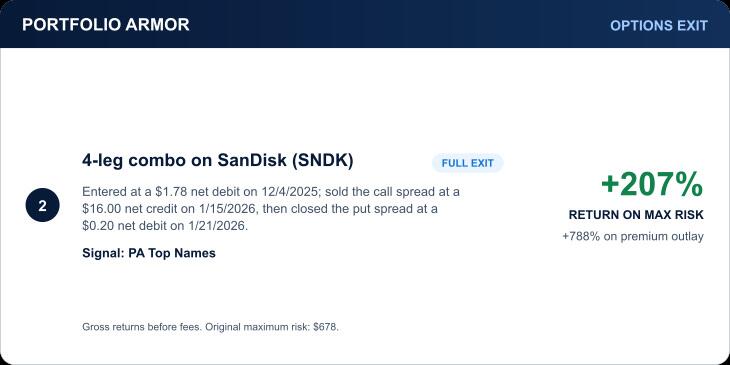
SanDisk (SNDK) makes NAND flash and enterprise solid-state drives for AI and data-center workloads. It was another Portfolio Armor Top Name when we placed our December 4 trade. We entered at a $1.78 net debit, below our published maximum of $2.45.
Both spreads reached their planned exit prices in January. Here's the result:
The Next Memory Trade
The supply squeeze gives us a reason to keep looking at memory stocks. Our reentry process combines that industry outlook with measurable evidence of a recovering share price. When those conditions line up and the options offer an attractive payoff, we can trade the same company again.
If you'd like a heads up when we place our next memory or other AI-related trade, you can become a free subscriber below.
To learn more about our approach and the types of trades we place, start here: