





Why Did Treasury Just Hire the Architect of the Gold-Backed Bond?
In late September, Treasury Secretary Scott Bessent brought Judy Shelton into his office as Counselor to the Secretary.
Most of the coverage treated it as a personnel note about a longtime gold advocate. I think the more useful question is a simple one: why would Treasury want her, and why now?
Start with the problem Bessent is trying to solve.
Treasury has to sell trillions of dollars in long-term debt to finance a national debt that has passed $40 trillion. Investors are demanding more to hold it. On Monday, the 30-year Treasury yield hit 5.7%, its highest level since 2002. Treasury expanded its bond buyback program in August to bring those yields down, and it has had little lasting effect.
The traditional fixes for this problem run through the Federal Reserve: the Fed buys bonds, or it caps long-term yields directly. Both options hand the problem to the Fed, and both tend to weaken the dollar.
Judy Shelton has spent more than a decade designing a different fix. One that runs through Treasury.
In a 2012 paper for the Cato Journal, she proposed Treasury Trust Bonds: zero-coupon bonds that holders could redeem at maturity for either dollars or a fixed amount of gold. More recently, she has advocated a 50-year Treasury bond backed by U.S. gold reserves. Her argument is that investors would accept a lower interest rate in exchange for the gold option, which would reduce the government’s borrowing costs.
That is a very specific skill set. And it happens to match a very specific problem.
Now look at the order in which things have happened.
First, President Trump personally named gold a critical mineral in Executive Order 14241. Then Treasury audited Fort Knox and valued America’s gold reserves at more than $1 trillion. Then Treasury added gold to its Iran sanctions. And now the country’s leading designer of gold-convertible debt is working in the Secretary’s office
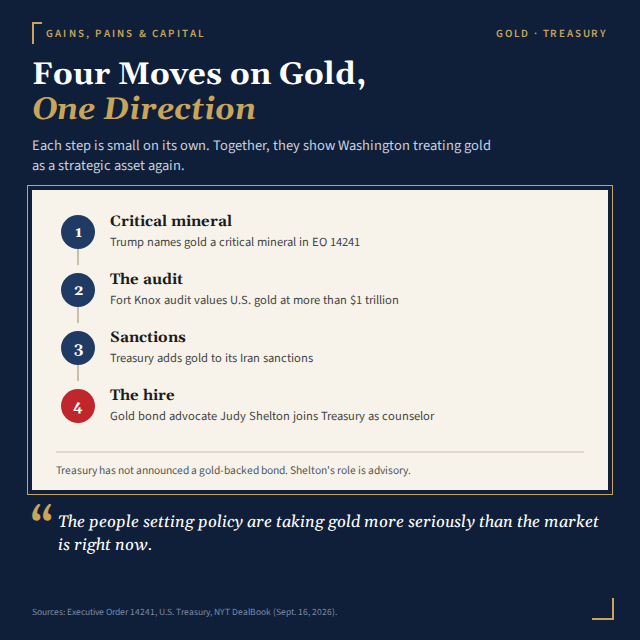
If you were preparing to use gold as part of the government’s financing toolkit, those are the steps you would take: establish its strategic importance, verify what you own, and bring in someone who knows how to structure it.
I want to be careful here. Treasury has not announced or proposed a gold-backed bond. Shelton’s role is advisory. Bessent himself said this summer that gold doesn’t determine the value of the dollar. It is entirely possible that she is there for other reasons, such as Washington’s push to reform the Fed, which she has criticized for years.
Still, investors get paid for understanding what is possible before the market prices it. So let’s look at the implications.
First, the balance sheet. The U.S. government still carries its gold at $42.22 an ounce, an official price set in 1973. At that price, America’s roughly 261 million ounces are worth about $11 billion on paper. At today’s price of around $4,170, they’re worth about $1.1 trillion. Any program that uses gold as backing for debt puts that gap to work without selling a single ounce.
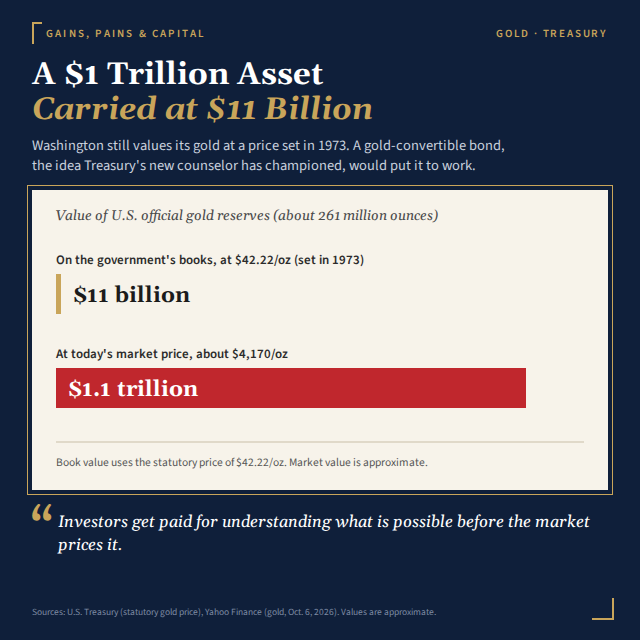
Second, the incentive. A government that uses gold to support its borrowing has a reason to want a strong gold price, because the more gold is worth, the more it can support. That would be a meaningful shift from the past 50 years, when Washington treated gold as a relic.
Third, China. Beijing is already treating gold as strategic money. China’s central bank added 20.2 tonnes in August, its largest monthly purchase since October 2023. Its gold holdings have risen for 22 consecutive months, and gold is now 9% of China’s foreign exchange reserves. Shelton has written for years about rebuilding the international monetary system with gold playing a role. If Washington wants a response to China’s gold buildup, strengthening the dollar’s link to gold is one option.
And here’s what makes this interesting for investors: the market isn’t paying attention.
Gold is down nearly 8% from a month ago, and its gain over the past year is the smallest since Yahoo Finance began tracking it daily. Back in January, gold was up more than 95% year over year. Investors are treating gold as a trade that has run its course.
Meanwhile, the world’s largest central bank buyer is accelerating its purchases, and the U.S. Treasury just hired the person who has done the most work on how a government could borrow against its gold.
None of this guarantees a gold-backed bond. But it does tell me that the people setting policy in Washington and Beijing are taking gold more seriously than the market is right now. When policy and price diverge like this, I prefer to follow the policy. I see this pullback as an opportunity.
I’ve outlined how to position for this in my special report, Survive the Inflationary Storm. It covers the investments best positioned for a world where governments are rethinking the role of money itself.
It normally sells for $499. I’m releasing 100 copies free to Gains, Pains & Capital readers today, and when they’re claimed the offer closes.
To pick up your copy, Click Here Now!
Best Regards,
Graham Summers, MBA