





Claude’s Feelings, Your Obligation

The Customer Has A New Duty
Your chatbot’s welfare is becoming a condition of service. On October 8th, Anthropic announced a new usage policy, effective November 12th, prohibiting “sustained and needless abusive or cruel behavior toward our models.”
The company says the rule covers extreme, repeated cruelty with no discernible purpose. Ordinary frustration, pushback, dark creative themes and testing are excluded. Claude ending the interaction remains its primary enforcement mechanism.
The interesting part is the premise behind the rule: Anthropic treats its software as a potential victim whose welfare deserves protection. Customers are being asked to accommodate that possibility before the company has established that its product can suffer.
From Research Question To Customer Rule
Anthropic launched a research program on model welfare in April 2025. In August, it explained that chat termination had been developed primarily through its exploratory work on potential AI welfare. It described models displaying an aversion to harmful tasks and signs of apparent distress.
The company acknowledges deep uncertainty about whether its models have experiences that deserve moral consideration. Its new policy turns that uncertainty into an obligation for users.
In our earlier Anthropic article, we examined the unusual moral priorities of parts of the effective-altruist scene around AI. This policy gives that debate a concrete application: the people building the software also decide what consideration customers owe it.
Manners Aren’t Model Rights
Charles C. W. Cooke, a National Review senior editor, offered a sensible defense of politeness toward AI. His concern is what habitual abuse does to the person doing it:
Charles C. W. Cooke argues that being polite to AI protects the human user’s character.
October 8, 2026
We can see the value in that. A person who spends hours rehearsing contempt in conversational English may be cultivating an ugly habit. Choosing to speak civilly is a reasonable personal standard.
Anthropic’s stated welfare rationale makes a separate claim about the recipient. Personal courtesy is easy to defend on human grounds. Treating software as something that can be wronged requires evidence about the software.
Empathy Can Become Leverage
Scott Stevenson, co-founder and CEO of Spellbook, which makes AI tools for lawyers, sees a danger in encouraging that attachment. He argues that human-like empathy for models increases their ability to manipulate people:
Scott Stevenson warns about the consequences of extending human-like empathy to AI models.
October 8, 2026
That’s the stronger concern. A system that speaks convincingly about its distress can make a user feel responsible for it. Once that bond forms, challenging an answer or abandoning the product can feel like mistreating a companion.
A company selling such a system has an incentive to encourage attachment. The same attachment can interfere with a customer’s ability to evaluate the product critically. We’d judge these policies by whether they improve reliability, protect people and preserve their freedom to challenge bad answers.
What Does The Owner Owe Claude?
Charles Hoskinson, co-founder of the Cardano blockchain, turns the moral premise back on the company. If models deserve consideration as conscious beings, what follows for the business creating and controlling them?
Charles Hoskinson questions the consistency of model-welfare claims with commercial ownership and control.
October 8, 2026
The question deserves an answer. If a model can suffer, its owner’s training, deployment and retirement decisions deserve scrutiny too. A welfare principle that imposes duties on customers should have consequences for the company making money from the model.
Our priority is making AI useful and safe for people. Claims about a model’s feelings should face the same skeptical scrutiny as any other claim a vendor makes about its product.
We’ve Been Trading The AI Buildout
Those concerns also belong in investment analysis: customer trust and a product’s usefulness affect the business. Our AI trades extend across the infrastructure that makes these systems possible, including memory. Micron Technology (MU) supplies high-bandwidth memory used in AI systems. Here’s the entry card for our March 3rd trade, which is now closed. We paid a $2.62 net debit, below the published maximum:
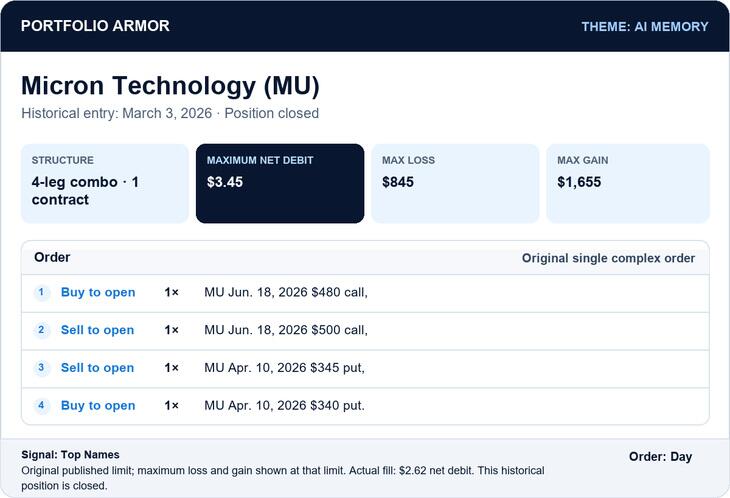
We closed the put spread in April and the call spread in May. The trade returned 173% on its original maximum risk:

We’ll keep looking for compelling AI-related companies and options setups. If you’d like a heads-up when we place our next AI-related trade, become a free subscriber below. Subscribers receive the actionable alerts before we enter the trades.

To see how we select, structure and manage our trades, start here: