





The Everything Bubble Is Already Deflating…
Everyone is watching the wrong asset.
Stocks are at or near record highs. The S&P 500 is trading around 7,800. Every headline this week is about chips, oil, bank earnings, and whether the Fed hikes again. If you went by the financial media alone, you’d think the Everything Bubble was still inflating at full speed.
It isn’t. One of its largest components has already rolled over, and almost nobody is connecting the dots.
I’m talking about housing.
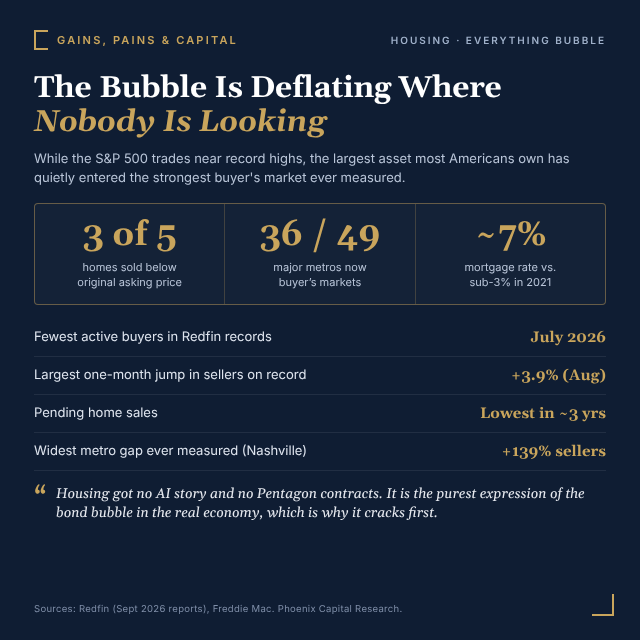
Last month, Redfin reported that home sellers outnumbered buyers by 57.9% in August. That is the widest gap in their records going back to 2013. There were roughly 1.53 million people trying to sell a home and fewer than 975,000 people trying to buy one. The number of sellers jumped 3.9% in a single month, the largest monthly increase Redfin has ever recorded. The number of buyers rose 0.1%. July had the fewest buyers in the history of the data.
Think about what that means. For every three people trying to buy a house in America, there are nearly five trying to sell one. Three out of five homes that sold in August went for less than the original asking price. Total inventory is at its highest level since 2020. Pending sales just hit their lowest level in nearly three years. Redfin has started calling 2026 “The Great Housing Reset.”
This is a buyer’s market in 36 of the 49 major metros Redfin tracks. In Nashville, there are 139% more sellers than buyers, the widest gap ever measured in any U.S. city. Miami is at 138%. Houston, Orlando, Las Vegas, and Dallas all set record gaps in August.

Now here is why this matters for the Everything Bubble thesis.
When I coined the term back in 2014, the core argument was simple. The Fed and other central banks had blown a bubble in the single most important asset class on the planet: sovereign bonds. Because every other asset is priced off of bond yields, the bubble in bonds spread to everything else. Stocks, real estate, private equity, collectibles, crypto, all of it.
Of all those assets, housing was the one most directly tied to the bond bubble. A home is the most leveraged purchase the average American ever makes, and the price they can pay is almost entirely a function of the mortgage rate. When the Fed drove mortgage rates below 3% in 2020 and 2021, it was pouring gasoline on the housing market. Prices went vertical.
Mortgage rates are now near 7%. The same house that was affordable at 3% requires roughly 50% more income to carry at 7%. That is the entire story of the buyer shortage. The demand for homes is still there. What vanished was the bond bubble that made those homes affordable at those prices, and housing is where that deflation shows up first.
Stocks got a lifeline that housing never did. The AI buildout, the wartime economy, trillions in capex, all of it has kept the S&P 500 propped up even as rates rose. Housing has no AI story. It has no Pentagon contracts. It is the purest expression of the bond bubble in the real economy, which is exactly why it is the first thing to crack.
And here is the part that should get your attention. This is happening with the Fed still leaning hawkish. New York Fed President John Williams said this week that he still sees one more rate hike as appropriate this year. Oil is back near $95 with Brent approaching $108. The Fed cannot ride to housing’s rescue the way it did in 2008 or 2020, because cutting rates into an oil shock would light inflation on fire. Housing is going to have to clear on its own.
Historically, when sellers outnumber buyers by this kind of margin, home prices follow within a few quarters. We saw a much milder version of this in late 2018, when sellers briefly outnumbered buyers by less than 10%. Price growth fell to a six-year low within three months. The current gap is six times that size.
To be clear, I don’t expect a repeat of 2008. The banking system is in far better shape, the mortgages written since 2010 are mostly fixed-rate and well underwritten, and there is no subprime time bomb sitting in the system. My point is that the largest asset most Americans own has quietly entered a multi-year repricing, and the market is filing this under real estate news when it is really the first major leg of the Everything Bubble letting air out.
This has real consequences for how you invest.
First, the wealth effect is going to weaken. Housing equity is the primary source of perceived wealth for most households. When that stalls or declines, consumer spending follows with a lag. That is a headwind for the consumer discretionary names and anyone counting on the American shopper to keep carrying the economy.
Second, this is going to feed directly into the inflation debate. Shelter is roughly a third of CPI, and it lags the real housing market by 12 to 18 months. Falling home prices and rising inventory eventually show up as softer shelter inflation, which gives the Fed cover to ease later. But in the meantime, oil and diesel are pushing the other way. The Fed is going to be caught between a weakening housing market and an energy-driven inflation problem, and that tension is going to define 2027.
Third, and most important, the money that isn’t going into housing is going somewhere. Over the past year, gold has run to roughly $4,600 and silver to $75. Hard assets have been absorbing the capital that used to flow into real estate as the default inflation hedge for the middle class. That trend has a long way to go. A house at 7% mortgage rates is a losing inflation hedge. An ounce of gold is not.
So while everyone else is watching the chip stocks and the oil chart, keep an eye on the asset that is actually deflating. It is telling you something about where this cycle is going, and it is telling you well ahead of the stock market.
This is precisely why I put together a special report called Survive the Inflationary Storm. It outlines how inflation is going to play out over the next 12 months, which assets will come out ahead, and specific investments to own as the Everything Bubble continues to shift.
It normally sells for $499. I’m releasing 100 copies free to Gains, Pains & Capital readers today, and when they’re claimed the offer closes.
To pick up your copy, Click Here Now!
Best Regards,
Graham Summers, MBA
Chief Market Strategist
Phoenix Capital Research